

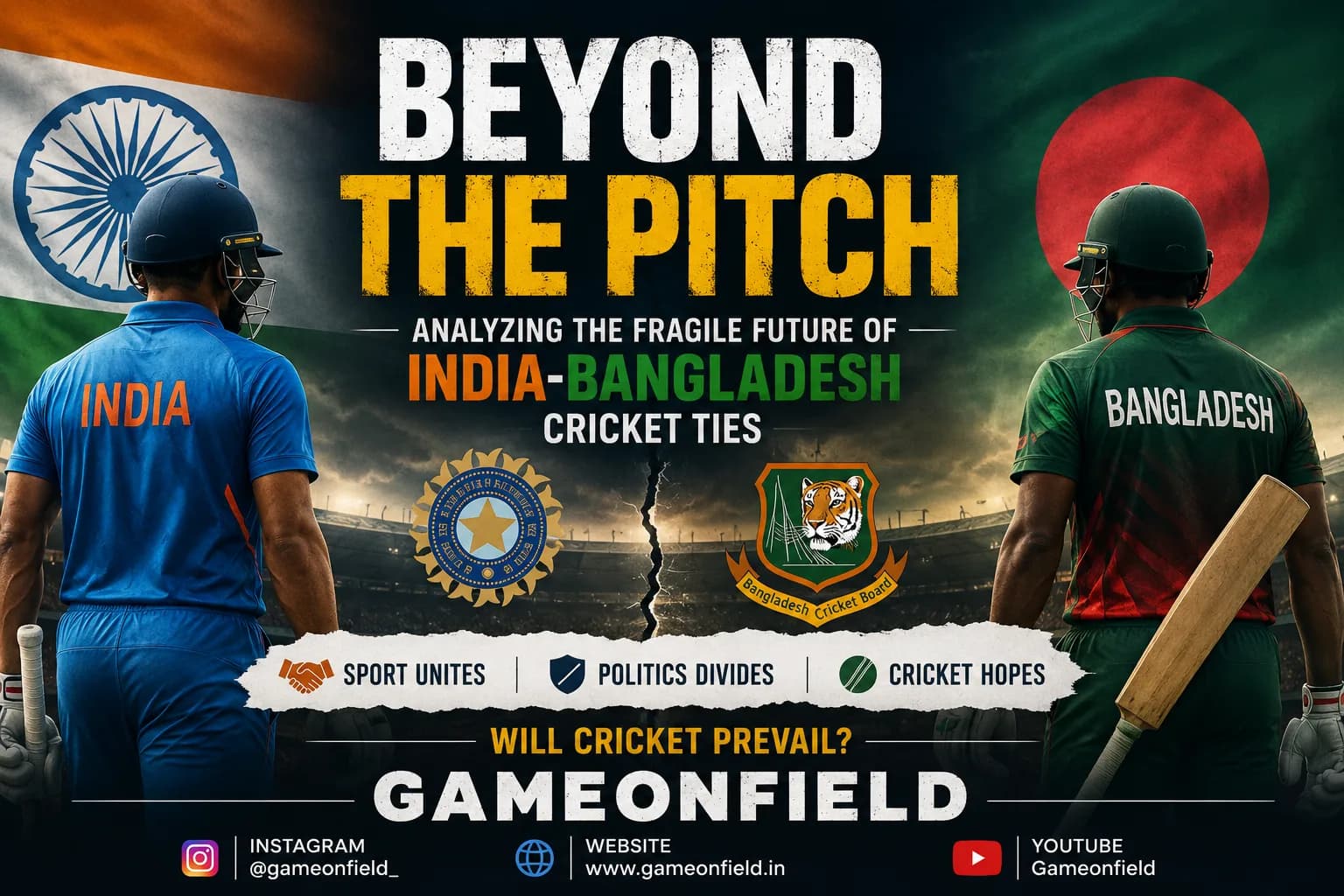
Cricket in South Asia has never existed in isolation from politics. Behind every bilateral series, there are diplomatic relationships, security considerations, commercial interests, and sometimes, difficult decisions that go far beyond what happens on the field.
That reality is once again coming into focus with the uncertainty surrounding the proposed India-Bangladesh white-ball series.
The Bangladesh Cricket Board (BCB) is reportedly hoping for an early resolution to the current deadlock over the series, which includes three ODIs and three T20Is. The tour was originally scheduled for August 2025 before being pushed to late 2026, and its future remains uncertain.
For cricket fans, the obvious question is: Can India-Bangladesh bilateral cricket remain consistent in the current geopolitical environment, or are we entering a prolonged period of uncertainty?
The answer may depend on much more than cricket.
1. When Cricket Meets Geopolitics
India and Bangladesh share a long sporting relationship, but bilateral cricket between the two countries cannot be viewed separately from the wider political environment.
For the BCB, an India series carries enormous importance. Matches involving India attract huge television audiences, strong sponsorship interest, digital engagement, and significant commercial value. An India tour can therefore have a major impact on the financial health and visibility of Bangladesh cricket.
The situation is different for the Board of Control for Cricket in India (BCCI).
When relations between neighboring countries become politically sensitive, cricket boards cannot always operate independently of government and security considerations. Decisions surrounding international tours can involve security assessments, diplomatic circumstances, and official clearances.
That makes the current situation particularly complicated.
The BCB can express its willingness to cooperate, maintain communication, and push for a resolution. But ultimately, the possibility of a bilateral series depends on whether the broader environment is considered suitable.
In other words, the cricket calendar cannot always move independently of the political calendar.
2. Bilateral Cricket Is More Vulnerable Than Multilateral Cricket
One of the clearest patterns in modern South Asian cricket is the difference between bilateral series and multi-nation tournaments.
Bilateral Series: Greater Vulnerability
A bilateral tour requires two boards to agree on dates, venues, security arrangements, logistics, broadcasting, and several other administrative issues.
When diplomatic relations become complicated, bilateral cricket is often among the first areas to feel the impact.
Tours can be postponed, rescheduled, or placed on hold until circumstances improve.
ICC and ACC Tournaments: A Different Equation
Multi-nation tournaments operate under a different structure.
ICC events and Asia Cup tournaments involve multiple boards, broadcasters, sponsors, and international commitments. There are also greater commercial and logistical pressures to ensure that major fixtures take place.
That is why India and other South Asian teams can still face each other in major tournaments even when bilateral cricket between them becomes difficult.
This creates an interesting possibility for the future.
If bilateral uncertainty continues, India-Bangladesh cricket could increasingly depend on ICC and ACC tournaments, with neutral venues becoming more important for major encounters.
That would keep the rivalry alive—but it would not provide the same cricketing relationship as regular home-and-away tours.
3. The Impact Could Extend Beyond International Cricket
The consequences of strained bilateral relations do not necessarily stop with national teams.
Bangladeshi cricketers have historically been part of the wider South Asian cricket ecosystem, while India's franchise cricket industry provides enormous exposure and commercial opportunities for players around the world.
An extended period of uncertainty could create complications around player participation, No Objection Certificates (NOCs), administrative approvals, commercial partnerships, and other forms of cricketing cooperation.
For emerging Bangladeshi players in particular, reduced access to major franchise opportunities could have consequences beyond finances.
It could affect exposure, experience, networking, and their ability to compete alongside some of the world's best players.
At the same time, Indian cricket also benefits from a strong and competitive regional ecosystem. A healthy Bangladesh cricket structure contributes to the overall quality and competitiveness of South Asian cricket.
So the consequences of prolonged isolation could eventually be felt on both sides.
4. The Road Ahead: Pragmatism Over Posturing
The BCB's desire for a quick resolution is understandable. For Bangladesh, an India series represents much more than six cricket matches. It represents commercial value, international visibility, and an important sporting relationship.
But solving the current impasse will require more than public statements or optimism from either cricket board.
There needs to be clarity over security, scheduling, administrative arrangements, and—most importantly—the wider political environment.
Neither Indian nor Bangladeshi cricket benefits from a permanently divided regional ecosystem.
The rivalry is valuable precisely because both teams regularly compete against each other. Fans want to see India travel to Bangladesh. Bangladesh wants opportunities to host India. Players benefit from high-quality competition. Broadcasters and sponsors benefit from the enormous interest surrounding the contest.
But cricket cannot completely escape the realities surrounding it.
For now, India-Bangladesh bilateral cricket appears to be in a delicate position—commercially attractive, competitively meaningful, but vulnerable to circumstances beyond the boundary rope.
The hope will be that pragmatism ultimately wins over uncertainty.
Because South Asian cricket is at its best when rivalries are settled on the pitch—not postponed by events away from it.
5. Gameonfield's Stump Mic: Where Should Cricket Draw the Line?
India-Bangladesh cricket has always been bigger than just runs, wickets, and results. It represents a sporting relationship between two passionate cricketing nations—and that relationship is now facing a test that cannot be decided by a scoreboard.
The real question is not simply whether the six-match series will happen, but what the future of bilateral cricket between the two countries should look like in an increasingly complicated geopolitical environment.
Should cricket continue wherever possible, keeping politics away from the boundary rope? Or is it unrealistic to separate international sport from diplomatic and security realities?
For Bangladesh, regular cricket with India brings enormous sporting and commercial value. For India, decisions around international tours must also consider wider security and diplomatic concerns. Somewhere between these two realities lies the path forward.
So, what do you think?
Should India and Bangladesh make every possible effort to keep bilateral cricket alive—even during difficult political periods? Or should cricket wait until relations between the two countries become more stable?
Tell us your view in the comments.
Because at the end of the day, cricket belongs to the fans—and sometimes, the most important debate happens long after the final ball is bowled.
Gameonfield — The Field of Dreams
Where Strategy meets Action
Key Takeaways
- The cricket calendar cannot always move independently of the political calendar.
- If bilateral uncertainty continues, India-Bangladesh cricket could increasingly depend on ICC and ACC tournaments, with neutral venues becoming more important for major encounters.
- India-Bangladesh bilateral cricket is commercially attractive, competitively meaningful, but vulnerable to circumstances beyond the boundary rope.