

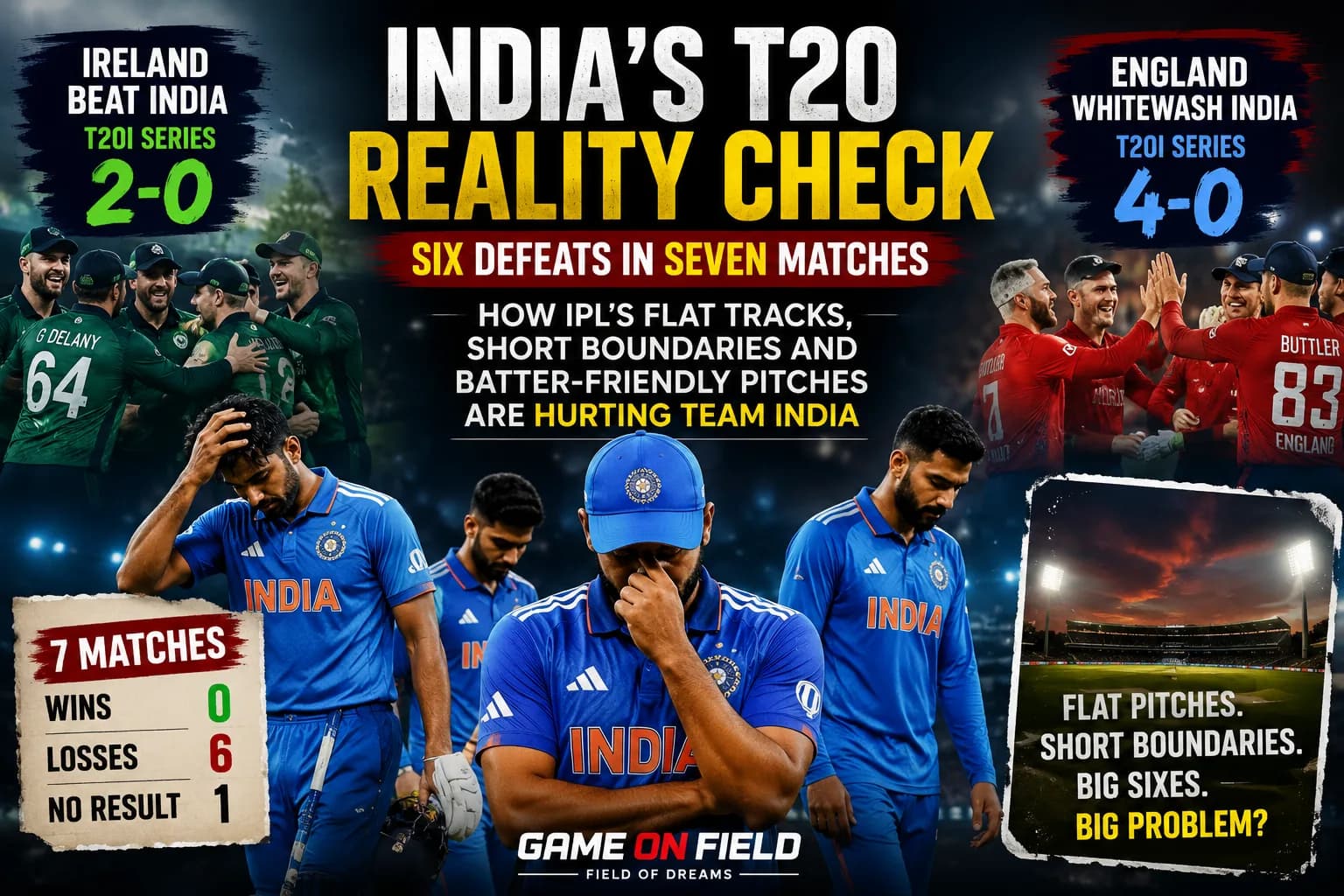
The excitement of a successful IPL season has quickly faded for India's T20 team. A shocking 2-0 series defeat to Ireland followed by a crushing 4-0 loss to England has exposed several weaknesses in the side. The results also marked India's longest winless streak in T20I history.
It is easy to blame poor captaincy, bad shot selection, or individual failures. But the bigger question is whether Indian cricket is preparing its players for international challenges in the right way.
The IPL has transformed cricket. It has produced world-class players, created financial opportunities, and made the game more entertaining than ever before. However, some aspects of the tournament may now be creating habits that do not work in international cricket.
Where Is the Problem?
The issue is not that the IPL is a bad tournament. The concern is that the conditions and rules of the competition are very different from what players face when representing India.
1. Batters Are Getting Used to Flat Pitches
Most IPL matches are played on batting-friendly wickets with short boundaries. The ball comes nicely onto the bat, making stroke play easier, and teams regularly score over 200 runs.
As a result, batters naturally develop an attacking mindset. From the very first ball, they look to score quickly because the conditions allow it.
But things changed completely in England and Ireland.
The pitches offered swing, seam movement, and extra bounce. Instead of adjusting to the conditions, many Indian batters continued playing aggressive shots. The result was predictable—early wickets, middle-order collapses, and constant pressure on the team.
International cricket demands adaptability. Unfortunately, that quality was missing throughout the tour.
2. The Impact Player Rule Has Changed Team Balance
The IPL's Impact Player rule allows teams to bring in an extra specialist during the match.
While this makes the tournament exciting, it also changes how players think.
Top-order batters know there is an extra batter available if things go wrong. That safety net encourages high-risk cricket.
The rule has also reduced the importance of genuine all-rounders because teams no longer depend on players who can contribute in both departments.
International cricket offers no such luxury.
Teams have only 11 players, and every batter carries greater responsibility. During the England and Ireland series, India's batting looked vulnerable once early wickets fell because there was no extra player to rescue the innings.
3. Bowlers Are Learning to Defend Instead of Attack
Modern IPL pitches are often heavily tilted in favour of batters.
For bowlers, the goal is no longer simply taking wickets—it is surviving.
Instead of attacking with the new ball or building pressure through consistent spells, bowlers often rely on slower deliveries, wide yorkers, and defensive plans just to limit the damage.
Those tactics can work on flat IPL pitches, but international cricket demands much more.
In England, bowlers needed to exploit swing, maintain disciplined lines, and attack with confidence. Too often, India looked reactive instead of proactive.
The Numbers Tell the Story
India's struggles throughout the England series clearly reflected these problems.
The third T20I at Trent Bridge summed up India's struggles. They were bowled out for just 76, their lowest point of the tour and their biggest defeat by runs in T20I cricket.
These were not isolated bad days. They reflected a team that struggled to adapt once conditions moved away from what players experience during the IPL.
What Can the BCCI Do?
The IPL should not be blamed for everything. England played outstanding cricket throughout the series, while Ireland fully deserved their historic success.
However, India's domestic structure should prepare players for international cricket, not just franchise success.
Here are a few changes that could help.
Prepare More Balanced Pitches
Not every IPL match needs to produce 220-plus scores.
A mix of batting-friendly, seaming, and spin-friendly wickets would force players to develop different skills and adapt to changing conditions.
Increase Boundary Sizes
Many IPL venues use relatively short boundaries.
Larger boundaries would reward proper timing, placement, and fitness between the wickets instead of encouraging every mishit to become a six.
Review the Impact Player Rule
The rule has added excitement, but it has also reduced accountability.
Removing or modifying it would bring greater value back to all-rounders and encourage batters to build innings with greater responsibility.
Use Different Types of Venues
Scheduling matches on a variety of surfaces—green tops, turning tracks, and balanced wickets—would expose players to conditions closer to those they face overseas.
That experience could prove invaluable when representing India.
The IPL remains one of the greatest cricket tournaments in the world. It has transformed the sport and continues to produce exceptional talent.
But international cricket asks different questions.
Modern T20 cricket demands more than raw power. It demands adaptability, tactical awareness, resilience under pressure, and the ability to perform in varied conditions. Those qualities are built over time, not just in international camps but in domestic competitions that challenge players in different ways.
India's disappointing tour of England and Ireland should not be seen simply as a failed series. It should be viewed as an opportunity to reassess how domestic cricket prepares players for the international stage.
Winning the IPL is a remarkable achievement, but building a team capable of winning consistently across different countries and conditions is what truly defines a great cricketing nation.
Winning the IPL is celebrated for two months. Winning World Cups defines generations.
Bottom Line
- India suffered their longest winless T20I streak in history, losing 2-0 to Ireland and 4-0 to England
- Flat IPL pitches and short boundaries encourage attacking batting habits that struggle on seaming, swinging overseas pitches
- The Impact Player rule reduces batting accountability and undervalues genuine all-rounders compared to international cricket
- IPL bowlers often play defensively on batting-friendly pitches, a habit that doesn't translate to attacking international cricket
- Suggested fixes include more balanced pitches, larger boundaries, reviewing the Impact Player rule, and varied venue types
What do you think? Is the IPL's current structure affecting India's performances in international cricket, or are there bigger issues at play? Share your thoughts in the comments—we'd love to hear your perspective.