

India vs Sri Lanka 2nd Test Day 4: What looked like a straightforward march towards an innings victory for India has suddenly turned into a fascinating final-day contest in Colombo. After being bowled out for 290 in their first innings, Sri Lanka were asked to follow on with a massive 213-run deficit. Yet, instead of collapsing, the hosts produced their best batting effort of the match.
At stumps on Day 4, Sri Lanka were 229/6 in their second innings, holding a slender 16-run lead over India's first-innings total.
And once again, Pasindu Sooriyabandara was at the heart of Sri Lanka's resistance.
The Sri Lankan debutant fell agonisingly short of another Test century, scoring 92, after previously making 80 in the first innings. Two scores in the 80s and 90s in the same Test tell only part of the story. His batting has been one of the biggest positives for Sri Lanka in a match that has otherwise been dominated by India.
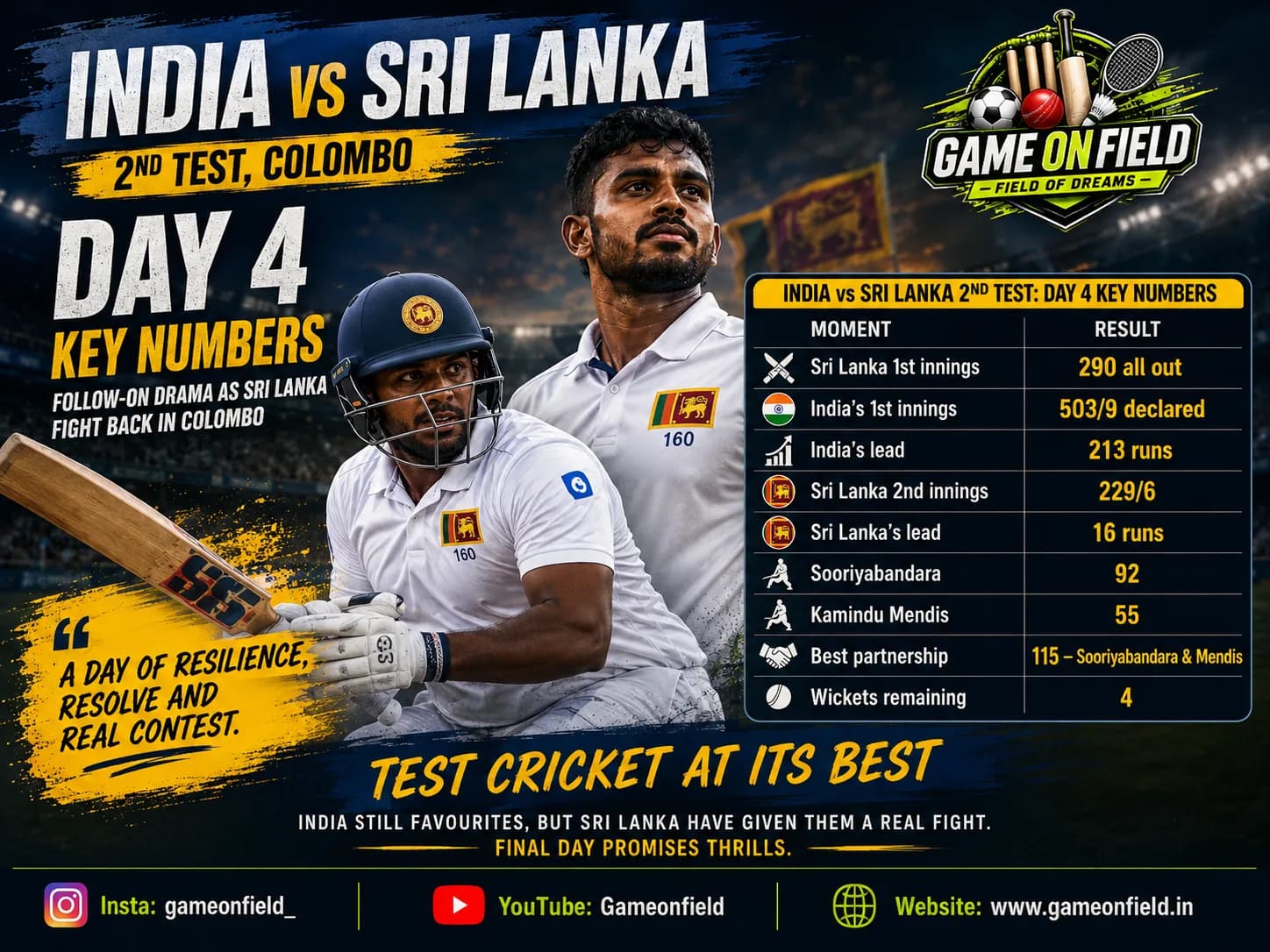
India vs Sri Lanka 2nd Test: Day 4 Key Numbers
| Moment | Result |
|---|---|
| Sri Lanka 1st innings | 290 all out |
| India's 1st innings | 503/9 declared |
| India's lead | 213 runs |
| Sri Lanka 2nd innings | 229/6 |
| Sri Lanka's lead | 16 runs |
| Sooriyabandara | 92 |
| Kamindu Mendis | 55 |
| Best partnership | 115 – Sooriyabandara & Mendis |
| Wickets remaining | 4 |
Sri Lanka Bowled Out for 290, India Enforce the Follow-On
The morning session began with India needing just two wickets to wrap up Sri Lanka's first innings.
Resuming at 265/8, Sri Lanka added only 25 more runs before being dismissed for 290.
That gave India a commanding 213-run first-innings lead, and captain Shubman Gill immediately decided to enforce the follow-on.
On paper, it was difficult to argue against the decision.
India had already produced a huge first innings, Sri Lanka had struggled badly with the bat earlier in the match, and forcing the hosts back into the middle offered India a chance to finish the Test inside four days.
But Test cricket has a habit of making seemingly simple decisions complicated.
Follow-On Turns Into Sri Lanka's Biggest Fightback
India would have expected early wickets.
Instead, Sri Lanka fought.
An early dismissal did little to change the mood as Kamil Mishara joined Sooriyabandara and helped build a valuable 58-run partnership for the second wicket.
Ravindra Jadeja eventually removed Mishara, but the wicket did not open the door to another collapse.
It brought Kamindu Mendis to the crease.
And from there, Sri Lanka began to change the complexion of the match.
Sooriyabandara and Kamindu Mendis Change the Game
The partnership between Sooriyabandara and Mendis became the defining passage of Day 4.
The pair took Sri Lanka to 83/2 at lunch, and more importantly, they had taken away the feeling that India were simply waiting to finish the match.
After lunch, they continued with remarkable discipline.
Their 115-run partnership became Sri Lanka's most productive batting stand of the match.
India's bowlers, who had looked so threatening earlier in the Test, suddenly found themselves dealing with two set batters on a tiring pitch.
Kamindu Mendis eventually departed for an excellent 55 off 92 balls, but the damage had already been done.
Sri Lanka had almost erased India's huge first-innings advantage.
Pasindu Sooriyabandara's Second Heartbreak
If there was one story that summed up Sri Lanka's Day 4, it was Sooriyabandara.
The youngster had already made 80 in the first innings, falling just 20 runs short of a maiden Test century.
On Day 4, he came even closer.
But once again, the century remained out of reach.
Sooriyabandara was dismissed for 92.
It was the kind of dismissal that leaves a batter wondering what might have been.
Two innings.
Two excellent contributions.
Two near-centuries.
And yet, no hundred.
Still, statistics cannot fully capture the impact of his batting. Coming into the series as a relative unknown, Sooriyabandara has emerged as one of Sri Lanka's most encouraging discoveries.
His ability to absorb pressure, rotate the strike and bat for long periods against India's attack has been particularly impressive.
80 and 92 in the same Test is not luck. It is a statement.
India Suddenly Have a Job to Finish
India remain firmly in control of the bigger picture, but Day 4 certainly made their task more complicated.
The visitors began the day with a 213-run lead.
By the end of it, that advantage had disappeared.
Sri Lanka were 229/6 and had moved 16 runs ahead.
India still have four wickets to take, but every additional run from Sri Lanka will increase the pressure on the eventual chase.
The difference between a 50-run target and a 150-run target could become enormous on a pitch that has continued to deteriorate.
Manav Suthar Leads India's Fightback
India's bowlers did eventually regain some control during the final session.
Manav Suthar was India's most successful bowler in the second innings, picking up two wickets, while Mohammed Siraj and Ravindra Jadeja also contributed.
But the bigger question will be why India struggled to break through during the middle part of the innings.
The absence of the second new ball reduced some of India's attacking options, while the tiring surface allowed Sri Lanka's experienced and increasingly confident batters to settle in.
The final four wickets could therefore prove extremely important.
Was Enforcing the Follow-On the Right Decision?
This is likely to become one of the biggest talking points after the match.
When India enforced the follow-on, the decision looked almost inevitable.
India had a 213-run lead, Sri Lanka had been bowled out for 290, and Gill had the opportunity to keep the pressure firmly on the hosts.
The risk was always that Sri Lanka would produce one big partnership.
And that is precisely what happened.
However, it would be too simplistic to call the follow-on a mistake.
India still have a huge advantage in terms of the match situation. Sri Lanka are only six wickets down, but they still need to protect their lead before India can begin their chase.
The follow-on has made the match more interesting.
It has not necessarily turned the advantage completely in Sri Lanka's favour.
What Sri Lanka Need on Day 5
Sri Lanka's objective is now crystal clear:
Bat as long as possible.
The hosts need their remaining batters to squeeze every possible run out of the morning session.
A lead of 50 would give India little to worry about.
A lead of 100 would create some uncertainty.
But if Sri Lanka can push the target towards 150 or beyond, suddenly the final innings could become very interesting on a deteriorating surface.
Sri Lanka's lower order, including Sonal Dinusha, will therefore have a crucial role to play.
Once they are dismissed, Sri Lanka's spinners will become their biggest weapon.
Can Sri Lanka's Spinners Create a Final-Day Shock?
This is where the match becomes particularly intriguing.
The surface has already started offering more assistance to spin, and conditions should become even more demanding on Day 5.
Prabath Jayasuriya and Sri Lanka's other spinners will know that they do not necessarily need a huge target.
If Sri Lanka can set India 100-150 runs and pick up two early wickets, pressure can build quickly.
Small fourth-innings targets have a habit of looking much larger once wickets start falling.
India, however, have already demonstrated their batting strength in this Test.
They will be favourites, but they cannot afford to treat the chase as a formality.
What India Need to Do on Day 5
For India, the first objective is simple:
Take the remaining four wickets quickly.
Every extra Sri Lankan run matters.
If India can dismiss Sri Lanka inside the first hour, the target could remain manageable.
Their bowling attack should have enough resources to exploit the deteriorating pitch, with Jadeja and Suthar expected to play a particularly important role.
Siraj and Prasidh Krishna could also become dangerous if reverse swing enters the equation.
Once the chase begins, India's biggest challenge will be patience.
There will be no need for unnecessary aggression.
The safest route will be to eliminate risk, play the conditions rather than the scoreboard and avoid giving Sri Lanka's spinners an opening.
The Bigger Picture: India Still Favourites, But Sri Lanka Have Hope
After four days, India remain the clear favourites.
They scored 503/9 declared, took a first-innings lead of 213 and forced Sri Lanka to bat again immediately.
But Sri Lanka deserve enormous credit for the way they responded.
Instead of allowing the follow-on to become a route to an innings defeat, they have turned it into an opportunity to fight.
Sooriyabandara's 92, Mendis's 55 and the team's overall resistance have ensured that Day 5 will matter.
That alone is a significant achievement.
Gameonfield's Stump Mic
What looked like an innings victory waiting to happen has suddenly become a genuine Test-match puzzle.
India's decision to enforce the follow-on was logical. Sri Lanka's response was exceptional.
The biggest story, though, may be Pasindu Sooriyabandara.
Two innings.
80 and 92.
Two heartbreaking near-centuries.
Yet perhaps the numbers that matter most are not the hundreds he didn't score, but the pressure he absorbed and the belief he has given Sri Lanka.
India still hold the advantage.
But after Day 4, they can no longer assume the finish line is just a few overs away.
Four wickets. One deteriorating pitch. A potentially tricky chase.
Day 5 has all the ingredients of a fascinating Test match finish.
Gameonfield — The Field of Dreams
Key Takeaways
- Sri Lanka were bowled out for 290 and made to follow on, 213 runs behind
- Pasindu Sooriyabandara fell for 92, following his first-innings 80 — two near-centuries in the same Test
- Sooriyabandara and Kamindu Mendis put on a match-best 115-run partnership
- Sri Lanka reached 229/6 at stumps, taking a slender 16-run lead
- India need four more wickets on Day 5 before beginning what could be a tricky chase