

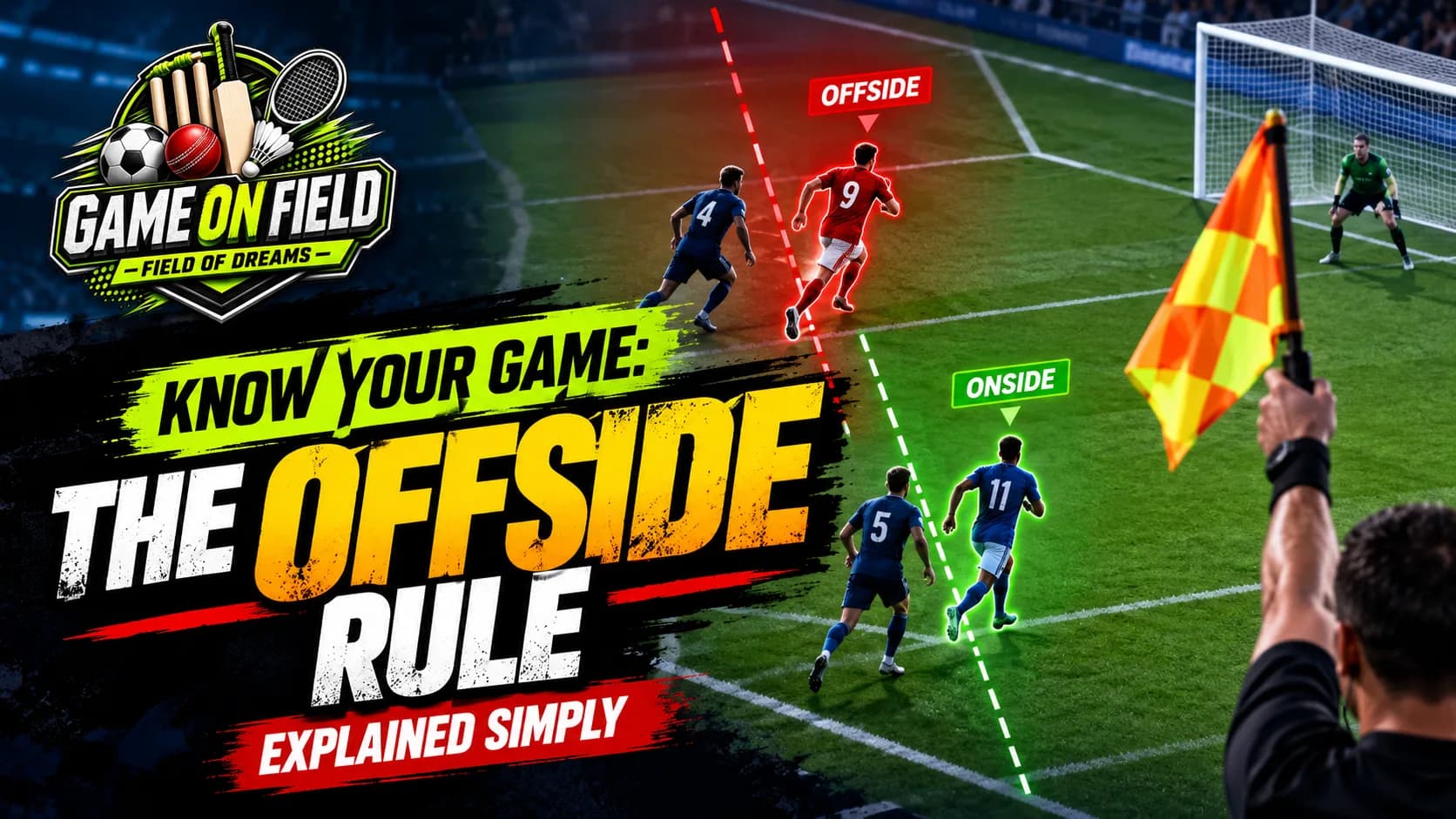
Few rules in football create as much confusion, debate and frustration as offside.
A striker scores. The celebration begins. Then comes the flag. Suddenly, the goal disappears from the scoreboard and the debate starts.
Was he offside? Was the defender playing him on? Did the pass come at the right moment? Was it the shoulder, the knee or the foot?
For new football fans, offside can feel unnecessarily complicated.
But once you understand three things — position, timing and involvement — the rule becomes much easier to follow.
Welcome to another edition of Gameonfield's "Know Your Game", where we break down one of football's most misunderstood rules.
Why Does the Offside Rule Exist?
Imagine a striker simply standing next to the opposition goalkeeper for the entire match.
A teammate could then launch a long ball toward them whenever possible.
That would make attacking football far too easy and would reduce the importance of midfield play, defensive organisation and movement.
The offside rule prevents exactly that.
Its basic purpose is to stop attackers from gaining an unfair advantage by positioning themselves too close to the opponent's goal before the ball is played.
In simple terms:
You can't just wait behind the defence for a pass.
You have to time your movement.
And that's where the real skill of offside comes in.
The Basic Idea
An attacker is in an offside position if, at the moment a teammate plays the ball, they are:
- In the opponent's half, and
- Closer to the opponent's goal line than both the ball and the second-last opponent.
The second-last opponent is important.
People often describe this as "the last defender", because the goalkeeper is usually the last opponent behind the defence.
But technically, the rule refers to the second-last opponent, not specifically the last defender.
Think of that player's position as an invisible line.
If the attacker is beyond that line when their teammate plays the ball, they may be in an offside position.
But there's an important catch.
Being in an offside position is not, by itself, an offence.
Position Alone Doesn't Mean Offside
This is probably the biggest misconception about the rule. A player can be standing in an offside position and still not be penalised. They become liable to punishment only when they become involved in active play—for example, by:
- Touching or playing the ball
- Interfering with an opponent
- Gaining an advantage from their position
So imagine a striker is standing behind the defensive line but isn't involved in the play.
The ball goes somewhere else. The striker doesn't interfere with a defender or play the ball.
No offside offence has occurred simply because they were standing there.
This distinction is fundamental:
Offside position ≠ offside offence.
The Most Important Moment: When the Pass Is Played
This is where many first-time viewers get confused. Offside is judged at the moment the teammate plays or touches the ball, not when the attacker eventually receives it.
Imagine this:
A striker starts behind the defender. The midfielder plays a through ball. At the exact moment the midfielder releases the ball, the striker is onside. The striker then accelerates beyond the defender and collects the pass.
That's perfectly legal.
The defender can't make the striker offside simply because the striker runs beyond them after the pass has already been played.
So remember:
The position is checked when the ball is played.
- Not when the ball arrives.
- Not when the striker shoots.
- Not when the striker scores.
At the moment of the teammate's touch.
Level Means Onside
Another common misconception:
"Any part of the attacker being level with the defender is offside."
No.
If the attacker is exactly level with the second-last opponent, they are onside.
The attacker must be closer to the goal line than the relevant opponents to be in an offside position.
And sometimes that difference can be incredibly small.
A player's shoulder, knee or toe may be a fraction ahead of the defensive line.
That's where modern technology enters the conversation.
Which Parts of the Body Count?
This is where things get particularly interesting.
For offside purposes, the parts of the body that can legally score a goal are considered.
That means:
- Head
- Body/torso
- Feet
Hands and arms are not considered.
So if an attacker's hand is beyond the defender but their legally playable body parts remain level, the player isn't offside because of that hand.
This is one reason some VAR decisions can look strange when viewed from the television angle.
The important question isn't:
"Is any part of the player ahead?"
It's:
"Is a part of the player that can legally score ahead?"
What About the Goalkeeper?
Here's another common misunderstanding.
The offside rule isn't simply:
"You must have two defenders between you and the goal."
The rule uses the second-last opponent.
The goalkeeper is usually one of those two opponents, but not necessarily.
For example, if the goalkeeper has moved far away from the goal and only one defender remains behind the attacker, that defender may effectively become the second-last opponent.
So when judging offside, don't automatically think:
"Where is the last defender?"
Think:
"Where is the second-last opponent?"
When Does Offside Not Apply?
There are some important situations where a player cannot be penalised for being offside when receiving the ball directly.
These are:
There is another important rule:
You Cannot Be Offside in Your Own Half
A player must be in the opponents' half to be in an offside position.
If the attacker is still in their own half when the teammate plays the ball, the offside rule doesn't apply to their position.
What Happens When Offside Is Given?
When an offside offence occurs, the defending team receives an:
Indirect free kick.
The free kick is taken from the location where the offside offence occurred, subject to the Laws of the Game and the specific circumstances of the offence.
And this is another reason why the assistant referee's flag doesn't necessarily mean the match stops immediately in every situation.
When there is a promising attacking situation, officials may sometimes delay the signal so that the play can develop before the decision is confirmed.
This is especially relevant when VAR is available.
VAR and the Offside Debate
Offside has entered a completely new era because of technology. In major competitions, VAR can review offside situations as part of its role in checking goals and other relevant incidents. Many competitions also use semi-automated offside technology, which can help officials identify the relevant moment of the pass and the players' positions.
The result?
Decisions can sometimes come down to extremely small margins.
- A toe.
- A knee.
- A shoulder.
- A fraction of a boot.
This precision has improved the ability of officials to identify marginal positions, but it has also created a new debate:
Should football really decide a goal based on a few centimetres?
That's a question about how the rules and technology should be applied, rather than about what the offside law itself says.
For fans, however, the practical lesson is simple:
Don't judge an offside call from a single replay angle.
The technology is looking at the exact frame in which the ball is played and the relevant parts of the players' bodies.
The Three-Question Offside Test
The next time you see the assistant referee's flag go up, don't panic.
Ask yourself three questions.
1. Where was the attacker?
Were they in the opponent's half and closer to the goal line than both the ball and the second-last opponent?
2. When was the ball played?
Look at the exact moment the teammate played or touched the ball.
Not when the attacker received it.
3. Did the attacker become involved?
Did they:
- Play or touch the ball?
- Interfere with an opponent?
- Gain an advantage from their position?
If the player was in an offside position and became involved in a way covered by the law, an offside offence may have occurred.
A Simple Example
Let's make it really easy.
Imagine the defensive line is here:
DEFENDER ─────────────
And the attacker is here:
ATTACKER ─────────────
If the attacker is closer to the opponent's goal than the second-last opponent when the teammate plays the ball, the attacker may be in an offside position.
But if the attacker starts behind the defender:
DEFENDER ───────── ATTACKER
The midfielder plays the pass.
The attacker then runs beyond the defender:
DEFENDER ───────→ ATTACKER
That's legal.
The attacker was onside at the crucial moment.
Remember: Where you are when the pass is played matters more than where you end up receiving it.
The Cricket Comparison
For Indian sports fans, here's a simple way to think about it.
Offside has a little bit of the same "crucial moment" logic that cricket fans are familiar with.
In cricket, a batter's position and the moment of delivery matter when judging certain dismissals or no-balls.
In football, the key moment is:
When the teammate plays the ball.
But unlike a cricket no-ball, football offside isn't simply about crossing a fixed line.
It depends on:
Position + Timing + Involvement.
That's why the rule can appear complicated at first.
Gameonfield's Stump Mic
Offside isn't designed to punish attackers for being aggressive.
It's designed to maintain a balance between attacking movement and defensive positioning.
And once you stop thinking of it as simply "the striker was ahead of the defender", everything becomes clearer.
The real questions are:
Where was the attacker? Where was the second-last opponent? Where was the ball? And what happened at the exact moment the ball was played?
Master those four questions and you will understand most offside decisions you see during a match.
Because football isn't just about where the ball goes.
Sometimes, where a player stands before the ball gets there is just as important.
Gameonfield — Field of Dreams.
Key Takeaways
- An attacker is offside only if, in the opponent's half, they're closer to the goal line than the ball and the second-last opponent when a teammate plays it
- Being in an offside position is not itself an offence — the player must also become involved in active play
- Position is judged at the exact moment the ball is played, not when the attacker receives it, shoots, or scores
- Only the head, body and feet count for offside — hands and arms don't, even if they're ahead of the defensive line
- There's no offside offence from a goal kick, throw-in or corner kick, or if the attacker is in their own half