

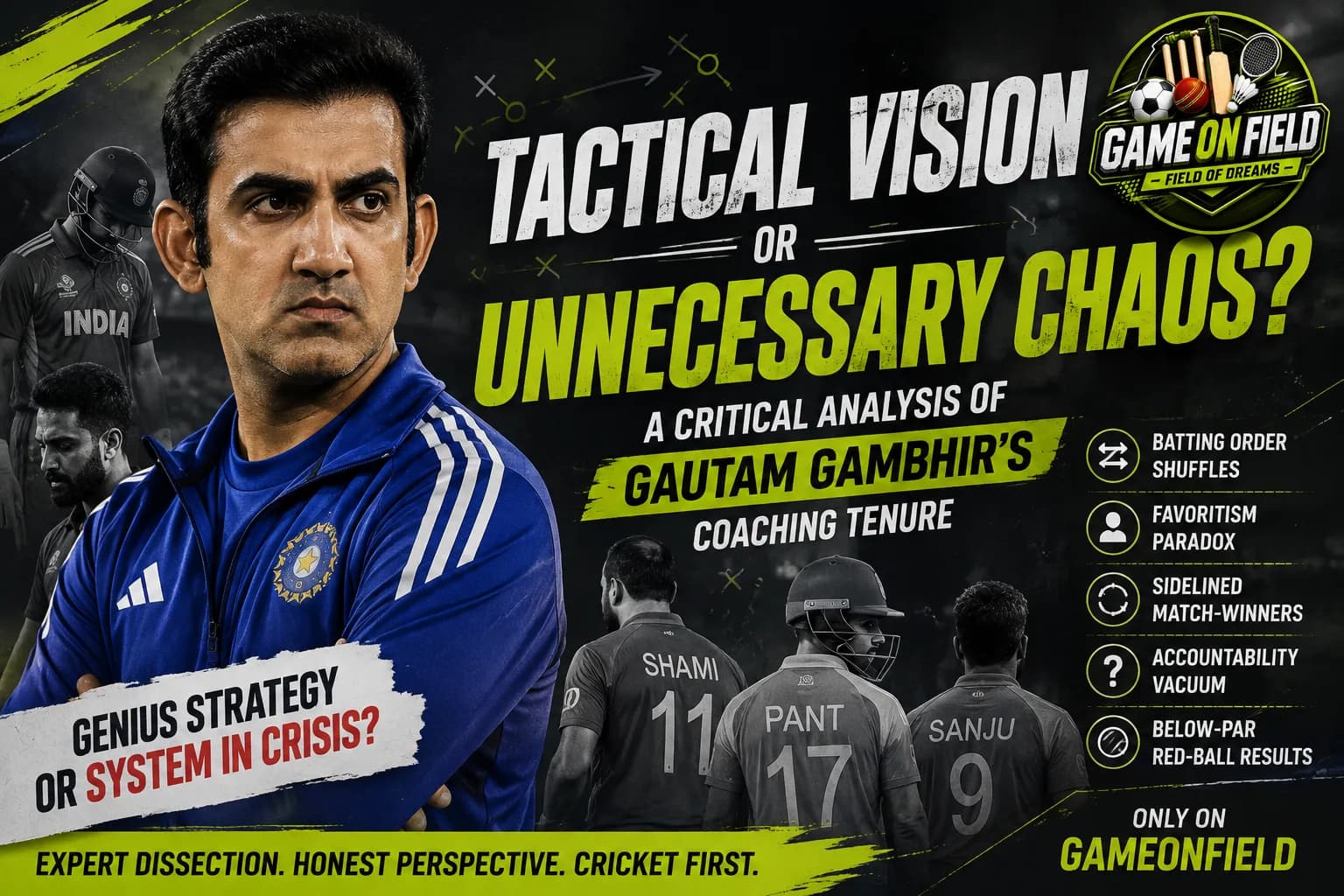
When Gautam Gambhir was appointed head coach of the Indian cricket team, the expectations were enormous.
Here was a former World Cup winner known for his intensity, tactical awareness, uncompromising approach, and an obsession with winning. His success as a mentor in franchise cricket had further strengthened the belief that Gambhir could bring a new tactical identity to Indian cricket.
The expectation was simple: India would become more fearless, flexible, and ruthless.
But as Gambhir's tenure has progressed, "uncertainty" has become the only certainty in Team India.
Experimentation is an essential part of modern cricket. Players need to adapt to different conditions, opposition, formats, and match situations. But experimentation becomes problematic when it begins to affect role clarity, player confidence, and accountability.
The central question, therefore, is not whether Gambhir should experiment.
It is whether the experimentation has a clear tactical purpose—or whether India is over-engineering its cricket.
1. The Asymmetric Risk of Batting Order Shuffles
One of the cornerstones of Gambhir's strategy has been "absolute fluidity" in the batting order. While adaptability is crucial in modern white-ball cricket, decisions often appear so spontaneous that they backfire, creating a unfair system of accountability for specialist batters.
On paper, there is nothing wrong with moving players around. Modern white-ball cricket demands adaptability, and using a player differently depending on match conditions can occasionally produce decisive results.
The concern arises when flexibility becomes the norm rather than the exception.
The Double Standard for Specialists vs. All-Rounders
There have been situations where players such as Washington Sundar and Axar Patel have been promoted ahead of established middle-order specialists. Such moves can work brilliantly when the promoted player delivers. But they also raise an important question about accountability.
If an all-rounder is promoted and scores quickly, the move is viewed as tactical brilliance. If he fails, the failure is often easier to dismiss because batting higher wasn't his primary responsibility. The situation is different for a specialist batter.
The Career Risk for Established Batters
Conversely, when specialist batters like KL Rahul are demoted or held back, they are forced to bat out of position under extreme pressure. If they fail in those unnatural entry points, their place in the team is immediately put at risk. This creates a deeply skewed environment where specialists bear all the risk with none of the tactical protection.
Individual Stability Drives Team Success
While the ultimate objective is always to win for India, cricket is a unique team sport. Unlike individual sports like singles badminton or golf, a cricket team functions only when individual roles are clearly defined and protected. Aggregating individual excellence requires individual stability—you cannot expect collective harmony when players are constantly walking on eggshells.
2. The Backing of Players and the Perception of Favouritism
Every coach has preferred player profiles. Some coaches value aggression. Others prioritise experience, versatility, athleticism, or specific bowling characteristics. That is normal. The problem begins when selection patterns create a perception that certain players are given significantly more patience than others.
The Fast-Tracking of Harshit Rana
Harshit Rana's emergence has generated considerable interest. He has pace, aggression, and the potential to develop into an important international bowler. Fast-tracking a talented young player is not inherently wrong. In fact, Indian cricket needs to identify and develop its next generation of fast bowlers. But selection becomes difficult to understand when young players appear to receive opportunities ahead of performers with stronger domestic or international bodies of work.
The larger issue is not necessarily Rana himself. It is the selection philosophy surrounding him. If the team management believes a particular player has exceptional potential, it should clearly communicate that vision and provide a structured development pathway. Otherwise, other domestic performers can reasonably wonder what standards they are expected to meet.
The Treatment of Sanju Samson & Specialists
Samson possesses the ability to change a game in a matter of overs. His range against pace, ability to clear the boundary, and experience make him an obvious match-winning option when used correctly. Yet his international career has frequently been marked by interruptions, inconsistent opportunities, and uncertainty surrounding his position.
For a player whose primary strength is confidence and freedom of stroke, constantly wondering whether he will play the next match or whether his position is secure can be damaging.
A match-winner does not necessarily need unlimited backing. But he does need a fair opportunity to establish rhythm.
The mishandling of Sanju Samson's position in the lineup exemplifies this chaotic approach. Instead of giving dedicated match-winners a guaranteed, extended run in their primary slots, players are shuffled endlessly, eroding their confidence and rhythm.
3. Sidelining Proven Match-Winners: The Curious Cases of Shami and Pant
While certain players enjoy an extended leash, key match-winners appear to be struggling for consistent backing or clear communication.
4. The Shami Enigma & The Selection Blame Game
The treatment of Mohammed Shami, in particular, exposes a deeply flawed long-term strategy. Even if playing Jasprit Bumrah and Shami in the exact same XI isn't always feasible due to tactical balance or workload management, omitting Shami as a primary option when Bumrah is injured or rested defies basic logic.
- The Youth-Transition Delusion: The team management seems intent on grooming young fast bowlers alongside a few senior figures. But transition shouldn't mean premature exile. Shami easily has at least 3 years of top-flight international cricket left in him and continues to deliver high-caliber domestic performances.
- An Accountability Vacuum: Who is actually making these decisions? We frequently hear indirect comments or subtle shifts in narrative between the coaching staff and the selection committee. Is the coach deflecting onto the selectors, or are the selectors shielding the coach's tactical preferences? This blame game leaves fans and players clueless about the actual vision for veteran match-winners.
5. Below-Par Red-Ball Performances: The Ultimate Reality Check
While white-ball experimentation can sometimes be masked by individual brilliance, Red-Ball cricket exposes structural flaws instantly. There is nowhere to hide from poor preparation, inconsistent batting technique, inadequate bowling plans, or a lack of discipline. Under Gambhir's tenure, India's recent struggles in Test cricket have therefore raised questions that go beyond individual selections.
Test cricket demands patience, rigid discipline, and unwavering role clarity—the exact opposite of spontaneous, impulsive decision-making. Batters need to understand their roles. Bowlers need sustainable workloads. Fielding plans need to remain disciplined. Partnerships need to be built over long periods.
Aggression has its place, but aggression without structure can become self-destruction.
— Gameonfield
When a squad is conditioned to expect constant shuffling in white-ball cricket, that culture of instability inevitably bleeds into the Test arena. Unorthodox tactics and impulsive batting orders cannot replace the fundamental requirement of grinding out long sessions in the longest format.
6. The Bigger Issue: Experimentation Without a Visible Blueprint
Criticism of Gambhir should not be interpreted as criticism of experimentation itself.
Indian cricket cannot remain static. The game is changing rapidly, and coaches must be willing to challenge conventional thinking. The problem occurs when individual experiments do not appear to fit into a larger strategic framework.
- Why is a player being promoted?
- Why is another player being dropped?
- Why is one player receiving repeated opportunities while another is being judged after a smaller sample?
- What is the long-term role of each player?
These questions need clear answers.
Because players cannot perform at their best if they are constantly trying to predict what the management wants from them.
Gameonfield's Stump Mic
Gautam Gambhir's passion and intent to win are unquestionable, but international coaching requires a delicate balance between aggression and structural stability. Spontaneous decisions, perceived favoritism, asymmetric accountability, and below-par red-ball outings have created an atmosphere of disruption. The best teams combine tactical flexibility with structural stability. They experiment when circumstances demand it, but they also give players enough certainty to develop confidence and consistency.
India has enough talent to compete with any team in world cricket. The challenge is not discovering more talent. The challenge is using the talent already available in a coherent system.
Gambhir does not need to abandon his aggressive philosophy. He needs to refine it. The next phase of his tenure should be about fewer unnecessary surprises, clearer player roles, greater consistency in selection, and stronger communication between the coaching staff and selectors.
Because ultimately, great teams are not built through constant tactical disruption. They are built through trust, clarity, accountability, and the intelligent use of talent.
And that is where Gambhir's biggest challenge—and perhaps his biggest opportunity—now lies.
What do you think? Is Gambhir's constant experimentation a sign of modern tactical evolution, or is India sacrificing stability in the pursuit of innovation?
Key Takeaways
- Cricket team functions only when individual roles are clearly defined and protected — aggregating individual excellence requires individual stability.
- The challenge is using the talent already available in a coherent system.
- Great teams are built through trust, clarity, accountability, and the intelligent use of talent.