

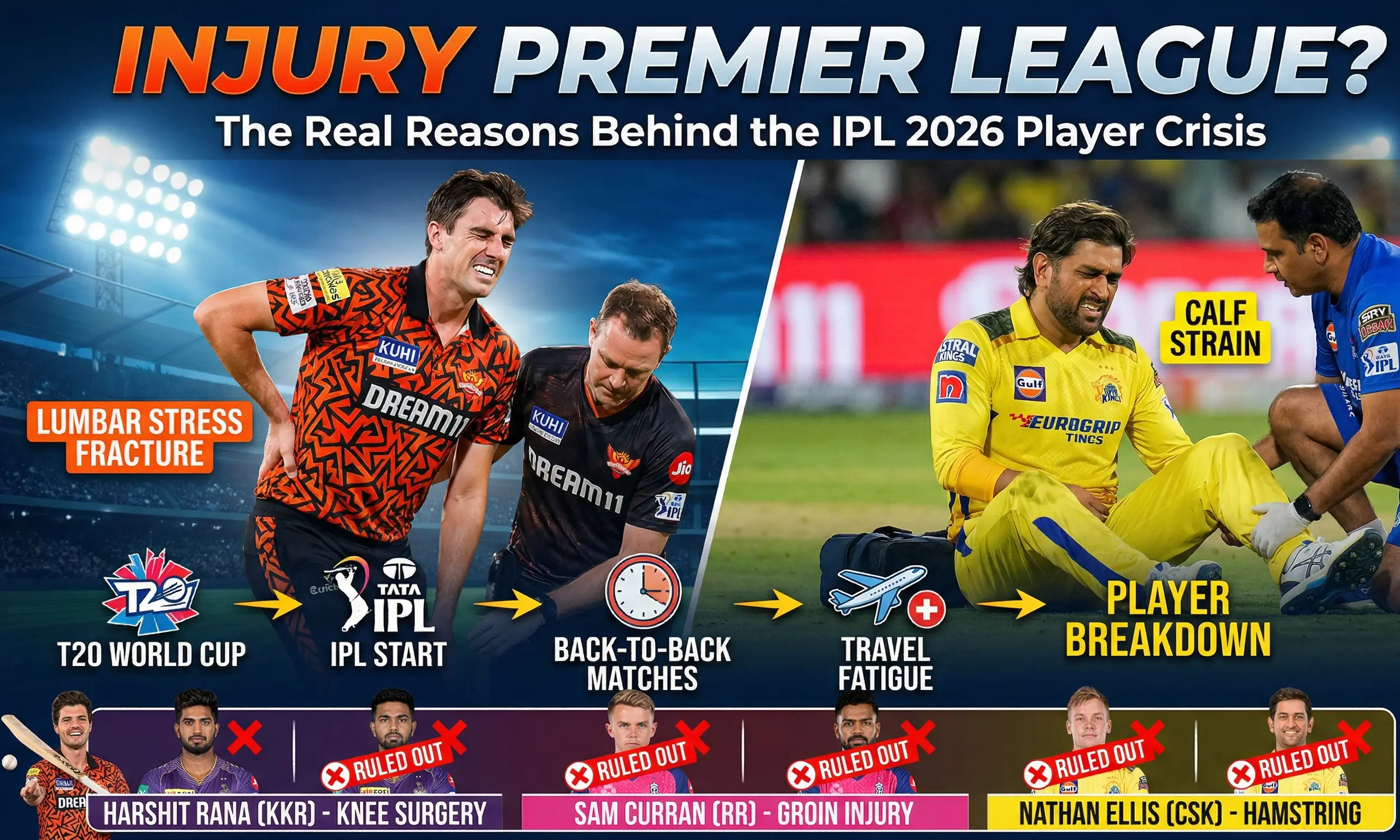
The Indian Premier League (IPL) has long been celebrated as the "pinnacle of domestic T20 cricket." However, as the 2026 season unfolds, the narrative has shifted from explosive strike rates to alarming medical bulletins. With a significant portion of the league's star power watching from the sidelines, a critical question emerges:
Why are injuries becoming so prevalent in the IPL?
Can the IPL at times feel like an “Injury Premier League”?
Is the strain on players a reflection of individual conditioning, or a consequence of how the modern cricket calendar is structured?
The answer lies at the intersection of a congested global calendar, the extreme physical demands of the modern T20 game, and the psychological pressure of high-stakes franchise cricket. In reality, it is a complex interplay between athlete workload, recovery limitations, and an increasingly demanding schedule.
For a professional athlete, the IPL is no longer just a tournament; it is a more than 60-day endurance test that pushes human physiology to its breaking point.
The Class of 2026: A Season Hampered by Absences
1. Harshit Rana (KKR): a knee injury.
2. Sam Curran (RR): groin injury
3. MS Dhoni (CSK): a calf strain
4. Dewald Brevis: a side injury
5. Pat Cummins (SRH): lumber stress injury
6. Nathan Ellis (CSK): hamstring issue.
7. Jack Edwards (SRH): a foot injury
8. Josh Hazlewood (RCB): lingering hamstring injury
9. Matheesha Pathirana (KKR) : a shoulder injury.
Why: The Primary Drivers
1. The Post-World Cup Hangover
The 2026 IPL comes almost immediately after the T20 World Cup, leaving players with barely any time to switch off and recover. In today’s game, there’s practically no off-season. Moving straight from the intensity of international cricket to the fast-paced IPL schedule takes a toll on the body. This lack of proper recovery leads to accumulated fatigue, where small muscle strains don’t fully heal and eventually turn into more serious injuries—like the groin and hamstring issues we’re seeing in players such as Curran and Ellis.
2. The Evolution of T20 Physicality
T20 cricket in 2026 has evolved far beyond a skill-based format—it is now a high-intensity, physically demanding sport that places significant stress on the human body.
Fast Bowlers: The biomechanics of fast bowling, particularly during the delivery stride, subject the body to extreme forces—often up to 8–10 times a bowler’s body weight through the front foot. This repeated impact has led to a surge in stress-related injuries, especially in the lumbar spine and knees, as seen in players like Pat Cummins.
Fielding Intensity: The introduction of the Impact Player rule has further accelerated the pace of the game. Fielders are now required to maintain peak explosiveness across the full 40 overs, executing high-speed sprints, sharp directional changes, and diving efforts with minimal recovery time. This sustained intensity has contributed to a noticeable rise in soft tissue injuries across the league.
3. The All-Rounder’s Burden
Modern T20 all-rounders operate under a uniquely demanding workload, often described as a “double load.” Players such as Cameron Green and Hardik Pandya are required to deliver full-intensity spells with the ball—frequently at high pace—while also making impactful contributions with the bat in high-pressure situations.
This dual responsibility significantly increases both physical strain and injury risk, particularly in areas like the lower back. KKR’s recent management of Green’s workload—specifically limiting his bowling duties due to back concerns—highlights a growing trend in franchise cricket. Teams are increasingly forced to strike a delicate balance between maintaining tactical flexibility and ensuring long-term player fitness and longevity.
4. The "Unseen" Culprits: Travel and Tight Scheduling
Although on-field intensity contributes to the issue, the primary causes of these injuries are rooted in the tournament’s logistical arrangements.
· The Science of Recovery: Elite athletes require 48–72 hours for full muscle recovery after a high-intensity T20 game. When matches are scheduled just 48 hours apart, the body remains in a state of "incomplete recovery."
· Micro-trauma Accumulation: Repeated stress without rest leads to micro-tears in soft tissue. This is why we see a high prevalence of hamstring and calf strains—injuries that aren't usually caused by a single impact but by cumulative fatigue.
5. Travel Patterns
Travel-Play-Repeat: A player might play a night match in Chennai, finish at midnight, catch a 6:00 AM flight to Delhi, and be expected to practice or play the next evening.
Circadian Disruption: Frequent travel and inconsistent sleep schedules disturb the body’s natural rhythm, which plays a crucial role in recovery and mental sharpness. This “travel fatigue” not only hampers performance but also increases the likelihood of lapses in concentration, often leading to on-field injuries.
The wave of injuries in IPL 2026 isn’t just down to “bad luck”—it’s a natural outcome of a packed schedule that often pushes players beyond their physical limits.
With teams like Delhi Capitals and RCB already managing the workloads of their key bowlers, the league seems to be at a turning point. If the IPL wants to maintain its quality, it needs to start thinking smarter—better scheduling, reduced travel fatigue, and maybe even mandatory rest periods for players. Otherwise, the so-called “pinnacle of T20 cricket” could slowly turn into a battle of survival rather than skill.
In today’s IPL, it’s not just about strike rates or economy anymore—the real measure of a player’s value is how long they can stay fit and available.
While the numbers and medical reports offer a clinical perspective, the true pulse of the game lies with the fans who witness this physical toll first-hand. Does the "Impact Player" rule demand too much of our athletes, or is it time for a radical overhaul of the global cricket calendar?
I would value your perspective on this evolving crisis—please share your thoughts and insights in the comments section below.