

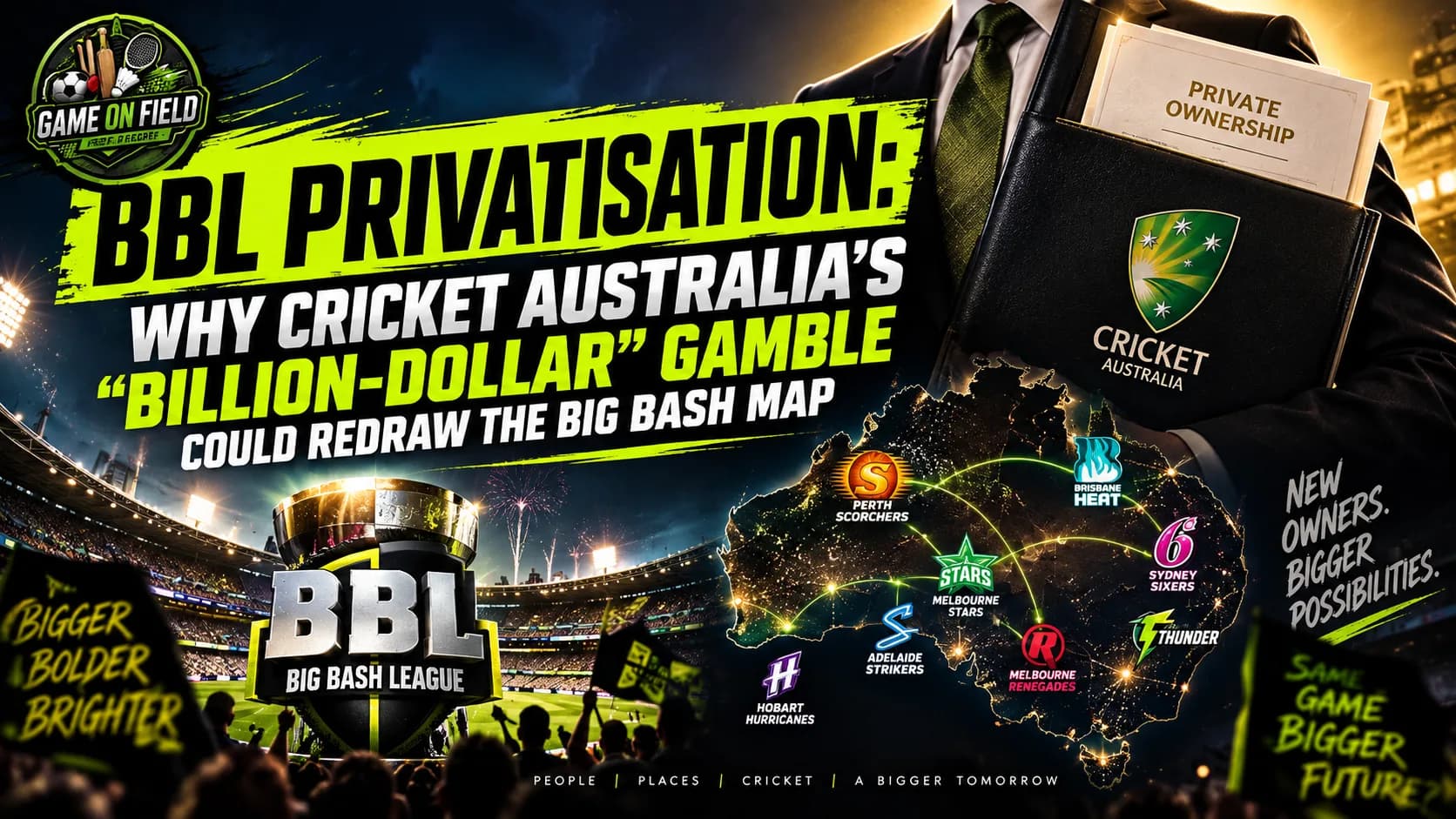
Australian cricket just crossed a line it had been circling for well over a year. On Tuesday, Cricket Australia's board formally cleared the path for private capital to enter the Big Bash League, ending months of tense back-and-forth with the state associations and setting up what CA chief executive Todd Greenberg has called a potential billion-dollar reshaping of the domestic game.
The first franchise to actually go up for grabs is the Melbourne Renegades, whose full ownership stake is now open for bidding — but the real story is the system CA has built around that sale, and what it signals for the other seven clubs in the competition.
What Actually Changed on Tuesday
CA didn't announce a single, uniform sell-off. Instead, it approved what it's branding a "self-determination" model: each state cricket association now gets to decide, on its own timeline, whether it wants to sell a partial or full stake in its BBL and WBBL franchise. There's no league-wide mandate forcing every club to the market at once.
The Renegades are the test case, and it's a full sale — CA will invite bids for 100% of the licence, with new ownership expected to be in place in time for the 2027-28 season. Until then, the club will operate under caretaker management run directly out of CA headquarters, meaning this summer's Big Bash campaign, including the season-opening fixture against Perth Scorchers in Chennai, goes ahead essentially unchanged.
That Chennai fixture is itself notable — it will reportedly be the first Big Bash match ever played outside Australia, a small but symbolic sign of how far the league's ambitions for global reach and investor interest now extend.
Melbourne's Restructure Is the Real Twist
Buried inside the Renegades news is an equally significant structural shift: the Melbourne Stars, the Renegades' inner-city rival, will now be run entirely by Cricket Victoria rather than pursuing a merger between the two clubs. Cricket Victoria had floated combining the Renegades and Stars months earlier, but that plan was shelved amid the wider privatisation negotiations. For now, Melbourne keeps two distinct Big Bash identities, but only one of them is headed toward private hands in the near term.
A League Split Down the Middle
Cricket Australia's self-determination framework has, unsurprisingly, produced a self-determination reality — the eight BBL states are not moving in unison.
This patchwork means the 2026-27 Big Bash season will look, on the field, almost exactly like the one before it. The real transformation — if it happens — is a 2027-28 story, contingent entirely on how smoothly (or messily) the Renegades sale goes and whether it convinces the hesitant states to follow.
Guardrails Cricket Australia Isn't Giving Up
For all the talk of private ownership, CA has been explicit that it isn't handing over the keys to the competition itself. Even after a franchise changes hands, Cricket Australia says it intends to retain control over:
- International scheduling
- Player availability
- Salary caps
- Media rights
- The right to approve or reject any prospective buyer
- The reserve price attached to any sale
In effect, CA is trying to sell equity in individual clubs while keeping centralised control over the levers that determine how the league actually functions — a model that echoes how some IPL-adjacent ownership structures work, where franchise owners run business operations but the parent board still sets the competitive framework.
The Player Question Nobody Has Answered Yet
This is where the announcement gets genuinely complicated. Cricket Australia staged Tuesday's unveiling at the Sydney Cricket Ground flanked by four of the biggest names in Australian cricket — Test captain Pat Cummins, Travis Head, Ellyse Perry and Sophie Molineux — all of whom struck a broadly supportive tone about what private investment could mean for the league's growth.
But star-power endorsement isn't the same as sign-off from the people who actually run player advocacy. The Australian Cricketers' Association has been unambiguous: it considers any change to BBL ownership structures — including the Renegades sale — subject to a renegotiated players' memorandum of understanding, and it isn't willing to wave deals through without one. ACA chief executive Paul Marsh said plainly that the two sides remain "a long way apart" on a new agreement, and that Australian cricket cannot proceed with any franchise sale without the union's sign-off. Cricket Australia, for its part, appears to believe it can proceed with the sale process regardless of where those talks land, setting up a possible collision between the administrators and the union before a single dollar changes hands.
At the heart of that dispute is money — and the numbers are more tangled than they first appear. Under the current MoU, players are entitled to 27.5% of total Australian Cricket Revenue (not profit, a much larger base), plus the chance to earn an extra 2.5% through a performance-linked pool that, in practice, has lifted their real-world share closer to 29% over recent years. The ACA wants the baseline permanently raised to 33%. CA and the states have pushed back hard on that jump, worried about what it would mean for grassroots and community cricket funding.
Layered on top of that headline fight is a separate, thornier legal question: whether the lump-sum proceeds from selling a stake in a club like the Renegades even count as "Australian Cricket Revenue" under the existing MoU at all. The ACA believes any sale proceeds should be shared at 27.5%; CA's position is that players are only entitled to a share of interest earned once that money is reinvested — a significant gap in interpretation that the union has proposed resolving through an independent arbiter. Until that's settled, one way or another, it hangs over CA's hoped-for Christmas timeline for closing the Renegades deal.
Will Private Money Actually Make the BBL Better?
This is the harder question, and it's the one CA has been least precise about. The pitch so far leans heavily on the word "billion" without a fully mapped-out explanation of how fresh capital converts into a better on-field product.
CA's stated anxiety is talent retention — the fear that Australian players will increasingly prioritise T20 leagues like South Africa's SA20 or the UAE's ILT20, both of which have benefited from franchise models with international ownership links and scheduling windows that don't clash as directly with players' calendars. Loosening overseas-player rules has already produced one high-profile signal that the BBL can still pull talent: former England captain Ben Stokes is set to return to the competition this season after signing with the Adelaide Strikers, alongside other international recruits expected to follow before the summer.
But the league's most persistent headache — the near-total unavailability of Australia's own top stars like Cummins and Head, whose international commitments keep them out of the Big Bash almost entirely — isn't something private capital resolves on its own. Ownership structure and player release policy are two different problems, and Tuesday's announcement addressed the first far more concretely than the second.
What to Watch Next
- The Renegades sale timeline. CA is reportedly hoping to have a deal closed by Christmas — a fast turnaround that will be the first real stress test of the whole model.
- Whether the ACA and CA reach a revised MoU before that sale closes, or whether the union tries to slow the process down.
- How the Scorchers, Hurricanes and Strikers respond if the Renegades sale draws strong bidding interest, since a successful auction is likely to be the trigger for the next wave of states to test the market.
- Whether Queensland and New South Wales hold their ground, or whether a well-priced Renegades sale shifts the political calculus in Brisbane and Sydney too.
For now, the Big Bash on the field remains recognisable. What's changed is everything sitting just underneath it — and how that plays out over the next twelve months will likely determine whether this becomes Australian cricket's version of The Hundred's ownership shake-up, or a far more contained, club-by-club evolution.
GameOnField Stump Mic
CA has sold the headline — "billion-dollar" — before it has sold the plan. The Renegades auction is a genuine test case, but it arrives with the players' union unconvinced, two states refusing to engage, and the league's actual on-field talent problem — Australia's own stars barely playing the Big Bash — still untouched by any of it. Private capital can change who owns a club. Whether it changes what happens on the field is a very different question, and Tuesday's announcement didn't really answer it.
Key Takeaways
- Cricket Australia has approved a "self-determination" model letting each state decide whether to sell a stake in its BBL/WBBL franchise, rather than a league-wide mandate
- The Melbourne Renegades are the test case, with a full 100% sale open for bidding and new ownership targeted for the 2027-28 season
- The Melbourne Stars will now be run solely by Cricket Victoria after a proposed Renegades-Stars merger was shelved
- The Australian Cricketers' Association says any sale needs a renegotiated players' MoU first, with a 27.5% vs 33% revenue-share gap still unresolved
- CA intends to retain control of scheduling, player availability, salary caps, media rights and buyer/reserve-price approval even after clubs are sold
This article draws on public reporting from Cricket Australia's official statements, the Australian Cricketers' Association, and multiple cricket news outlets including Cricinfo and cricket.com.au, and reflects analysis and original commentary by the GameOnField editorial desk. All information has been independently rewritten and is not reproduced verbatim from any source.