

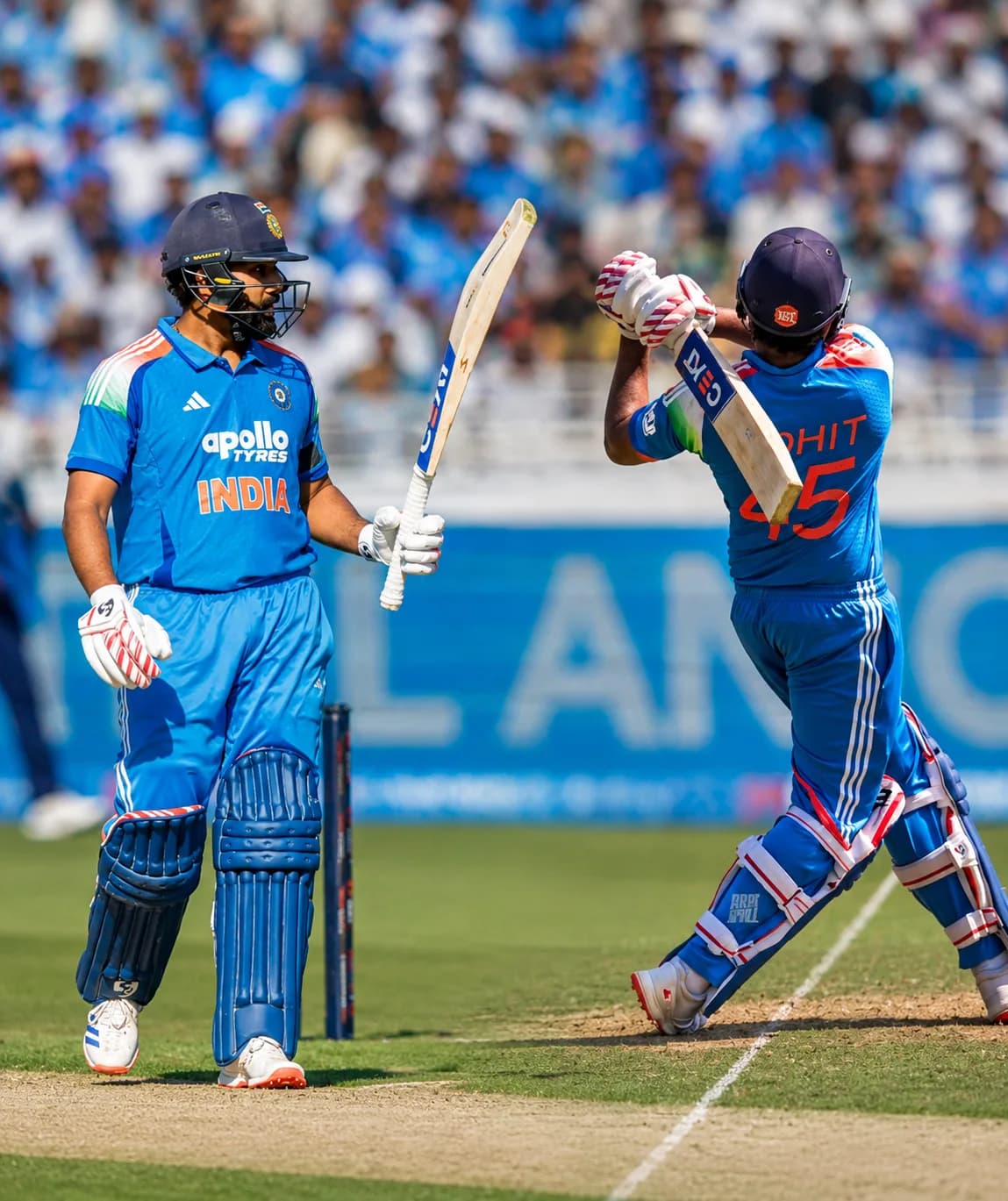
Cricket scorebooks record numbers, but the real story of an innings often lives in the context around it — the pressure, the opposition, and what it means for what comes next. Rohit Sharma's 138 off 110 balls in the third ODI against England at Lord's is exactly that kind of innings.
India lost the match by 27 runs while chasing a daunting 388, and the result will sit in the books as another away defeat. But look past the scoreline, and this knock could end up being one of the most significant innings of Rohit's later career.
For weeks, the conversation around Indian cricket had been dominated by doubt rather than certainty. Is Rohit entering the last stretch of his career? Can he still take down top-quality attacks overseas? Is it time to hand the reins to the next generation? Great players rarely answer such questions in interviews. They answer with the bat — and at the Home of Cricket, Rohit did exactly that.
The Weight of Expectations Before the Match
This was never just another bilateral fixture. It was the series decider against England at one of the sport's most historic venues, with India chasing 388 — a target that demanded sustained aggression paired with careful shot selection from every batter in the lineup.
Rohit walked out carrying more scrutiny than most. Every low score in recent months had been magnified, every dismissal had fed retirement chatter, and every innings was being judged through the lens of his age rather than his ability. That kind of pressure affects even the best in the world — yet he came to the crease looking calm, and that composure defined everything that followed.
A Player Who Read the Chase First
Plenty of modern ODI innings start with intent regardless of conditions. Rohit did the opposite. Before he expanded his strokeplay, he assessed the seam movement on offer to England's quicks, the pace of the pitch, the field settings, the boundary size, and how the bowlers were being rotated.
That is what separates elite batters from good ones — every aggressive shot he played afterwards had a purpose, and every calculated risk shifted the pressure back onto England.
Technical Excellence Behind the 138
The Pull Shot — His Signature Weapon
England leaned repeatedly on short-ball tactics, and Rohit's answer was emphatic. Whether the ball climbed chest-high or shoulder-high, he controlled the pull with real balance, turning England's aggressive lengths into scoring opportunities instead of just surviving them — forcing the bowling unit to abandon one of its main plans.
Front-Foot Dominance
When England searched for swing with fuller lengths, his footwork stood out. His drives through extra cover and mid-off were textbook — minimal head movement, a bat coming down dead straight, and timing that looked almost effortless. These are the small technical details that go unnoticed but explain why experienced batters remain dangerous even as reflexes shift with age.
Reading Length Earlier Than Anyone Else
One of Rohit's enduring strengths has always been picking the length of a delivery early. Against England, that instinct was on full display — balls that looked threatening to those watching were dispatched with ease because he had already made his decision a fraction of a second sooner. Elite batting, in that sense, begins before the ball even arrives.
Building Partnerships Over Personal Milestones
One of the clearest signs of Rohit's maturity as a batter is understanding that ODI chases are won through partnerships, not isolated brilliance. His 147-run stand with Shubman Gill steadied India after the early overs, with both batters rotating strike efficiently and targeting specific bowlers rather than forcing boundaries every over.
His later 113-run partnership with Virat Kohli reflected the same principle. Neither batter let England dictate the tempo — they accelerated in phases, absorbed pressure when needed, and capitalised whenever the bowlers erred in length. That tactical batting kept India within touching distance of a massive asking rate for longer than seemed possible.
Tactical Intelligence That Often Goes Unnoticed
Strike rate dominates most modern batting discussions, but it can be misleading without context. Rohit's innings carried several tactical layers that a scorecard alone won't show.
Manipulating the field: whenever England protected the square boundaries, he drove straight; when the off side got crowded, he worked the ball behind square — constantly forcing the fielding side to stay reactive.
Targeting bowlers, not overs: he picked out England's weaker match-ups and accelerated against them, while staying calculated against their strike bowlers.
Managing the required rate: chasing close to 400 tempts panic, but his calculated acceleration kept the equation under control — for over thirty overs, India genuinely believed the chase was on, largely because he was still at the crease.
Breaking Records While Chasing History
Rohit became the first Indian batter to score an ODI century at Lord's, and now holds the record for the most 50-plus ODI scores by a visiting batter in England, surpassing Virat Kohli — all while notching his 34th ODI century.
There was no extravagant celebration and no emotional outburst — just a quiet acknowledgement. It reflected a player whose own standards remain exceptionally high, and who knew the job wasn't finished.
Leadership Beyond Captaincy
Leadership isn't only about bowling changes and field settings — it's about influencing teammates through action. Through the chase, India's younger batters looked composed despite the pressure, and much of that confidence traced back to Rohit's presence at the crease.
When senior players stay calm, dressing rooms follow suit. When experienced batters absorb pressure, younger players get room to play freely. It's an influence that can't be measured in a stat column, yet it often decides outcomes.
Why Rohit Remains the Backbone of India's ODI Team
Indian cricket has no shortage of emerging talent — players like Shubman Gill, Yashasvi Jaiswal, and Ruturaj Gaikwad represent the future. But transitions only succeed when experienced leaders keep delivering alongside them, and Rohit continues to offer qualities that are hard to replace.
Experience in big games: World Cups, ICC tournaments, series deciders, away tours, knockouts — few active cricketers have seen every scenario the way he has.
Tactical reading of conditions: he combines instinct with years of accumulated knowledge, reading pitches and bowling plans quickly and adjusting before opponents notice the shift.
Calm under pressure: even chasing almost 400, he never looked rushed — and that composure spread through India's entire batting order.
Mentoring the next generation: his partnership-building with Gill, his communication between overs, and his tempo management let younger batters flourish — perhaps his biggest long-term contribution to Indian cricket.
The Bigger Concern: India's Bowling Unit
As much as this innings deserves celebration, it also exposed an uncomfortable truth — India should never have been chasing 388 in the first place. England's batting dominated for long stretches because India's bowling lacked consistency in death-over execution, middle-over wicket-taking, yorker accuracy, and containment.
This defeat should point the introspection toward India's bowling combinations rather than its batting unit. When a batter scores 138 in a chase this steep, the real questions shift to why the team was defending such a total to begin with.
What This Innings Means Ahead of Major ICC Events
As India looks toward upcoming ICC tournaments, this Lord's innings carries real weight. It confirms that Rohit can still produce match-defining knocks against elite attacks, that he continues to thrive in overseas conditions, that he can still control an ODI chase, and that he remains mentally ready for cricket's biggest stages — qualities that are priceless for any team with title ambitions.
Class is permanent, champions never stop evolving, and Rohit Sharma remains one of the strongest pillars holding Indian cricket together.
— GameOnField's Stump Mic
Cricket history remembers more than victories — it remembers resistance, courage, and greatness shown even in defeat. Rohit's 138 at Lord's belongs in that category. It wasn't just a century; it was a technical exhibition, a tactical masterclass, and a statement from one of modern white-ball cricket's greatest batters. Critics wondered if time had finally caught up with him. He answered in the only language that truly matters in this sport — the language of runs.
| Category | Gameonfield Rating |
|---|---|
| Batting Quality | 10/10 |
| Pressure Handling | 10/10 |
| Shot Selection | 9.8/10 |
| Game Awareness | 10/10 |
| Captain's Impact | 9.7/10 |
| Overall Match Influence | 9.9/10 |
Bottom Line
- Rohit Sharma scored 138 off 110 balls (17 fours, 5 sixes) in a losing cause, as India fell 27 runs short chasing 388 at Lord's.
- He is now the first Indian batter to score an ODI century at Lord's, with the most 50-plus ODI scores by a visiting batter in England, and his 34th ODI hundred overall.
- Key stands of 147 with Shubman Gill and 113 with Virat Kohli kept India in the chase deep into the innings.
- The defeat points to bowling inconsistency rather than any batting failure, with India conceding 388 in the first place.
- The innings reaffirms Rohit's continued importance to India's ODI setup heading into future ICC tournaments.