

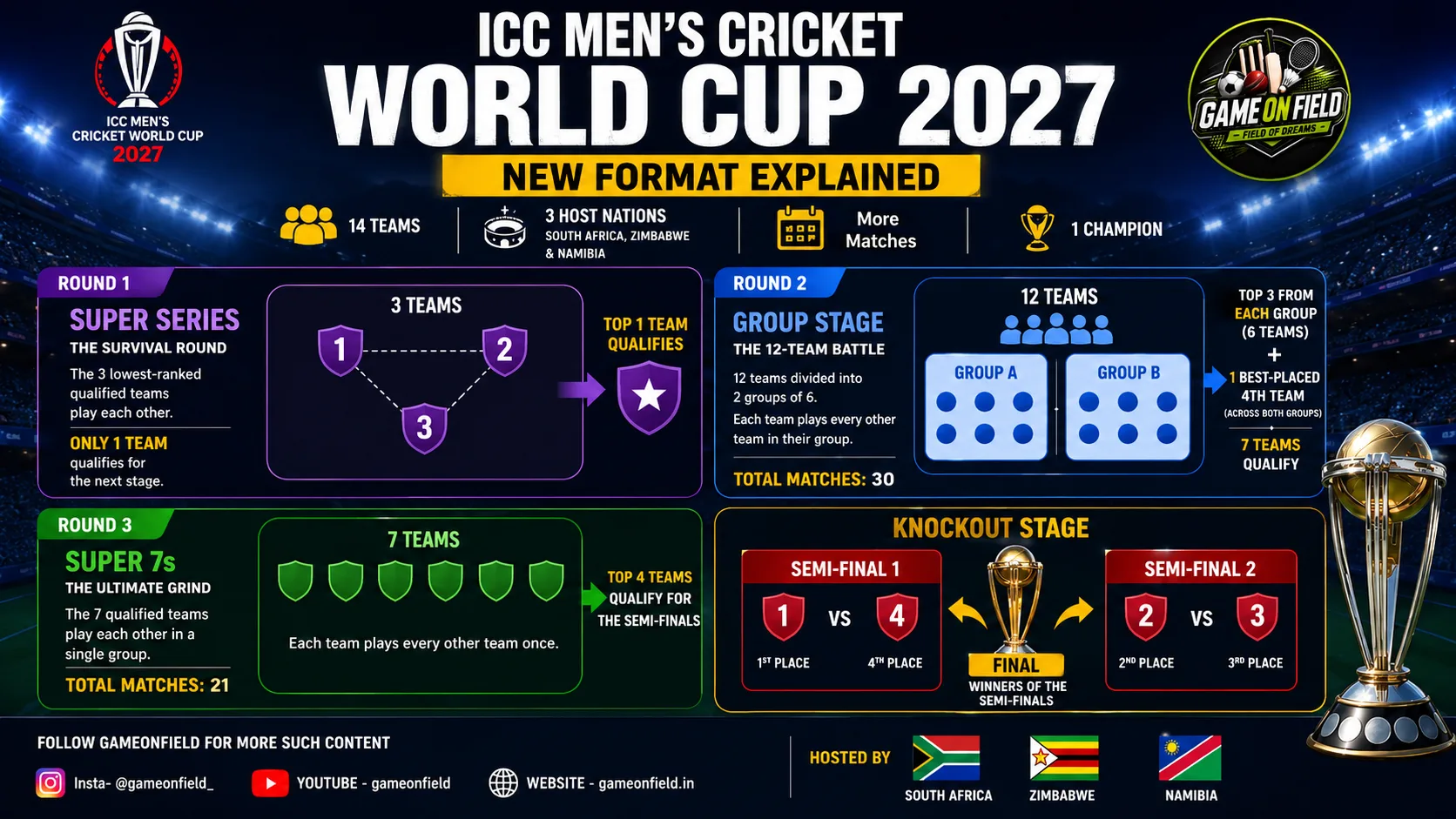
The ICC Men's Cricket World Cup is set for a major transformation in 2027. After two editions featuring a 10-team round-robin format, the International Cricket Council (ICC) has introduced a significantly revamped tournament structure for the next edition, which will be jointly hosted by South Africa, Zimbabwe, and Namibia.
The biggest change is the expansion of the competition from 10 to 14 teams, a move that promises greater global representation while introducing a more competitive qualification pathway. Alongside the expansion, the ICC has also unveiled a new three-stage tournament format designed to increase the importance of every match and reduce the number of dead-rubber fixtures.
Here's a detailed breakdown of how the new World Cup format will work.
A New Era for the Cricket World Cup
The 2027 edition represents one of the most significant structural changes in ODI World Cup history. Rather than having every team play each other in a single league stage, the tournament will now follow a progressive three-stage format before reaching the knockout rounds.
The objective behind the redesign is simple:
- Expand opportunities for more nations.
- Keep qualification scenarios alive throughout the tournament.
- Increase competitive balance.
- Deliver more meaningful matches for players and fans alike.
Stage 1: Super Series – The First Test
The tournament begins with the Super Series, featuring the three lowest-ranked qualified teams among the 14 participating nations.
Instead of directly entering the main competition, these teams will compete in a mini round-robin league.
How it works
- Three teams compete against each other.
- Every team plays the other two once.
- The team finishing at the top of the standings qualifies for the next stage.
- The remaining two teams are eliminated from the tournament.
This opening phase adds immediate pressure, ensuring there are no easy entries into the main event.
Stage 2: Group Stage – The Main Competition
Following the Super Series, the tournament enters its primary phase with 12 teams.
These teams will be divided into two groups of six.
Format
- Each team plays every other team in its group once.
- Every side plays five group-stage matches.
- A total of 30 matches are played during this phase.
Qualification
The qualification system introduces an interesting twist.
- Top three teams from Group A qualify.
- Top three teams from Group B qualify.
- One additional team qualifies as the best-performing fourth-placed side across both groups.
This means seven teams progress to the next stage.
The wildcard qualification keeps more teams mathematically alive until the closing stages of the group phase, making every point and every net run rate calculation crucial.
Stage 3: Super 7 – Where the Tournament Truly Begins
The seven remaining teams enter the Super 7 stage.
Rather than another split-group system, all seven teams compete together in a single league.
Format
- Seven teams.
- Round-robin competition.
- Each team faces every other qualified side.
- A total of 21 matches.
This stage becomes the defining phase of the tournament.
Every victory directly impacts the race for the semi-finals, while every defeat can dramatically alter qualification chances.
Unlike previous World Cups where knockout places were sometimes decided well before the final group matches, the Super 7 format is expected to keep the tournament competitive until the very end.
Knockout Stage
Once the Super 7 concludes, the tournament moves into traditional knockout cricket.
Semi-Final 1: 1st place vs 4th place
Semi-Final 2: 2nd place vs 3rd place
The winners advance to the ICC Men's Cricket World Cup Final, where one team will lift cricket's most prestigious trophy.
Why Has the ICC Changed the Format?
The previous 10-team round-robin format used in 2019 and 2023 received mixed reactions. While it ensured every major team faced one another, several concerns emerged over time.
Limited Global Representation
Only ten teams participated, leaving several deserving Associate and emerging nations without an opportunity to compete on cricket's biggest stage.
Expanding to 14 teams allows more countries to experience elite ODI cricket while supporting the ICC's long-term objective of growing the game globally.
More Competitive Cricket
The new structure introduces multiple qualification checkpoints.
Teams cannot afford slow starts because progression now depends on performing consistently across different stages rather than surviving one long league phase.
Fewer Dead Matches
One of the biggest criticisms of the previous format was the number of matches with little qualification significance during the latter stages.
The introduction of the Super Series, the wildcard qualification spot, and the Super 7 stage significantly reduces that possibility.
Every match is expected to carry qualification implications.
What Makes the Super 7 Interesting?
The Super 7 stage is arguably the biggest innovation of the tournament. Instead of teams carrying momentum directly into semi-finals, they must survive another intense league where every opponent is among the tournament's best performers.
This rewards consistency over short bursts of form and creates a genuine battle among the strongest teams before the knockout rounds.
From a tactical perspective, net run rate, squad rotation, workload management, and adaptability across different conditions will become even more important.
What This Means for Fans
For supporters, the new format promises:
- More participating nations.
- Higher-stakes matches throughout the competition.
- Greater unpredictability.
- Better opportunities for emerging teams to create history.
- A longer, more competitive road to becoming world champions.
With matches spread across South Africa, Zimbabwe, and Namibia, the tournament is also expected to showcase cricket across Southern Africa on one of the sport's biggest stages.
Final Thoughts
The ICC Men's Cricket World Cup 2027 is not simply expanding—it is evolving.
The move to a 14-team tournament reflects cricket's growing global ambitions, while the new three-stage format aims to strike a balance between inclusivity and competitiveness.
Whether this structure proves to be an improvement over the previous round-robin model will only become clear once the tournament begins. However, on paper, it promises a competition where every stage presents new challenges and every match has something meaningful at stake.
For players, it means a tougher journey to the trophy.
For fans, it promises more drama, more storylines, and more unforgettable moments.
And ultimately, that's exactly what a Cricket World Cup should deliver.
Key Takeaways
- ICC Men's Cricket World Cup 2027 expands from 10 to 14 teams, hosted by South Africa, Zimbabwe, and Namibia.
- New three-stage format: Super Series (3 teams) → Group Stage (12 teams) → Super 7 (7 teams) → Knockouts.
- Group Stage sees 30 matches; Super 7 adds 21 more round-robin matches before semi-finals and the final.
- Wildcard qualification spot for the best fourth-placed team keeps more sides alive longer.
- Format aims to expand global representation, boost competitiveness, and cut down on dead-rubber matches.
What are your thoughts on the new ICC Men's Cricket World Cup 2027 format? Do you prefer this expanded 14-team, three-stage structure, or was the 10-team round-robin format better? Share your opinions in the comments below and stay connected with Gameonfield for in-depth cricket analysis, tactical breakdowns, match previews, and everything happening in the world of cricket.