

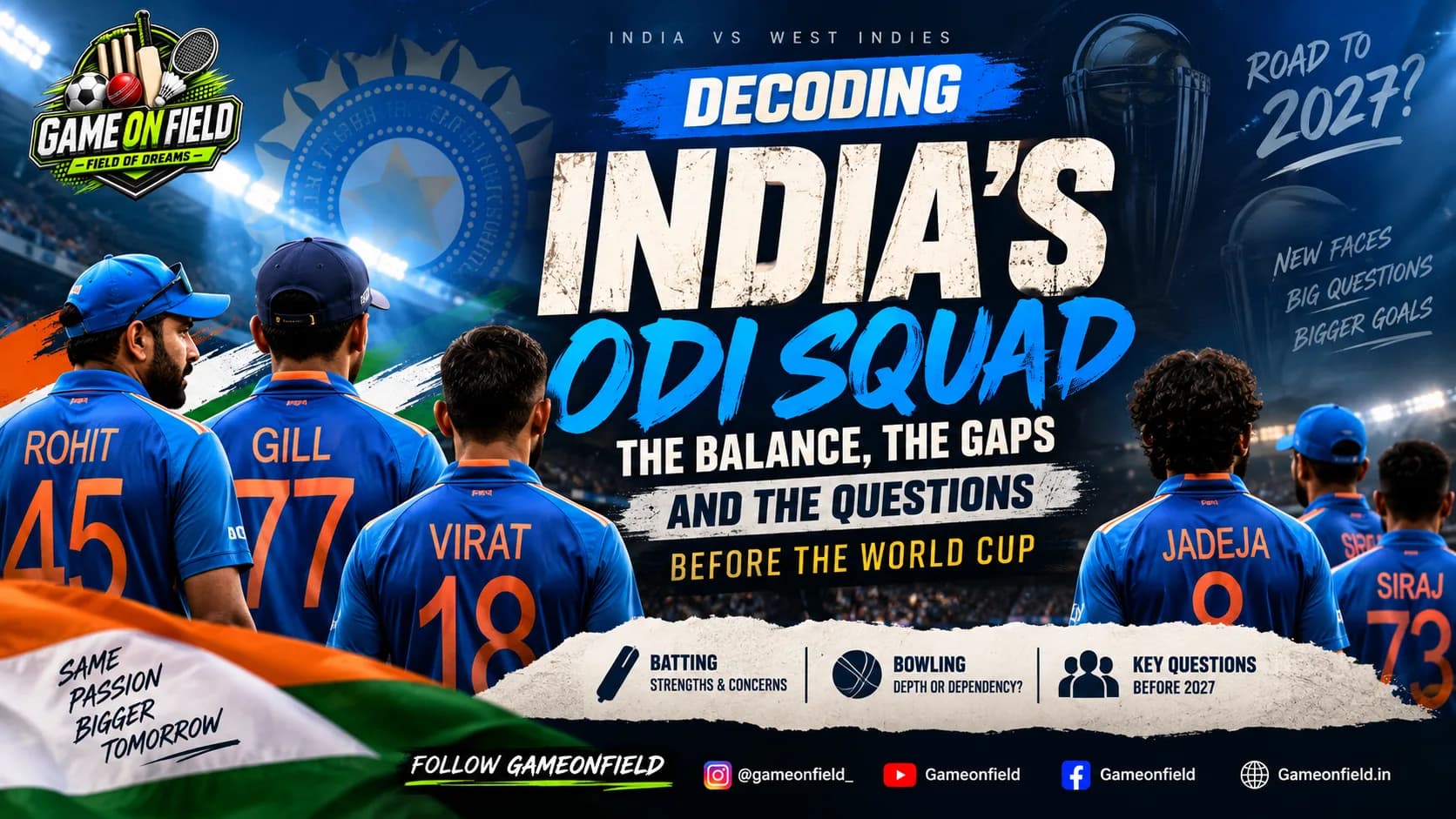
India's ODI squad for the West Indies series looks experienced at first glance. But underneath that experience lies a very different story.
This is not quite India's first-choice ODI squad. With the Asian Games running alongside the ODI leg of the West Indies tour, several regular white-ball players are unavailable. That has opened the door for a group of players who now have an opportunity that goes beyond three matches.
For India, this series is therefore less about simply winning an ODI series and more about testing the depth of the squad ahead of the 2027 World Cup cycle.
There are established names, returning veterans, players waiting for their opportunity and a few selections that suggest the selectors are already looking beyond the immediate series.
The important question is not just who has been selected?
It is why have these players been selected, and what problem is India trying to solve?
The Batting: Experience at the Top, Uncertainty in the Middle
At the top, India still possesses enormous experience.
Rohit Sharma, Shubman Gill and Virat Kohli provide a combination of experience, class and proven ODI performance that few teams can match.
Gill has increasingly taken responsibility as captain, while Rohit and Kohli continue to remain relevant whenever they are selected.
But there is an unavoidable long-term question.
The 2027 World Cup is still ahead, and both Rohit and Kohli will be considerably older by then. That makes every ODI appearance during this cycle more significant from a selection perspective.
India doesn't necessarily need to make an immediate decision on either player. What it does need is a clear understanding of how the transition will happen.
And that brings us to the more complicated part of the batting order.
The No. 4 Problem
With Shreyas Iyer unavailable, Ruturaj Gaikwad gets another opportunity to strengthen his case.
Gaikwad has already demonstrated that he can score heavily in white-ball cricket and possesses the technique required for ODI batting. But the challenge is converting that potential into a clearly defined role.
If he is being considered for No. 4, India needs to know whether he can handle the specific demands of that position:
- ✓ rebuilding after early wickets
- ✓ rotating strike through the middle overs
- ✓ attacking spin
- ✓ accelerating after the 35th over
- ✓ and finishing an innings when required
Three ODIs cannot answer all those questions, but they can provide useful evidence.
Yashasvi Jaiswal adds another interesting dimension.
His primary identity remains that of an opener, but his presence gives India flexibility. He can provide cover at the top while potentially being tested in different batting positions.
That flexibility could become particularly important during the transition towards 2027.
Then there is Naman Dhir, whose selection represents a different type of investment.
India needs players capable of changing the tempo of an innings during the middle and death overs. Dhir's power-hitting makes him an intriguing option, but power alone will not secure a World Cup place.
He needs to demonstrate that he can contribute consistently enough to become a genuine middle-order option rather than simply an impact substitute.
Gameonfield Analysis: The Batting Gap
India's biggest batting question isn't at the top. It is Nos. 4, 5 and 6.
When players such as Shreyas Iyer, Hardik Pandya and Rishabh Pant are available, India's options look considerably stronger. But this series exposes the depth behind those first-choice names.
Gaikwad, KL Rahul and Dhir have an opportunity to make the selectors' future planning more complicated — and that is exactly what India should want from a series like this.
Bowling: Depth Is Growing, But the Pace Hierarchy Isn't Settled
The bowling group has an interesting combination of experience and experimentation.
At the centre of the attack is Kuldeep Yadav. His role in India's ODI plans remains particularly important because of what he provides in the middle overs.
Kuldeep isn't simply a defensive spinner. His wrist-spin gives India a genuine wicket-taking option against established batting partnerships.
In a World Cup environment, that ability to break partnerships can become decisive.
But the pace department raises more questions.
Mohammed Siraj: Present or Part of the Future?
Mohammed Siraj brings experience, control and familiarity with international ODI cricket. But India's selectors also have to consider the bigger timeline.
Siraj is now 32, which means the question isn't whether he can contribute today. It is how heavily India should build its 2027 pace plans around him.
That doesn't make his selection a problem. It makes it a timeline decision. India needs experienced bowlers for the present while simultaneously developing the next generation.
Prasidh Krishna therefore becomes an important player to monitor.
His pace, bounce and ability to extract something from helpful surfaces make him an attractive ODI option. The challenge has been consistency and fitness. Then come the less-established options.
Gurnoor Brar and the other emerging pace selections indicate that India is widening the search. That is important. India cannot enter the 2027 World Cup with a pace strategy that depends almost entirely on Bumrah being available and everyone else remaining fit.
The Bumrah Factor
Jasprit Bumrah remains central to India's long-term ODI planning whenever available.
But workload management and fitness mean India must develop alternatives rather than simply assuming Bumrah will carry the attack. The West Indies series provides an opportunity to test the next layer.
Not necessarily to find a replacement for Bumrah — because there is no simple like-for-like replacement — but to identify bowlers capable of sharing the responsibility.
Nitish Kumar Reddy: A Selection With Structural Importance
Among the younger names, Nitish Kumar Reddy deserves particular attention. His value isn't limited to his batting. India has spent considerable time searching for a reliable seam-bowling all-rounder who can genuinely contribute with both disciplines.
That role becomes even more important in ODI cricket because team balance often depends on having a sixth bowling option.
If Nitish can establish himself as a reliable bowler while continuing to contribute with the bat, he could provide India with something strategically valuable:
flexibility.
A player who can bat in the middle order and deliver a meaningful number of overs gives the captain greater freedom in constructing the XI. However, the key word is reliability.
Occasional overs are not enough.
If India eventually sees him as part of its 2027 plans, he must demonstrate that he can consistently handle the physical and tactical demands of ODI cricket.
Ravindra Jadeja's Return: More Than Just Experience
The return of Ravindra Jadeja may be the most significant selection in the squad. Not because India needs another experienced name. Because Jadeja solves multiple problems simultaneously.
He offers:
- ✓ left-arm orthodox spin
- ✓ middle-over control
- ✓ batting depth
- ✓ finishing ability
- ✓ exceptional fielding
- ✓ and enormous international experience
That combination is difficult to replicate.
His presence also gives India flexibility in team composition. Depending on conditions, Jadeja can effectively strengthen either the batting or bowling unit. But there is a bigger question.
Is Jadeja Part of the 2027 Plan?
Age makes this an unavoidable discussion. Jadeja will be well into his late 30s by the 2027 World Cup. Therefore, his return should not automatically be interpreted as India committing to him for the next World Cup.
It could instead represent a bridge between the present and the future.
India has potential alternatives in Axar Patel and Washington Sundar, while other players could emerge during the next year. That means Jadeja's importance may be two-fold. He can help India win now while simultaneously giving the selectors time to identify his eventual successor.
The way India uses him during this series could therefore be revealing.
- ➤ If he is primarily deployed as the main middle-overs spinner, that tells us one thing.
- ➤ If he is used predominantly as a batting all-rounder, it tells us something else.
His role could provide an insight into how the selectors see the next phase of India's ODI team.
The Wicketkeeping Puzzle: Rahul, Jurel and the Pant Question
KL Rahul provides India with the obvious short-term solution. He has experience as both a batter and wicketkeeper and is also the vice-captain.
That combination gives India stability. Behind him is Dhruv Jurel, one of the younger players trying to establish himself at international level. The important question is whether Jurel is being developed specifically as India's long-term ODI wicketkeeper or simply being retained as the next available option.
And then there is Rishabh Pant. Pant's eventual return to India's ODI setup could significantly alter the team's balance. His ability to change games with aggressive batting makes him a unique option. But until he is fully back in the ODI setup, India has to plan without assuming his availability.
That makes this series important for Rahul and Jurel. India doesn't necessarily need to settle the entire wicketkeeping debate immediately.
But it does need to start building a hierarchy.
Three Selection Questions India Must Answer Before 2027
1. Who bats from No. 4 to No. 6?
The answer becomes complicated when Iyer, Pandya and Pant are all available. Gaikwad, KL Rahul and Dhir can strengthen their cases during this series, but the bigger test will come when India's first-choice players return. India needs a middle order that isn't dependent on one or two individuals.
2. Who bowls alongside Bumrah?
Bumrah's presence changes the entire bowling attack. But India needs two or three reliable options alongside him.
- ✓ Siraj offers experience.
- ✓ Prasidh offers pace and bounce.
- ✓ The emerging fast bowlers offer possibilities.
The selectors now need to turn those possibilities into a clear pecking order.
3. What is Jadeja's role in the 2027 transition?
Jadeja can solve India's current balance problem. But India also has to prepare for the day when he is no longer available. That means developing the next generation while still using Jadeja's experience effectively.
What This Series Really Represents
The West Indies ODI series should not be viewed only through the lens of results.
It is an opportunity to collect information.
- Gaikwad's performance can tell India more about its middle-order depth.
- Jaiswal can demonstrate whether his ODI future extends beyond opening.
- Nitish Kumar Reddy can show whether he can become a genuine seam-bowling all-rounder.
- Jurel can strengthen his case as a long-term wicketkeeping option.
- Prasidh and the emerging pacers can push themselves into India's wider fast-bowling plans.
- And Jadeja can provide both immediate balance and valuable experience during a period of transition.
India doesn't have to find all the answers in three matches. But it does need to start asking the right questions.
Gameonfield's Stump Mic
India's ODI squad for the West Indies series is best understood as a transition squad rather than a finished World Cup squad.
There is enough experience to provide stability, but enough uncertainty to make every opportunity meaningful.
The top order remains packed with pedigree. The middle order needs clarity. The pace attack needs succession planning. The wicketkeeping hierarchy remains open. And Jadeja's return solves a present problem while creating an unavoidable future question.
The biggest takeaway is simple:
India doesn't need to find its final 2027 XI right now. It needs to identify the players who deserve to be part of the conversation.
Key Takeaways
- India's biggest batting question sits at Nos. 4–6, not at the top, with Gaikwad, KL Rahul and Naman Dhir all fighting to strengthen their case
- The pace attack beyond Bumrah is still unsettled — Siraj offers experience, Prasidh offers pace and bounce, and emerging names like Gurnoor Brar widen the pool
- Ravindra Jadeja's return solves India's immediate balance problem but raises a genuine question about his role in the 2027 World Cup plan
- The wicketkeeping hierarchy between KL Rahul, Dhruv Jurel and a returning Rishabh Pant remains an open question
- This series is being treated as a data-gathering exercise for the 2027 World Cup cycle, not just a three-match series to win