

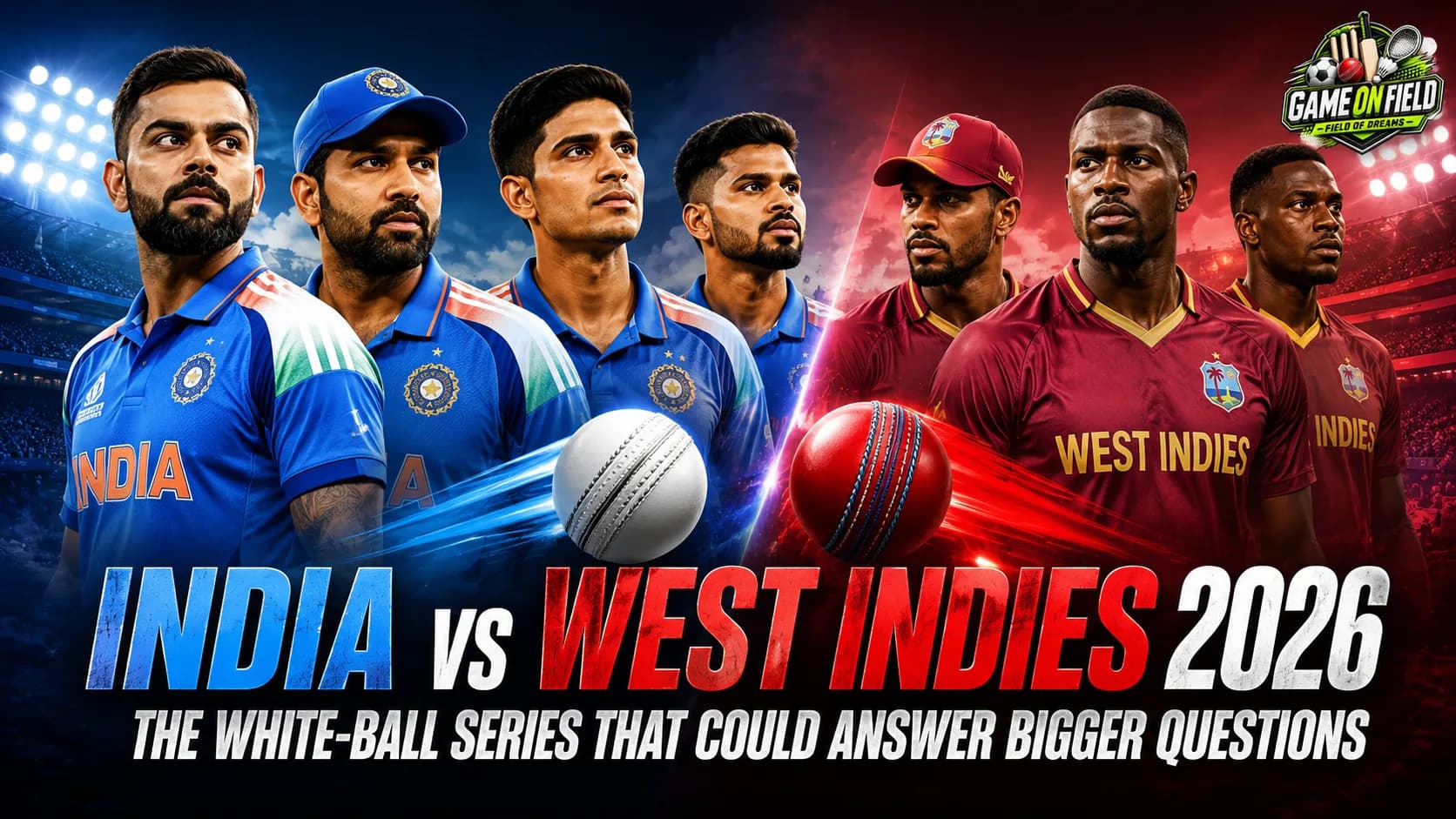
Three ODIs. Five T20Is. Eight cities. Three weeks. And plenty of questions for India to answer before a huge year of cricket.
Right after the dust settles on the Sri Lanka Test tour, India are straight back into action — this time at home, and this time in whites-off, lights-on mode.
West Indies arrive for a long limited-overs tour featuring three ODIs and five T20Is, with matches spread across eight cities between September 27 and October 17. It's a lot of cricket in a short window, and while it won't get the same attention as a Test series or an IPL auction, there's actually more going on here than it looks like on paper.
But look a little closer, and this tour becomes much more interesting.
For India, this is about more than winning another home series. The ODIs are part of the long road towards the 2027 ODI World Cup, while the T20Is offer Shreyas Iyer and his new-look leadership group another opportunity to establish themselves.
There are selection questions, captaincy questions, workload questions — and, inevitably, questions surrounding two of Indian cricket's biggest names.
This could be one of those series that looks routine on the surface but leaves behind a few important answers.
India vs West Indies 2026: The Full Schedule
ODI Series
| Match | Venue | Date |
|---|---|---|
| 1st ODI | Thiruvananthapuram | September 27 |
| 2nd ODI | Guwahati | September 30 |
| 3rd ODI | New Chandigarh | October 3 |
T20I Series
| Match | Venue | Date |
|---|---|---|
| 1st T20I | Lucknow | October 6 |
| 2nd T20I | Ranchi | October 9 |
| 3rd T20I | Indore | October 11 |
| 4th T20I | Hyderabad | October 14 |
| 5th T20I | Bengaluru | October 17 |
Eight matches. Eight cities. Three weeks.
If you're anywhere near one of these venues, this is about as much live international cricket as you'll get in one stretch all year.
Why this series is worth paying attention to
The first three games are the ones to watch most closely from a long-term perspective.
The 2027 ODI World Cup may still be more than a year away, but India's planning for that tournament has already begun. Every ODI between now and then is another opportunity to understand what the eventual squad could look like.
That makes selection particularly important.
India don't necessarily need to discover ten new players in this series. They need to establish which players deserve to be part of the conversation.
Who can handle pressure?
Who can bat through difficult phases?
Who can adapt when conditions change?
And perhaps most importantly, who can perform consistently enough to make the selectors stop looking elsewhere?
A series against West Indies provides India with the luxury of finding some of those answers without the risk of a major tournament defeat.
Kohli and Rohit: The Questions Aren't Going Away
There is one storyline that will inevitably dominate the ODI series.
Virat Kohli and Rohit Sharma.
Both have retired from Test and T20I cricket but remain available in ODIs. The question isn't whether either player needs to prove their greatness — that argument ended a long time ago.
The question is whether they will still be part of India's plans when the 2027 World Cup arrives. That makes every ODI appearance relevant.
A strong series against West Indies won't automatically guarantee either player a World Cup place. But sustained form will strengthen the argument that experience still has a role to play in India's next generation of ODI cricket.
At the same time, India's selectors need to look beyond reputation. The 2027 World Cup isn't about what a player did five or ten years ago. It is about what the team believes that player can contribute then.
That's why this series could become an interesting balancing act between experience and succession.
Shubman Gill Gets Another ODI Leadership Test
The ODI captaincy returns to Shubman Gill, and that makes the series significant for another reason. Gill's leadership journey hasn't been completely straightforward. He missed India's South Africa ODI series in November-December 2025 after suffering a neck injury during the Kolkata Test. KL Rahul stepped in as stand-in captain and led India to a 2-1 series victory.
Gill's most recent full ODI assignment as captain was India's 1-2 series defeat to New Zealand in January. Now he is back.
The West Indies series therefore represents more than just another captaincy assignment. It is an opportunity for Gill to re-establish his authority over the ODI side and begin building the identity he wants this team to have. His biggest challenge may not be tactical. It could be selection.
A captain in a World Cup cycle needs to know when to experiment and when to start building stability. Giving opportunities to fringe players is important, but constantly changing combinations can make it difficult to establish a settled XI. Gill will have to find that balance.
Shreyas Iyer's T20I Chapter Is Just Beginning
The T20I side presents an entirely different story.
Shreyas Iyer is now India's T20I captain, following the selectors' decision to move on from Suryakumar Yadav after the 2026 T20 World Cup and IPL 2026. His first few assignments were anything but comfortable.
India lost the T20I series against Ireland 0-2 and then suffered a 0-4 defeat against England.
The turnaround finally came in Zimbabwe, where India swept the series 3-0 in late July.
That Zimbabwe series gave Iyer his first series win as captain, but it also left an obvious question:
Was that the beginning of a genuine turnaround, or simply a successful series against weaker opposition?
The West Indies series gives him the chance to answer that. And unlike a single T20I, five matches provide enough time to see whether the team's approach is actually changing.
Rotation vs Stability: India's T20I Dilemma
One of the most interesting things to watch will be how India manages their squad.
India has plenty of talent waiting outside the first-choice XI. That creates an obvious temptation to rotate heavily. But there is a limit. Too much rotation means players don't get enough consecutive opportunities to establish themselves. Too little rotation means India miss the chance to properly test their depth.
The West Indies series is almost the perfect environment to strike that balance.
India can afford to give opportunities to fringe players while still maintaining enough experience around them.
The question is whether the management uses that freedom intelligently.
The ODI Middle Order Still Needs Answers
India's top order gets most of the attention, but the middle order could be just as important. The team still has decisions to make about the roles behind the top three.
Who is the long-term No. 4?
Who provides finishing ability?
Who can absorb pressure if India lose early wickets?
And who offers enough versatility to survive different conditions?
These aren't questions India want to be asking for the first time during a World Cup.
That's why matches against West Indies are valuable. There is room to experiment, and there is enough international pressure to make those experiments meaningful.
Don't Forget the Bowlers
The batting combinations may dominate the headlines, but India's bowling workload could quietly become one of the biggest stories of the tour.
The calendar isn't slowing down.
After the West Indies white-ball series, India move towards the New Zealand Test tour in November.
That means the team management will have to think beyond individual matches. Fast bowlers, particularly Jasprit Bumrah, cannot simply be asked to play every game because this is an international series.
Workload management isn't about weakening the team. It's about making sure India's most important players are available when the stakes become much higher.
Expect rotation, carefully managed spells and perhaps a few opportunities for the next layer of India's bowling depth.
West Indies: The Other Side of the Story
It's also important not to judge this series purely through India's lens. West Indies are themselves going through a rebuilding phase. This isn't the dominant West Indies of previous generations, and expecting a classic India-West Indies contest every time these teams meet would be unrealistic. But that doesn't make the series meaningless for them.
For West Indies, these games are an opportunity to test their emerging players against one of the world's strongest white-ball sides.
And for India, that makes the opposition useful in a different way.
The question isn't simply:
"Will India win?"
The more interesting question is:
"What does India learn while winning?"
That's where this series could become genuinely valuable.
Five Things to Watch Closely
- India's ODI Top Three: Does India settle on a preferred combination, or does the chopping and changing continue?
- The Kohli-Rohit Question: How do the veterans perform, and does their form strengthen their case for the 2027 World Cup?
- Shubman Gill's Captaincy: Can Gill turn his return to ODI leadership into the beginning of a stable World Cup-building phase?
- Shreyas Iyer's T20I Leadership: Was Zimbabwe the start of a turnaround, or merely a temporary improvement?
- India's Bench Strength: When the fringe players get their opportunity, who actually grabs it?
Gameonfield's Stump Mic
Don't expect India vs West Indies 2026 to be remembered as an all-time classic series.
And that's okay.
Sometimes the quieter series are the ones where the important work happens behind the scenes.
India has eight matches to test combinations, manage workloads, assess fringe players and begin shaping the next phase of their white-ball teams.
The wins may feel routine.
The answers won't be.
And by the time India leaves Bengaluru on October 17, we might have a much clearer idea of which players are building towards the next big chapter — and which ones are running out of time.
If you could pick just one thing to watch in this series, would it be the Kohli-Rohit era, Gill's captaincy, Iyer's T20I rebuild, or India's next generation?
Key Takeaways
- India host West Indies for 3 ODIs and 5 T20Is across 8 cities between September 27 and October 17.
- The ODIs are part of India's build-up to the 2027 ODI World Cup, with selection, the top order, and the middle order all under scrutiny.
- Shubman Gill returns to ODI captaincy after missing the South Africa series through injury, while Shreyas Iyer looks to build on his first series win as T20I captain, in Zimbabwe.
- Virat Kohli and Rohit Sharma's ODI futures, and how India balances squad rotation with bowling workload ahead of the New Zealand Test tour, are among the series' biggest storylines.