

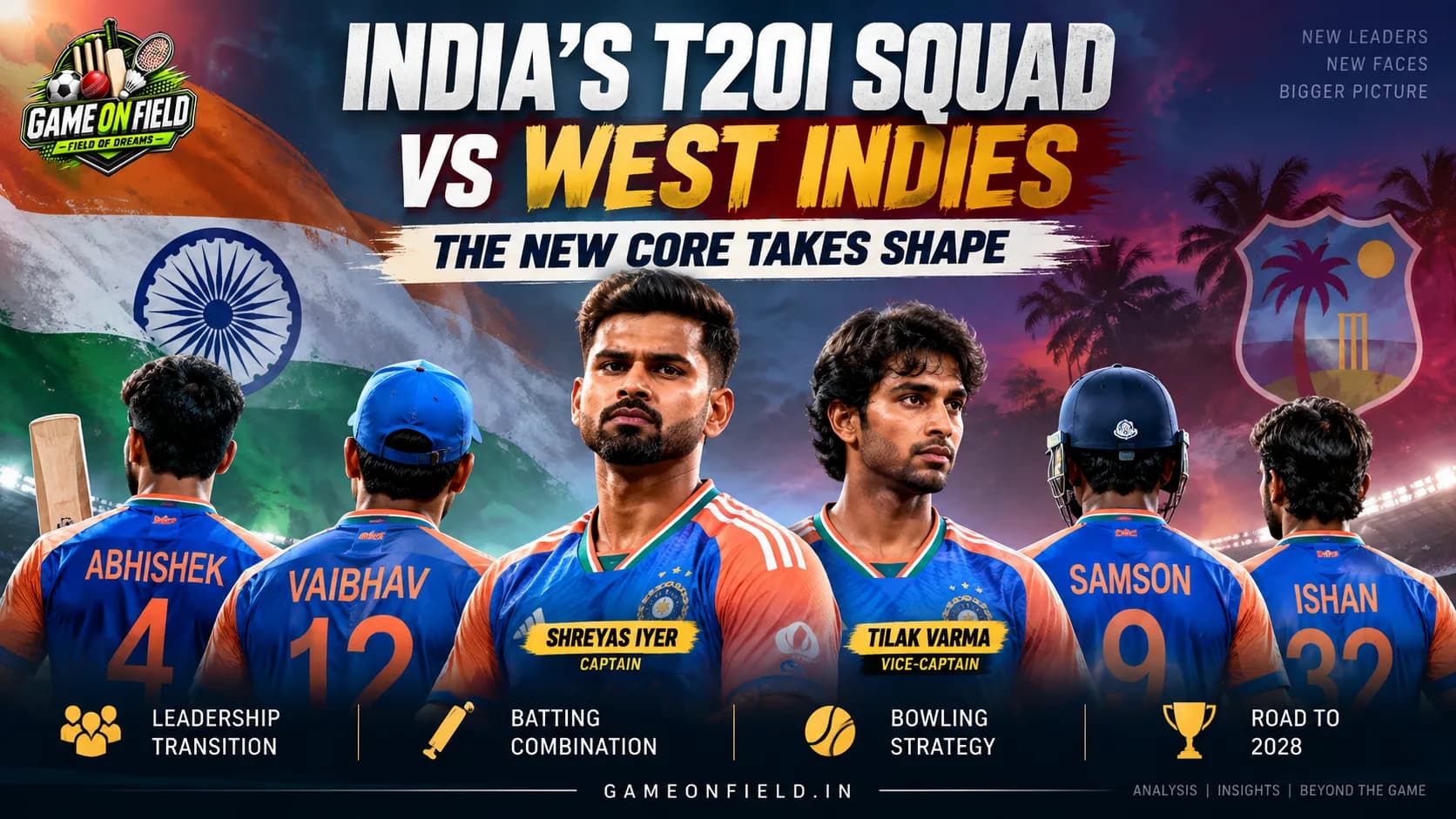
If the ODI squad against West Indies is about patching gaps in a settled side, the T20I squad represents something much bigger: a genuine changing of the guard.
Shreyas Iyer now leads the side, Tilak Varma is his deputy, while Suryakumar Yadav — the man who lifted the T20 World Cup as captain in March — isn't in the frame at all.
This isn't simply a tweak to the existing setup. It is the beginning of a four-year rebuild, with India's eyes already on defending the T20 World Cup title in 2028.
The squad tells us quite a bit about where Indian T20 cricket is heading — and, perhaps more importantly, which questions remain unanswered.
A Leadership Change That's Really a Statement
Shreyas Iyer's appointment isn't simply a reward for recent T20I performances. Instead, it represents a bet on his tactical record, including his IPL title-winning campaign with Kolkata Knight Riders and his experience of reaching finals with Punjab Kings.
Tilak Varma's elevation to vice-captain tells an even bigger story.
He has been placed ahead of more experienced names such as Axar Patel, signalling that India isn't just selecting players for the present. The selectors appear to be building around a core that can still be in its prime when the 2028 World Cup arrives.
But every succession plan comes with a cost.
That cost, in this case, is Suryakumar Yadav.
After a modest 2026 T20 World Cup and a quiet IPL season, Suryakumar has been left out of the current setup. He will be 38 by the next World Cup, making the transition easier to justify from a long-term perspective. Yet his proven big-game record remains a significant part of the equation.
India has effectively chosen to move away from an established leader and build around a younger leadership axis with more time to develop.
That is a major strategic decision.
The Batting: Power at the Top, Old Question Marks in the Middle
Abhishek Sharma and Vaibhav Sooryavanshi at the top give India plenty of intent from the very first ball.
Abhishek brings aggression and experience in the format, while Sooryavanshi remains one of the most closely watched young talents in Indian cricket.
For Sooryavanshi, every series is more than just another opportunity to score runs. It is also part of his development as India evaluates whether his extraordinary talent can translate consistently at international level.
Behind the openers, Tilak Varma now looks like the clearest long-term piece in the middle order.
He isn't simply another player being given an opportunity. The leadership role itself suggests that the selectors see him as part of the team's long-term structure.
The uncertainty begins after that.
Sanju Samson and Ishan Kishan provide two wicketkeeping options, but both can operate in similar batting positions.
That leaves India with a familiar question:
Who is the first-choice keeper-batter, and who becomes the backup?
A World Cup squad cannot keep rotating between options indefinitely. At some stage, India will need a clear hierarchy.
Then there is Shivam Dube.
His ability to provide power in the middle and lower order remains valuable, but his role now needs to be re-established. The batting structure has changed considerably, with Iyer and Tilak occupying positions previously associated with the likes of Suryakumar and Rohit.
The Gap
India has power at the top and a genuine long-term No. 3/4 option in Tilak, but the finishing positions remain an open competition. The No. 5, 6 and 7 combination is yet to develop a settled hierarchy.
The Bowling: A Spin-Heavy Blueprint for Home Conditions
The bowling combination gives away another important part of the selection strategy. It is unmistakably designed with Indian conditions in mind.
Kuldeep Yadav, Axar Patel, Washington Sundar and Ravi Bishnoi give India four frontline spin options.
For a five-match home series, that is arguably more spin depth than India actually needs. And that may be precisely the point.
These matches aren't only about winning the series. They provide the selectors with an opportunity to understand which combinations work together — and, more importantly, which spinners are most likely to travel when conditions become less spin-friendly.
India can experiment with two or three spinners here while building a clearer understanding of the pecking order.
The pace department is considerably more experimental.
Arshdeep Singh remains the closest thing India has to an established death-overs option.
Behind him, Prince Yadav and Mayank Yadav represent high-upside, high-pace investments rather than finished international products.
That is exactly the kind of experimentation a rebuilding team needs to conduct now.
If India can expose these players to international pressure early, they have more time to develop before the 2028 World Cup.
One major absence, however, changes how this bowling unit should be assessed.
Jasprit Bumrah is not part of the squad, with his workload being managed and the Asian Games taking priority. That means this series won't tell us much about India's first-choice pace attack when all its leading options are available.
Nitish Kumar Reddy: The Balance Piece India Is Still Developing
Nitish Kumar Reddy's inclusion is another important part of the bigger picture.
India continues to look for an all-rounder who can genuinely contribute across phases rather than simply fill a statistical role.
If Nitish can develop into a reliable seam option while contributing meaningful runs, he could solve one of India's longest-running balance problems.
The ideal T20 combination isn't just about having the best batters and bowlers. It is about having enough players who can perform multiple roles without weakening the XI.
Nitish potentially gives India that flexibility. But, at this stage, potential is still different from certainty.
The Gap
India has considerable spin depth, but the pace attack away from home remains a question.
Beyond Arshdeep, the death-bowling hierarchy is still largely untested, while the absence of Bumrah means this series cannot provide a complete picture of India's eventual first-choice attack.
The Big Picture: Three Questions on the Road to 2028
1. Can the Iyer-Tilak leadership axis deliver quickly?
New leadership appointments in Indian cricket rarely get unlimited time. Iyer and Tilak may have a long-term mandate, but results will still matter in the short term. Their biggest challenge will be balancing experimentation with the pressure to keep winning.
2. Who wins the keeper-batter race?
Sanju Samson and Ishan Kishan both bring international experience and batting ability.
But India eventually needs clarity. A World Cup squad requires a first-choice wicketkeeper to be established well before the tournament — not selected through endless rotation.
3. Which spinners travel best outside India?
Kuldeep, Axar, Washington and Bishnoi provide India with four different spin options. But a home series cannot fully answer how this group will perform in pace-friendly conditions. How the selectors use them now, however, could offer clues about the emerging pecking order.
Gameonfield's Stump Mic
This T20I squad is about more than the immediate series. The bigger story is India's attempt to build a settled core, establish new leadership and identify its next generation before 2028 arrives.
The biggest change isn't just the captain. It is the philosophy behind the selection.
India appears to be prioritising players who can form the core of the team through the next World Cup cycle rather than simply selecting the strongest possible XI for the present.
That comes with uncertainty.
The middle-order finishing roles aren't settled. The wicketkeeper position remains open. The pace attack lacks its biggest name. And the leadership combination of Iyer and Tilak has yet to prove itself over time.
But rebuilding is supposed to create questions before it creates answers.
This series won't settle all of them. No five-match bilateral against one opponent possibly can.
What it can do is provide India with five more opportunities to discover which combinations have the substance to survive beyond home conditions and eventually stand up on the biggest stage.
The 2028 World Cup may still be two years away. But India's T20I reboot has already begun.
Key Takeaways
- Shreyas Iyer takes over as T20I captain with Tilak Varma as his deputy, while Suryakumar Yadav — the 2026 T20 World Cup-winning captain — is left out entirely
- Abhishek Sharma and Vaibhav Sooryavanshi open, but the keeper-batter race between Sanju Samson and Ishan Kishan remains unresolved
- The bowling attack carries four frontline spinners (Kuldeep, Axar, Washington, Bishnoi) — more spin depth than a home series needs, hinting at pecking-order experimentation
- Jasprit Bumrah's absence, with workload management and the Asian Games taking priority, means this series can't reveal India's true first-choice pace attack
- This squad reflects a deliberate four-year rebuild toward the 2028 T20 World Cup, prioritising a settled long-term core over the strongest possible XI right now