

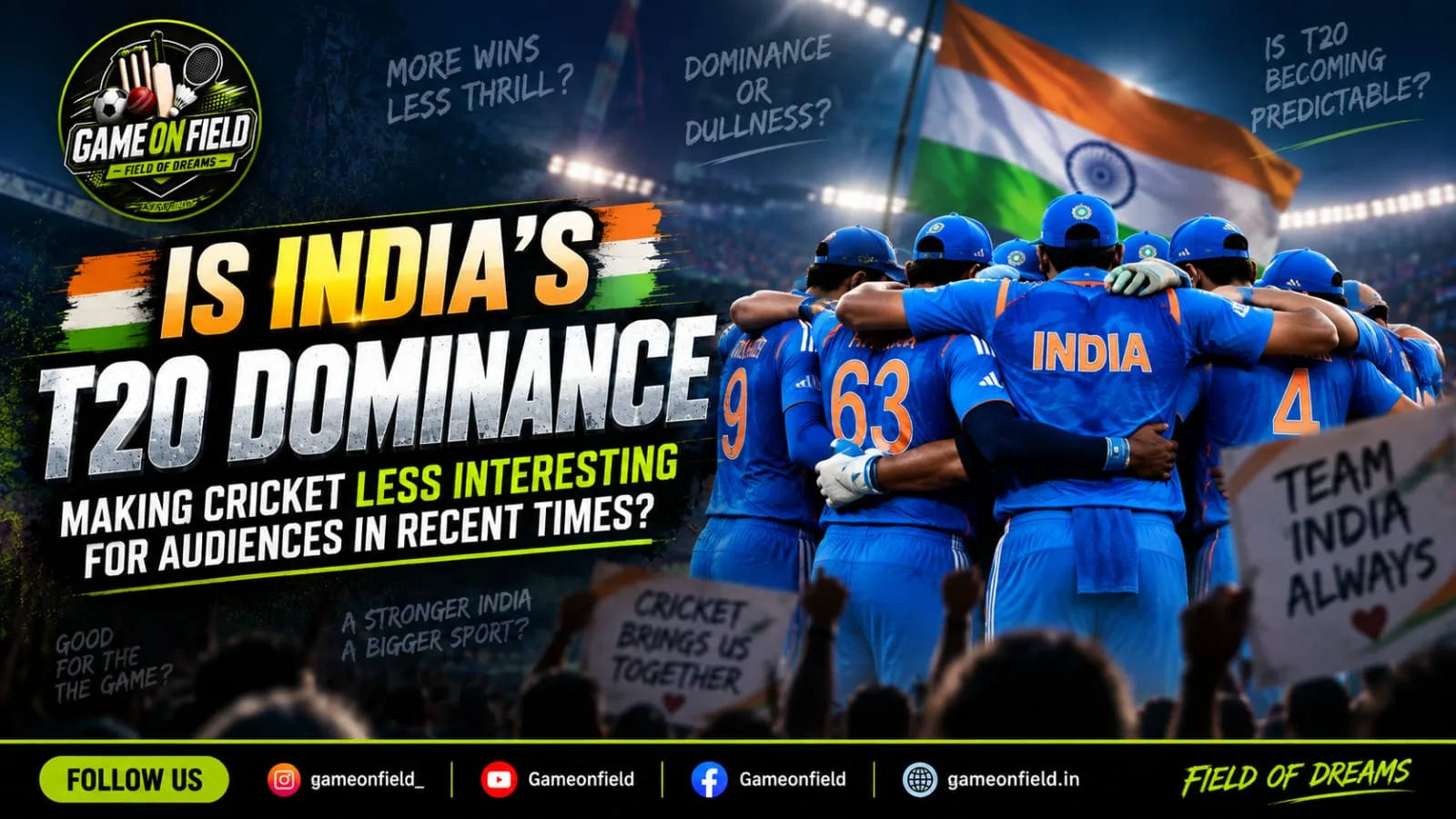
India's dominance has become one of the defining stories of modern T20 cricket. But as the Indian team continues to win major tournaments and dominate opponents, an interesting question has emerged: is India's success making T20 cricket less unpredictable—and therefore less interesting—for some audiences?
T20 cricket was built around uncertainty.
A match can change within a few deliveries. A team chasing 200 can collapse in ten minutes, while an apparently impossible target can suddenly become achievable through a couple of explosive overs.
That unpredictability is one of the biggest reasons T20 cricket became such a global phenomenon.
But what happens when one team becomes consistently better than most of its opponents?
India's recent success has brought this question into focus.
India's T20 Dominance Has Reached a New Level
India's recent achievements demonstrate just how strong the team has become in the shortest format.
At the 2026 ICC Men's T20 World Cup, India defeated New Zealand in the final by 96 runs and became the first team to successfully retain the men's T20 World Cup title.
India's success has also been supported by considerable depth.
The team can select from a huge pool of players capable of performing at international level, while the IPL continues to expose Indian players to high-pressure T20 cricket.
This creates a situation where India can replace established stars with younger players without necessarily experiencing a major decline in quality.
For Indian cricket, this is a positive development.
For the global T20 competition, however, it raises a different question: does a dominant team reduce the element of surprise?
Why Dominance Can Make Some Matches Feel Predictable
One of the biggest attractions of sport is uncertainty.
Fans want to believe that either team can win.
When one side repeatedly defeats its opponents, the competitive tension can sometimes decrease—particularly in bilateral series where there is less at stake than in a World Cup.
For a neutral viewer, an India match may feel less exciting if the expectation is that India will eventually control the game.
This does not mean the cricket itself is becoming poorer.
In fact, the opposite may be true.
India's performances often showcase extremely high levels of batting, bowling, athletic fielding and tactical planning.
The issue is not necessarily quality. It is competitive uncertainty.
A neutral fan may be more emotionally invested when the outcome remains unclear until the final few overs.
But There Is a Strong Argument Against the "T20 Is Becoming Boring" Theory
The audience numbers tell an important story.
The 2026 T20 World Cup generated record digital engagement. The ICC reported that the tournament had already surpassed the entire 2024 edition in total users and minutes watched before the knockout stage was completed. Unique users were up 28%, while total playtime had increased by 56% at that stage.
The India–England semifinal provided an even stronger example.
The match produced 499 runs and attracted 65.2 million peak concurrent viewers on JioHotstar, while generating 619 million views on the platform. The ICC described it as the most-streamed T20I match in history.
Those numbers make it difficult to argue that India's success has simply driven audiences away.
Instead, they suggest that India remains one of the biggest attractions in world cricket.
The IPL Provides Another Perspective
India's dominance in international T20 cricket should also be separated from the popularity of domestic T20 cricket.
The IPL remains a massive entertainment product.
According to JioStar, IPL 2026 reached more than 1.2 billion viewers, an increase of 7% from the previous season, while total watch-time reached 870 billion minutes.
This is significant because the IPL does not depend on India winning.
Fans support different franchises, players and rivalries.
An RCB vs CSK match, Mumbai Indians vs Kolkata Knight Riders contest or Rajasthan Royals vs Punjab Kings encounter can attract viewers regardless of which team eventually wins.
The franchise structure therefore provides something that bilateral international cricket sometimes lacks: multiple storylines and competing identities.
The Real Issue May Be T20 Saturation
Perhaps the bigger question is not India's dominance.
It may be the sheer amount of T20 cricket being played.
Fans now have access to international T20 series, the IPL, other franchise leagues and multiple ICC tournaments throughout the year.
When T20 cricket was relatively new, a 200-plus total could feel extraordinary.
Today, enormous scores and explosive batting performances are much more common.
That can create a different kind of fatigue.
Some viewers may not be losing interest in cricket itself. They may simply be becoming more selective about which matches they watch.
Recent discussion around IPL viewing has also pointed toward this possibility, with some observers describing audience fatigue caused by the volume of T20 cricket and increasingly high-scoring games.
Does India's Success Hurt Neutral Viewership?
This is where the debate becomes particularly interesting.
For Indian supporters, India's dominance can make matches more enjoyable.
Watching a strong team consistently produce excellent performances creates its own form of entertainment.
But neutral viewers may have a different perspective.
If India is playing a weaker opponent, the match can sometimes appear less competitive on paper.
On the other hand, India's popularity can actually increase interest in cricket in countries where the sport is still developing.
A recent example is Japan, where India is scheduled to play a historic T20I as part of efforts to grow cricket's profile in the country. Reuters reported that the fixture is Japan's first against a full ICC member and is being viewed as an important opportunity to introduce the sport to a wider audience.
So India's dominance can have two seemingly opposite effects:
It can reduce uncertainty for some neutral viewers while simultaneously attracting new viewers who want to watch one of cricket's biggest teams.
The Importance of Competitive Rivalries
For T20 cricket to remain compelling globally, strong rivalries are important.
India needs competitive opponents.
England, Australia, South Africa, New Zealand, Pakistan, West Indies, Sri Lanka and other teams all have the ability to produce high-quality T20 cricket.
Recent results also demonstrate that India is not permanently unbeatable.
In September 2026, England completed a 3–0 T20I series sweep against Sri Lanka and moved back to the top of the T20 rankings, replacing India.
That illustrates an important point: T20 cricket remains dynamic even when one team has enjoyed a particularly successful period.
Rankings, form and tournament results can change quickly in this format.
Star Players Also Keep T20 Cricket Interesting
T20 cricket is not only about teams.
It is also about personalities.
A young batter scoring an explosive hundred, a fast bowler producing a match-winning spell or an established superstar returning to form can become a major storyline.
India's enormous talent pool constantly creates new stars.
The recent emergence of players such as Abhishek Sharma and Vaibhav Sooryavanshi demonstrates how quickly the Indian T20 landscape can change.
Abhishek Sharma, for example, recently scored a 30-ball T20I century against Afghanistan, the fastest T20I century by an Indian batter.
These individual stories create fresh reasons for audiences to watch, even when the broader competitive landscape feels familiar.
So, Is India's T20 Dominance Making Cricket Less Interesting?
The answer depends heavily on the viewer.
For some neutral fans, repeated Indian victories may reduce the feeling of uncertainty—especially in matches where India enters as a clear favourite.
For Indian supporters, however, dominance can be part of the entertainment.
And the available audience data does not support the idea that India's success has caused a broad collapse in interest.
The 2026 T20 World Cup and IPL produced enormous audiences and record digital engagement.
Therefore, the more complicated conclusion is that India's dominance may affect the way some people experience T20 cricket, but it has not made the format universally less interesting.
The bigger challenge for T20 cricket may be maintaining novelty and competitive balance in an era where fans have access to an enormous number of matches.
What Could Make T20 Cricket More Exciting?
If T20 cricket wants to maintain long-term audience interest, several factors could help:
Gameonfield's Stump Mic
India's dominance is not necessarily a problem for T20 cricket.
In many ways, it is evidence of how strong India's cricket ecosystem has become.
The real challenge is ensuring that India's success exists alongside a competitive global cricket environment.
Fans ultimately want two things at the same time:
They want to see great cricket—and they want to believe that anything can happen.
India's dominance provides the first.
The future of T20 cricket will depend on whether the rest of the world can consistently provide the second.
And perhaps that is the real question for the next generation of T20 cricket:
Can India remain dominant while the global game becomes even more competitive?
Key Takeaways
- India retained the 2026 T20 World Cup, beating New Zealand by 96 runs in the final, becoming the first team to successfully defend the title
- The India-England semi-final produced 499 runs and 65.2 million peak concurrent JioHotstar viewers, the most-streamed T20I in history
- IPL 2026 reached over 1.2 billion viewers and 870 billion watch minutes, showing domestic T20 cricket doesn't depend on India winning
- England swept Sri Lanka 3-0 in September 2026 to retake the No.1 T20I ranking spot from India, proof the format remains competitive
- Audience data suggests India's dominance hasn't broadly hurt interest, but T20 saturation across multiple leagues may be the bigger long-term challenge