


Some fast bowlers announce themselves with noise. Mohammed Shami never needed to. His loudest statements were always made by a seam standing upright and a stump leaning backwards.
If I had to pick one day to explain what he meant to Indian Test cricket, I would take the third day at Centurion, 28 December 2021. India had put up 327 on a pitch where South Africa’s seamers had made every run feel expensive. The home side, on their own bouncy turf, were ready to bat India out of the contest.
Then Shami got the ball.
He bowled 16 overs, and five of them were maidens. He built pressure first and wickets second. Aiden Markram was bowled. Keegan Petersen was bowled. The ball kept landing on the same spot and asking the same hard question, and South Africa kept running out of answers. When Kagiso Rabada nicked one through to Rishabh Pant, it was Shami’s fifth wicket. Figures of 5/44 bundled South Africa out for 197 and gave India a 130-run lead. It was also his 200th Test wicket, which made him only the fifth Indian fast bowler to reach that mark.
India went on to win that Test. They won it because one man refused to let the day drift. Shami didn’t need rhythm or luck from the crowd. He had wrist position, seam control and patience, the three things that make Test bowling an art.
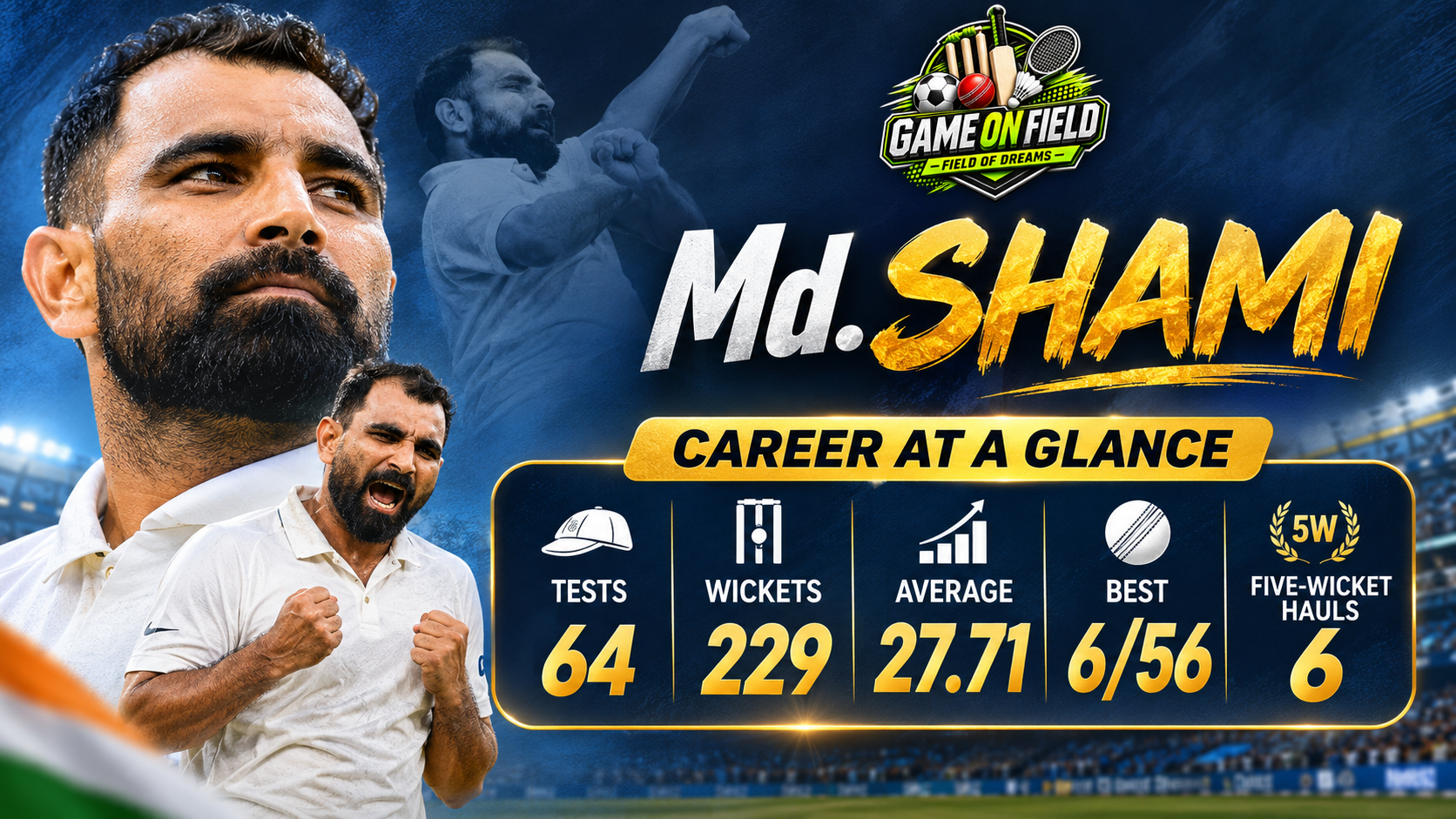
That is how Shami played the red-ball game. On 6 November 2026, thirteen years to the day after he took nine wickets on debut, he said goodbye to the white jersey. 229 wickets in 64 Tests is the number. The memory is that spell at Centurion, a quiet bowler making a very loud point.
The Debut: Nine Wickets at Eden Gardens
Every great career has a first page, and Shami’s was written at Eden Gardens, the home ground of his Bengal years. He debuted against West Indies in November 2013 and took 4/71 in the first innings and 5/47 in the second. That made nine wickets in the match and an innings-and-51-run win for India. Nobody had expected a debutant to bowl like a veteran. The surprise was the way he did it. He didn’t rely on raw pace or shouting. He had a wrist behind the ball and a seam that stayed wonderfully upright.
Perth 2018: The Afternoon the Pitch Belonged to Him
His career-best, 6/56, came at Perth in December 2018. It was a bouncy surface on which India had gone in with four fast bowlers. Shami had been wicketless in the first innings, then returned after lunch on day four with Australia comfortable at 190/4. In one afternoon he ran through them. Khawaja, Paine and Finch all fell in quick succession, and he was on a hat-trick after dismissing Paine and Finch off successive deliveries. When Lyon sliced him to deep point for the sixth wicket, Australia were all out for 243, having once been 190/4. He finished with 6/56 off 24 overs, eight of them maidens.
He also passed Anil Kumble’s record for the most Test wickets by an Indian bowler overseas in a calendar year, reaching 42. India lost the Test by 146 runs, but few bowling performances have deserved a better result.

The Art of Reverse Swing
This was Shami’s real gift. When the ball got old and scuffed, most bowlers lose their way. Shami started to find it. He angled the ball away from the batter, held his wrist behind the seam, and made it dip back late. The stumps were his target, and the ball kept finding them.
His 2019 shows how good he could be. He took 33 wickets in 8 Tests at an average of 16.66. That is the kind of number you expect from a bowler who has worked the old ball out completely, and he was doing it away from home as well.
The Man Who Showed Up When India Needed Him
Mohammed Shami was one of those players who put his hand up first, and you could see it on the days when India had the least going for them. He did it in two ways: with the ball when the match was stuck, and with a bat when the match was slipping away.
Lord’s, 2021, is the best example. It was the fifth morning, and England were marginal favourites. India led by 154 with four wickets in hand, and Rishabh Pant’s early dismissal made a fightback look unlikely. Shami walked out with Jasprit Bumrah and decided not to defend. The two tailenders added an unbeaten 89 for the ninth wicket, with Shami finishing on 56 and Bumrah on 34. Shami’s 56 was a Test best for him, and England’s bowlers, who kept pitching short, couldn’t shift the pair. India declared at 298/8 and set a target of 272. England then folded for 120, and India won by 151 runs.
A fast bowler had batted like a frontline player, and the whole team followed his lead. He did the same for India with the ball. That is the Shami we should remember: a man who carried the flag when it mattered most.
Thank You, Shami
He last played Test cricket in the 2023 World Test Championship final against Australia. In the years since, the selectors moved on, even as he kept bowling well in domestic cricket for Bengal. He chose to leave quietly, with a farewell note about the white jersey and the memories attached to it. He has said he is not retiring from cricket altogether, so white-ball India, Bengal and the IPL will still see him.
To Test cricket, Shami gave 229 wickets in 64 matches and six five-wicket hauls. To the Indian fan he gave something harder to count: the feeling that whenever the ball was old and the match was stuck, he could still change it. Thank you, Shami, and thank you for every upright seam.
Gameonfield's Stump Mic
Picture the stump mic at the end of a long day, with the ball old, the first innings wicketless and the captain looking at Shami.
“Come on, Lala. One more spell.”
They called him “Second-Innings Shami,” and it fits. He could go a whole first innings without a wicket, then come back with the ball scuffed and the afternoon heavy and turn the match around. Perth showed it. It takes patience to keep running in when the wickets aren’t coming, and not many bowlers have it.
The question I keep asking is who carries that old-ball art for India now. Bumrah, Siraj and the young seamers each bring something different. But the quiet skill of making a worn ball talk is something you have to see and be taught, and I hope someone is learning it.
For Shami, though, this isn’t a goodbye. He says he isn’t leaving the game, so the IPL, Bengal and white-ball India will still see him. The white jersey is folded, the red ball is done, and the man is still bowling.
Keep running in, Lala. We’re still watching.
Test cricket will have faster bowlers and louder celebrations. It will be harder to find another one who made an old ball sound like a conversation, where every delivery asked a question and the last one answered it.
Shami has put the white jersey away, but the stumps remember him. They always leaned back first.
Thank you, Lala. From all of us at gameonfield.
Key Takeaways
- Shami’s best session was a match-turner, not just a stat. At Centurion in 2021 he took 5/44 in 16 overs, reached his 200th Test wicket and gave India a 130-run lead. His impact came from what the spell did to the match.
- He started big and finished with a solid record. After nine wickets on debut at Eden Gardens, he ended with 229 wickets in 64 Tests, six five-wicket hauls and a best of 6/56 at Perth.
- His exit was quiet, but his career isn’t over. He retired from Tests on the 13th anniversary of his debut and is expected to keep playing white-ball cricket, the IPL and Bengal matches
- Reverse swing was his real gift. He made the old ball work for him, and in 2019 he took 33 wickets in 8 Tests at 16.66.