


There are series where a team wins by dominating, and there are series where a team wins by surviving. So far, India's 2-0 lead in New Zealand belongs firmly to the second kind. Two matches, two rain interruptions, two Duckworth-Lewis-Stern finishes, and not a single easy afternoon. Now the tour moves to Seddon Park, Hamilton, on Tuesday, 10 November, and India stand one win away from an unassailable 3-0 lead in a five-match series.
That is the headline. But the real story of this ODI series is how India got here, and whether the way they have won so far is repeatable.
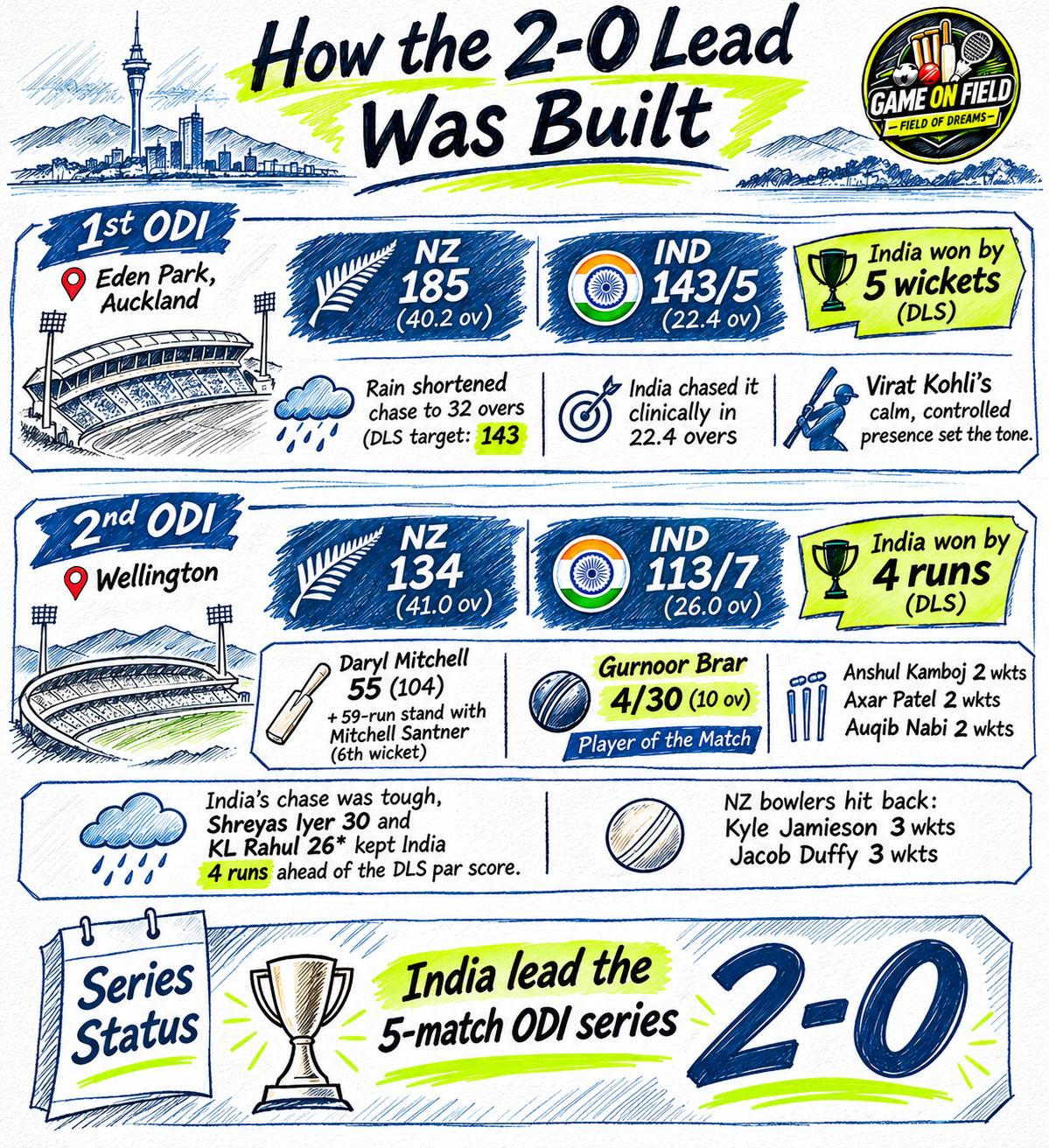
How the 2-0 Lead Was Built
In the first ODI at Eden Park, India's bowlers did the early damage and bundled New Zealand out for 185 in 40.2 overs. Rain then shortened India's chase to 32 overs with a DLS target of 143, and India got there with five wickets in hand, finishing on 143/5 in 22.4 overs. It was a clinical chase, and Virat Kohli's calm, controlled presence at the crease made the rest of the batting look rushed by comparison.
The second ODI in Wellington was a very different kind of contest. The pitch gave the bowlers help, the scoreboard crawled, and batters on both sides were forced into low-percentage shots. New Zealand were dismissed for 134 in 41 overs. Daryl Mitchell's 55 (104) was the backbone, and his 59-run stand with captain Mitchell Santner for the sixth wicket briefly pulled the innings past 100. Then Gurnoor Brar broke the partnership and finished with a career-best 4/30 from his 10 overs, earning Player of the Match. Anshul Kamboj, Axar Patel and Auqib Nabi took two wickets each.
India's chase was far from smooth. Kyle Jamieson and Jacob Duffy both picked up three wickets, and India were 113/7 after 26 overs when rain ended the match. Shreyas Iyer's 30 and KL Rahul's unbeaten 26 kept India four runs ahead of the DLS par score. Four runs. That is the margin between a 2-0 lead and a 1-1 series.
The way India's bowlers have used the conditions in both matches is hugely praiseworthy. They hit the right lengths, used the seam movement and bounce better than the hosts, and gave the batters very little to work with. At the same time, we should not draw big conclusions yet. Two matches make a very small sample, and both were played on helpful, bowler-friendly surfaces. Until India's bowlers are tested on a flatter pitch or against a set batting line-up, this is a promising start rather than a final verdict.
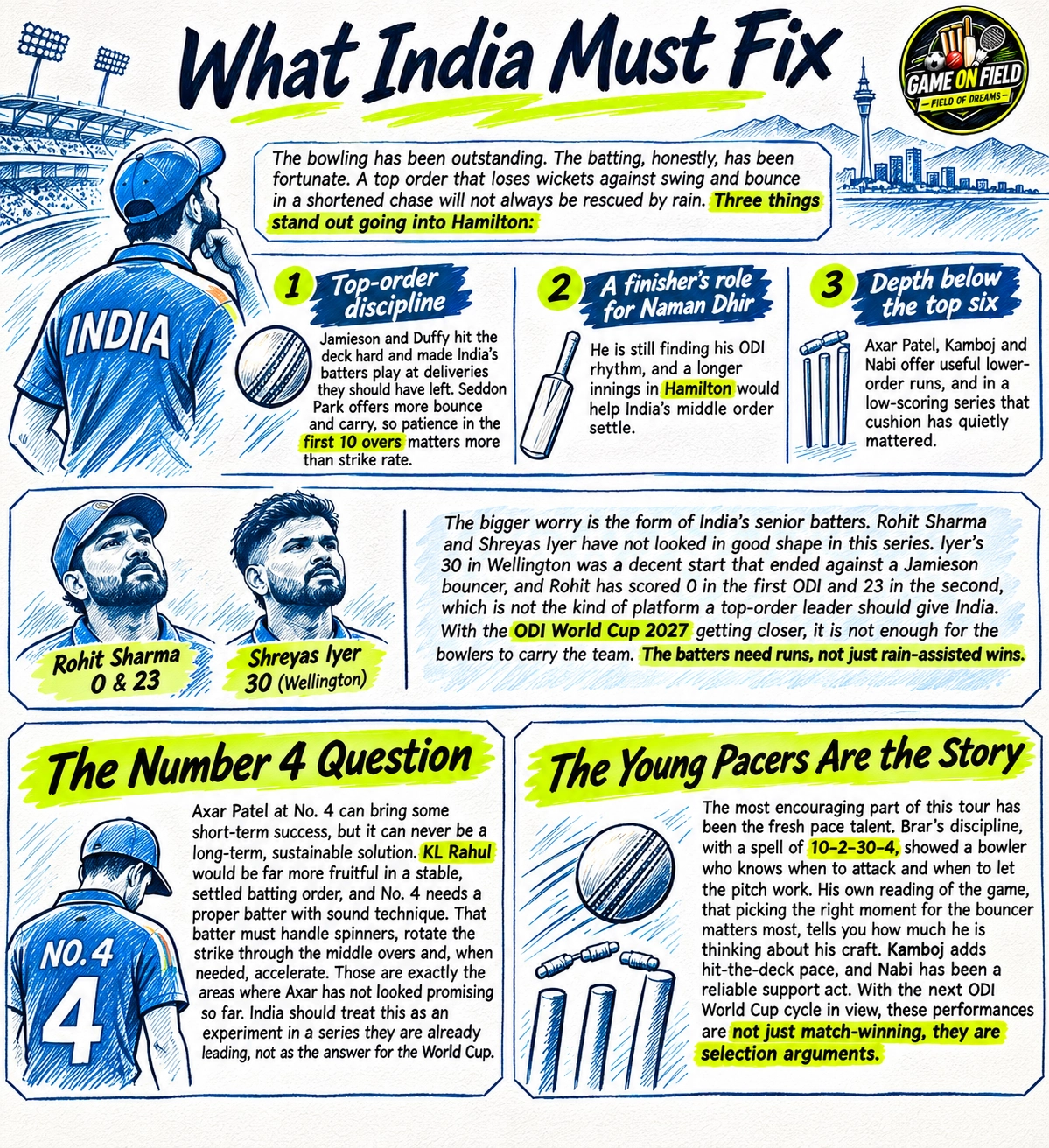
What India Must Fix
The bowling has been outstanding. The batting, honestly, has been fortunate. A top order that loses wickets against swing and bounce in a shortened chase will not always be rescued by rain. Three things stand out going into Hamilton:
- Top-order discipline. Jamieson and Duffy hit the deck hard and made India's batters play at deliveries they should have left. Seddon Park traditionally offers a little more bounce and carry, so patience in the first 10 overs matters more than strike rate.
- A finisher's role for Naman Dhir. He is still finding his ODI rhythm, and a longer innings in Hamilton would help India's middle order settle.
- Depth below the top six. Axar Patel, Kamboj and Nabi offer useful lower-order runs, and in a low-scoring series that cushion has quietly mattered.
The bigger worry is the form of India's senior batters. Rohit Sharma and Shreyas Iyer have not looked in good shape in this series. Iyer's 30 in Wellington was a decent start that ended against a Jamieson bouncer, and Rohit has scored 0 in the first ODI and 23 in the second, which is not the kind of platform a top-order leader should give India. With the ODI World Cup 2027 getting closer, it is not enough for the bowlers to carry the team. The batters need runs, not just rain-assisted wins.
The Number 4 Question
Axar Patel at No. 4 can bring some short-term success, but it can never be a long-term, sustainable solution. KL Rahul would be far more fruitful in a stable, settled batting order, and No. 4 needs a proper batter with sound technique. That batter must handle spinners, rotate the strike through the middle overs and, when needed, accelerate. Those are exactly the areas where Axar has not looked promising so far. India should treat this as an experiment in a series they are already leading, not as the answer for the World Cup.
The Young Pacers Are the Story
The most encouraging part of this tour has been the fresh pace talent. Brar's discipline, with a spell of 10-2-30-4, showed a bowler who knows when to attack and when to let the pitch work. His own reading of the game, that picking the right moment for the bouncer matters most, tells you how much he is thinking about his craft. Kamboj adds hit-the-deck pace, and Nabi has been a reliable support act. With the next ODI World Cup cycle in view, these performances are not just match-winning, they are selection arguments.
Key Battles to Watch
Gurnoor Brar vs Daryl Mitchell: Mitchell is the Black Caps' most dependable batter this series, and Brar has already shown he can unsettle left-handers and right-handers alike. If Brar gets Mitchell early, New Zealand's innings loses its anchor.
Kyle Jamieson vs India's top order: Jamieson's extra bounce took out Iyer in Wellington. Against a batting line-up that has been tested rather than dominant, he is New Zealand's best chance to turn the series around.
Virat Kohli vs the new ball: When Kohli bats through the first powerplay, India's whole innings changes shape. His Eden Park innings showed exactly why.
Mitchell Santner's captaincy: With the series slipping away, will Santner gamble with attacking fields early, or lean on spin to slow the game down?
What to Expect
New Zealand are the home side and have been unlucky with conditions, but India's bowling attack is the best-balanced unit on view. If the match goes the full distance, we expect India's bowlers to again hold New Zealand to a total in the 200s and the batters to do just enough. India to win and take a 3-0 lead, with the series decided before the fourth ODI at Bay Oval on 13 November.
One caution: India have been lucky to win both games, and a team that relies on DLS luck eventually runs out of it. A full 50-over contest will tell us whether this India side is genuinely a series winner or just a good survivor.
Conditions and Rain
Three things have defined this series so far: seam movement, slow scoring and weather. Both completed matches were shortened or decided by DLS, so toss strategy and a clear read of the forecast are as important as the XI itself. In a rain-affected game, the side that understands the par score better will usually win. Captains on both sides will be watching the sky as closely as the pitch.
There is a bigger point here too. With both matches rain-affected, this is not a great series for preparing for the ICC World Cup 2027. Shortened chases and DLS targets do not test a batting line-up the way a full 50-over contest does, and they hide problems that a complete game would expose.
Gameonfield's Stump Mic
- Two matches, two DLS results. India are the only team that has needed a calculator to celebrate.
- Gurnoor Brar's figures of 10-2-30-4 mean he has already stolen the show from everyone with a famous surname.
- Kyle Jamieson is the tallest reason India's top order keeps checking the weather app.
- If Hamilton produces a full 100 overs, someone should check the sky for a rain delay in disguise.
Do you think India can seal the series in Hamilton? Tell us in the comments.
Key Takeaways
- 1. India lead 2-0, but both wins were narrow DLS results.
- 2. The bowling has been excellent, though two matches is a small sample.
- 3. The batting is a concern, with Rohit (0 and 23) and Iyer out of form
- 4. No. 4 needs a specialist rather than Axar as a long-term fix.
- 5. Rain-hit games are poor preparation for World Cup 2027.