

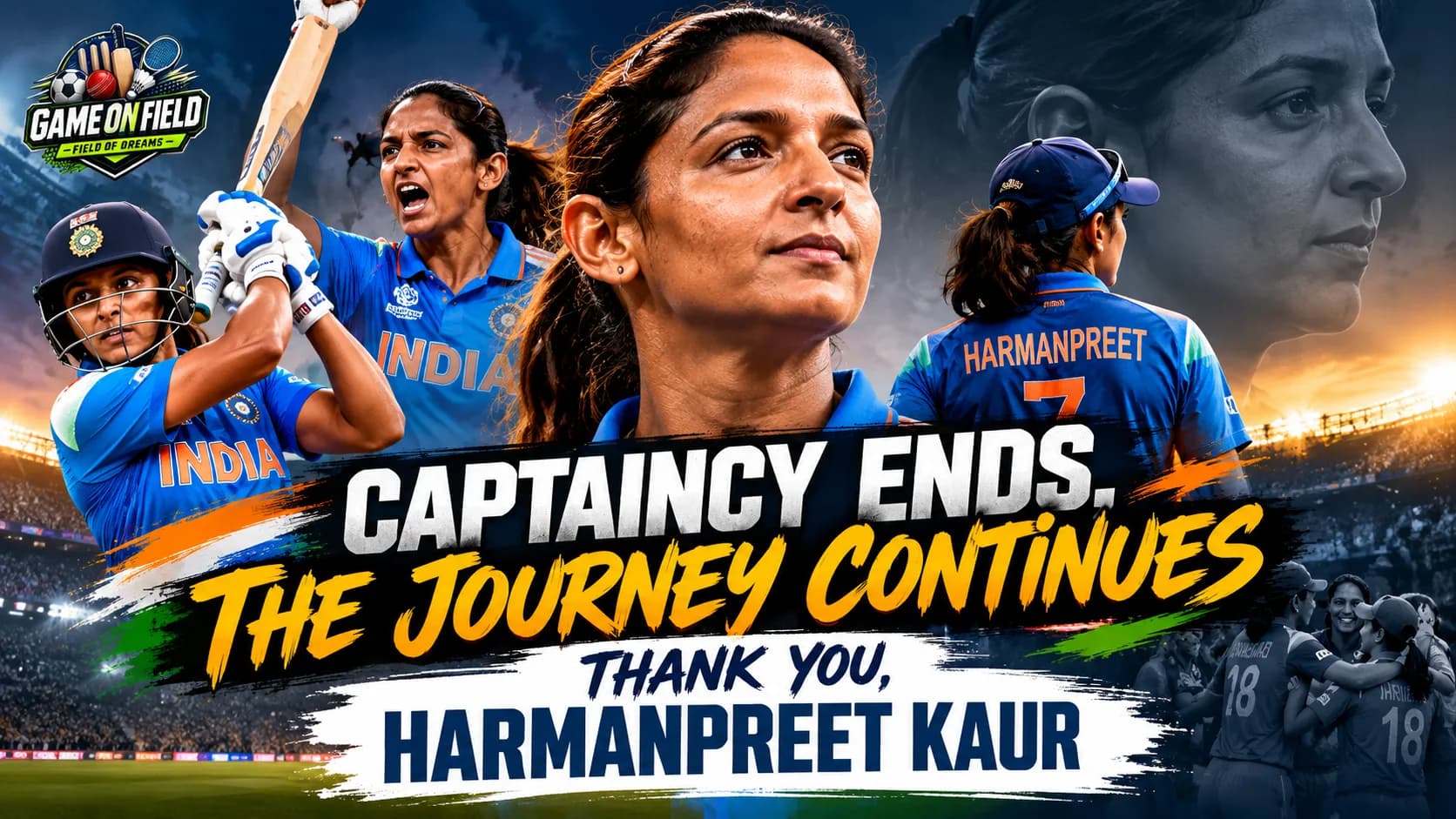
Some moments in cricket arrive without noise. There is no collapse, no sacking, no dramatic press conference. On Tuesday, October 6, Harmanpreet Kaur stepped down as India's women's captain across all three formats, just days after leading the side to a second consecutive Asian Games gold. She chose her own moment and her own words. For a player who has spent her career forcing the game to bend to her will, that feels exactly right.
At Gameonfield, we want to mark the end of one of the most consequential leadership eras Indian cricket has seen. We want to look at what she said, revisit the three innings that define her, and say what every Indian cricket fan should say: thank you.
The Announcement
Harmanpreet's decision came after a BCCI review meeting in Guwahati assessing the team's direction over recent months. She announced it herself on Instagram, and the tone of her message was not bitter or defensive. It was reflective, even peaceful.
She began plainly: "This is not an easy decision." She spoke of years of memories, emotions and sacrifices that will stay with her for life. She then said something that deserves attention from anyone who has ever criticised a captain from the stands. There were times, she explained, when she set aside her own performance and growth because the team had to come first.
That is the quiet cost of captaincy that scorecards never show. A captain's runs are judged more harshly, her failures are amplified, and her tactical calls are dissected by every former player with a microphone. Harmanpreet carried that for a decade in T20Is and for four years in ODIs, and she never stopped batting like a match-winner.
She also addressed her critics, in the most dignified way possible. Decisions, she said, were not always understood or easy, and sometimes came at personal cost. But each one was made to improve the team and give other players the chance to grow and believe in themselves. Anyone who has watched the rise of Shafali Verma, Jemimah Rodrigues, Richa Ghosh, Renuka Singh and Deepti Sharma over this period can see that this is more than a defence. It is a record.
Her closing line was the most memorable: "Captaincy ends. The journey continues." Elsewhere in her message she said she was ready to play for the love of the game again. The sentence tells us two things. She is not retiring, and she is not leaving with bitterness. She is handing over the armband and keeping the bat.
The Legacy in Numbers and Moments
Harmanpreet took over the T20I side in 2016, then became ODI captain in 2022 after Mithali Raj's retirement, and all-format leader in 2023. Across her tenure she led India in five Tests, 51 ODIs and 155 T20Is. She became the first cricketer to captain a side in 150-plus T20Is, a figure that took her past Dhoni and Rohit Sharma on that count.
Her record includes a historic Test win over Australia in 2023, a breakthrough T20I series victory in England in 2025, a record-breaking Test victory over England at Lord's, and consecutive Asian Games gold medals. Above all, it includes the 2025 ODI World Cup title, the trophy that generations of Indian women cricketers dreamed about and that Mithali, Jhulan and others came agonisingly close to winning. Harmanpreet's India finally did it.
Critics will point to the T20 World Cup exits, and that is fair. Two successive tournaments without a knockout place is a real blemish, and the questions about middle-overs batting and team selection were legitimate. A fair assessment keeps both truths in view. She was not a perfect tactician, but she was a transformational leader who changed what the team believed about itself.
Her Top 3 Innings
Picking three innings from a career this long is nearly impossible. These are the ones that, for us, tell her story best.
1. 171* vs Australia, 2017 World Cup Semi-Final, Derby
If you ask any cricket fan to name one Harmanpreet innings, this is the one. Chasing a big total, India were in trouble at 35 for 2 against a formidable Australian attack. What followed was among the greatest innings in the history of women's cricket.
She came out swinging. She hit 171 not out off just 115 balls with 20 fours and seven sixes, taking India to a total of 281 in a rain-shortened match. She played shots that women's cricket had rarely seen at the time, lofted drives over the bowlers' heads and clean pulls into the stands. Australia, the seven-time champions, had no answer.
The numbers are remarkable, but the real impact was cultural. That innings brought women's cricket into living rooms across India. It turned Harmanpreet into a household name. Many of the young girls who picked up bats after that summer are now playing for India. Without Derby, there is no 2025 trophy. It was the innings that began everything.
2. 103 off 51 balls vs New Zealand, 2018 T20 World Cup, Guyana
Ask a T20 purist and they will probably point here. India's opening game at the 2018 tournament in the West Indies saw Harmanpreet become the first Indian, man or woman, to score a T20I century.
She reached three figures in only 51 balls, with a combination of power and timing that made the New Zealand bowlers look helpless. Eight fours and seven sixes later, she had set up a commanding win and sent a message to the whole field. This Indian team could dominate the shortest format.
What made this innings special is how it showed her range. Derby was a patient build that exploded in the final overs. Guyana was explosive from the start. She could pace an innings in whatever way the situation demanded, and that adaptability is the mark of a truly great batter.
3. 89 vs Australia, 2025 World Cup Semi-Final, Navi Mumbai
Our third choice is a fascinating one, because it is not a century. In the 2025 semi-final, India faced a daunting target of 339 against Australia, the same opponent from Derby eight years earlier. Many fans remember Jemimah Rodrigues's unbeaten hundred, and rightly so. But the foundation was laid by the captain.
Harmanpreet's innings of 89 was a masterclass in controlled aggression, built on judgement rather than pure power. At 37, she was no longer the explosive hitter of 2017, but she was a smarter and more complete batter. She rotated strike, punished loose balls and kept the required rate in check while Jemimah settled at the other end. Her partnership with Jemimah turned a seemingly impossible chase into a famous victory.
This innings also captures what she did as a captain. She understood that sometimes leading means building a platform so someone else can finish. A younger Harmanpreet might have tried to win the match alone. The older one trusted her partner and her own planning. India won, and a few days later they were world champions.
What Comes Next
The immediate question is who takes over. Smriti Mandhana is the widely expected successor. She has served as deputy for years, has already captained India in Harmanpreet's absence, and has leadership experience in franchise cricket. We have not yet seen an official BCCI announcement, so we will wait for that confirmation. Still, if the armband does go to Mandhana, it will be a smooth transition between two players who understand each other well.
The more interesting question is what a captaincy-free Harmanpreet looks like. Some of her best batting came in moments when the burden was lightest. Freed from the daily weight of selection meetings, press conferences and tactical planning, she may rediscover the fearless hitting that made the world sit up in 2017. If so, the next few years could produce some of her most entertaining cricket. She can still be a mentor in the dressing room, with all that experience at Mandhana's disposal.
For the team, the lesson is that a leadership change does not have to be a crisis. The squad is deep, the core players are in their primes, and the culture Harmanpreet built, one that believes it can beat Australia and England anywhere, will outlast her tenure. That may be her most valuable contribution of all.
Thank You, Captain
Let us end where this should end, with gratitude.
Thank you, Harmanpreet, for Derby, for the innings that made a nation watch women's cricket. Thank you for the courage to back young players when it would have been easier to rely on the familiar. Thank you for carrying a decade of expectation without ever hiding from it. Thank you for the World Cup trophy, the Test victories, the Asian Games gold medals and every night we stayed up past our bedtimes to watch you bat.
Thank you also for the way you leave. You have not disappeared or been pushed out. You have stepped aside on your own terms, after a gold medal, with a smile and a bat still in your hand. That is a captain's farewell in the truest sense.
Captaincy may end today. But for those of us who love this game, the journey, and the watching, continues.
What is your favourite Harmanpreet innings? Tell us in the comments, and follow Gameonfield for more cricket analysis and tributes.
Key Takeaways
- Harmanpreet Kaur stepped down as India's captain across all three formats on October 6, days after a second consecutive Asian Games gold
- She led India in 5 Tests, 51 ODIs and 155 T20Is, becoming the first cricketer to captain a side in 150+ T20Is
- Her tenure delivered the 2025 ODI World Cup, a Test win over Australia, a Test win at Lord's, and back-to-back Asian Games gold medals
- Her defining innings span 171* vs Australia (2017), 103 off 51 vs New Zealand (2018), and 89 vs Australia in the 2025 World Cup semi-final
- Smriti Mandhana is the widely expected successor as captain, pending official BCCI confirmation