

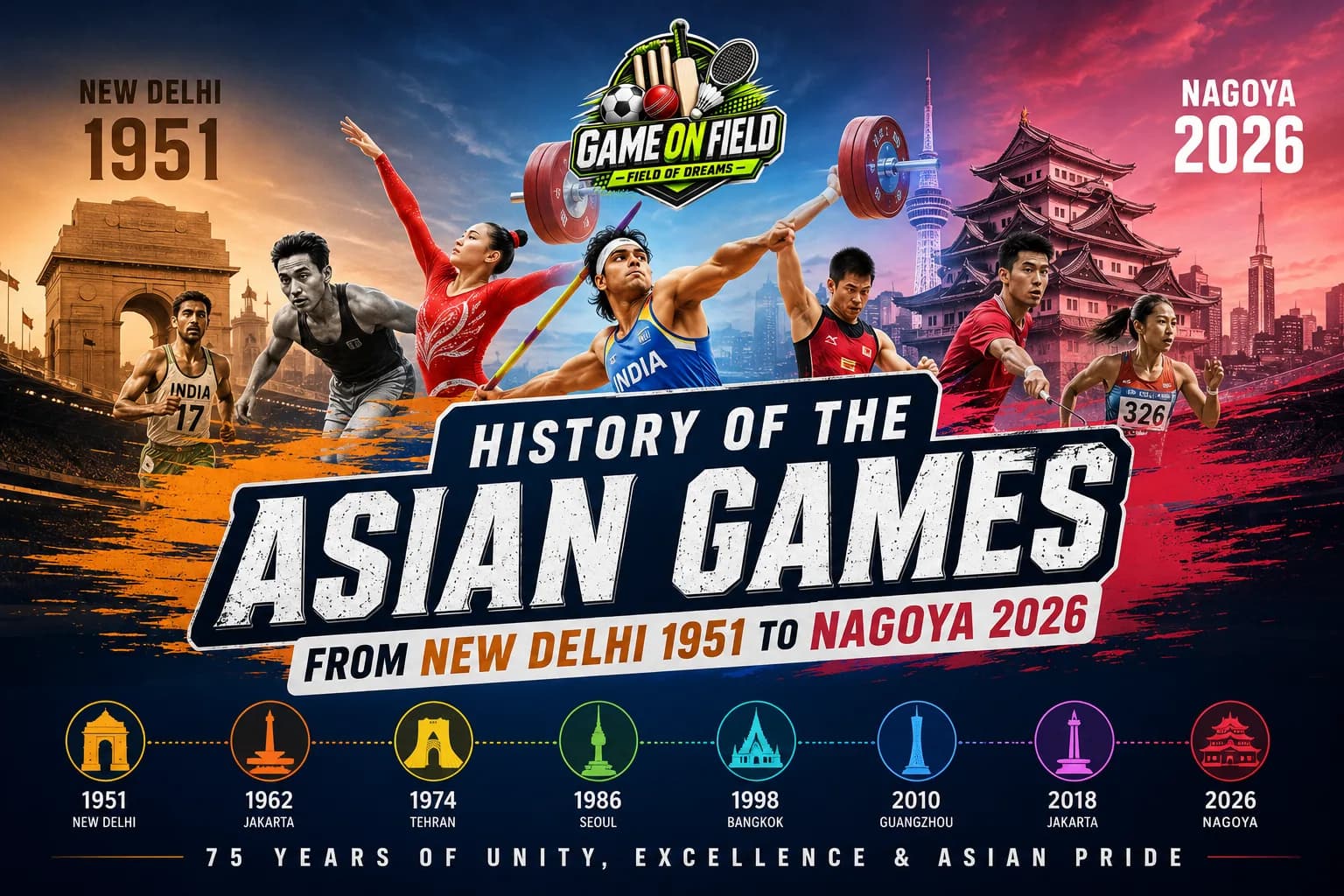
Every four years, thousands of athletes from across the continent gather for the Asian Games — the world's second-largest multi-sport event after the Olympics. As the 20th edition prepares to open in Aichi-Nagoya, Japan on September 19, 2026, it's worth looking back at how a modest gathering of 11 nations in New Delhi grew into a 46-nation, 43-sport spectacle that now even crowns esports champions.
Check Full Asian Games 2026 Coverage
The Idea Before the Games
The roots of the Asian Games actually stretch back further than 1951. Between 1913 and 1934, Asian nations competed in the Far Eastern Championship Games (sometimes called the "Oriental Olympics"), but political tensions between Japan and China, followed by the Second World War, brought that competition to an end.
The modern Asian Games movement began to take shape in the aftermath of the 1948 London Olympics, where Indian IOC representative Guru Dutt Sondhi proposed a more inclusive regional competition. In February 1949, delegates meeting in New Delhi established the Asian Games Federation, with Maharaja Yadavindra Singh of Patiala as its first president and Sondhi as secretary. The group settled on a sun-and-rings emblem and Jawaharlal Nehru's motto, "Ever Onward," to represent the new movement.
New Delhi 1951: A Games Built From Scratch
Organizing the first Games was far from smooth. India had no stadium, no cinder track, and no real budget to work with, and the event was pushed back a full year from its original 1950 date. Sondhi himself resigned from the organizing committee six months before the Games under the financial strain, and it fell to Anthony de Mellow and Sheri Dhawan to get the National Stadium (today's Dhyan Chand National Stadium) ready in time.
Despite the chaos, the First Asian Games opened on March 4, 1951, with 489 athletes from 11 nations — Afghanistan, Burma, Ceylon, India, Indonesia, Iran, Japan, Nepal, the Philippines, Singapore, and Thailand — competing in six sports. Japan, competing internationally for the first time since the war, dominated the medal table.
Finding a Rhythm: 1954–1980s
From the second edition in Manila (1954) onward, the Games settled into their now-familiar four-year cycle. Over the following decades, the event steadily expanded — more nations joined, more sports were added, and host cities grew more ambitious. Japan's continued strength through this era, along with the rise of countries like South Korea, began to reshape the medal tables.
A major structural shift came in 1982, when the Olympic Council of Asia (OCA) was formed to take over governance of the Games from the original Asian Games Federation — the body that still runs the Games today.
Going Bigger: Beijing to Guangzhou
By the time Beijing hosted in 1990, the Asian Games had become a genuine showcase event, comparable in scale and ambition to an Olympics. China's rise as a sporting powerhouse tracked closely with the Games' own growth. Guangzhou 2010 pushed the event to a new scale altogether, hosting what was then the largest edition in the Games' history in terms of participating nations and events — a record that later editions would continue to chase.
The Digital Turn: Jakarta-Palembang and Hangzhou
The Games began experimenting with esports at the 2018 Jakarta-Palembang edition, where competitive gaming appeared as a demonstration sport. That experiment paid off at Hangzhou, where — after a pandemic-forced delay pushed the 2022 Games to September–October 2023 — esports made its debut as a full medal event. Seven titles, including Dota 2, League of Legends, and PUBG Mobile, were contested at a purpose-built esports center, drawing nearly 500 athletes from 30 nations and cementing gaming's place as a mainstream Asian sport.
Hangzhou also marked China's return as host for the first time since Guangzhou in 2010, and it leaned heavily into digital technology and broadcast innovation to mark the occasion.
Aichi-Nagoya 2026: Japan's Third Time Hosting
Which brings the story to Nagoya. When the 20th Asian Games open this September, Japan will become just the third country to host a Games on home soil more than once at the city level within Asia's rotation — Nagoya follows Tokyo (1958) and Hiroshima (1994) as Japanese host cities, marking 32 years since Japan last staged the event.
Aichi-Nagoya 2026 will also be paired for the first time with the Asian Para Games hosted in Japan, running afterward in October. Around 46 nations and roughly 15,000 athletes and officials are expected, competing across 43 sports — a scale that would have been unimaginable to the organizers scrambling to finish a stadium in Delhi 75 years earlier.
India's Journey: Host, Founder, and Rising Powerhouse
India's relationship with the Asian Games is unlike any other nation's — it didn't just compete in the first edition, it helped create the whole movement. Guru Dutt Sondhi's proposal at the 1948 London Olympics and the founding of the Asian Games Federation in New Delhi in 1949 made India a co-architect of the Games before a single event was contested.
That involvement paid off immediately. At New Delhi 1951, India finished second on the medal table behind Japan, taking home 51 medals — 15 gold, 16 silver, and 20 bronze. It remains India's best-ever finishing position at the Games. Swimmer Sachin Nag became India's first-ever Asian Games gold medallist in the 100m freestyle, while Roshan Mistry took silver in the 100m sprint to become the first Indian woman to medal at the event.
For decades afterward, India's medal counts settled into a more modest, athletics-and-wrestling-driven pattern, even as the Games themselves grew larger around it. That changed sharply in the 21st century, as expanded shooting, archery, and athletics programs — along with growing corporate and government investment in Olympic sports — began translating into bigger hauls.
The breakthrough arrived at Jakarta-Palembang 2018, where India won a then-record 70 medals (16 gold), highlighted by Neeraj Chopra's javelin gold — the first time an Indian had won the event — and Dutee Chand's 100m medal, India's first in the women's sprint since P.T. Usha in 1982.
India smashed that record at Hangzhou 2023, finishing with an all-time-high 107 medals (28 gold, 38 silver, 41 bronze) — becoming only the fourth nation in Asian Games history to cross the 100-medal mark, and finishing fourth overall in the standings. Shooting was the single biggest contributor with 22 medals (seven gold), while athletics added 29 medals across the board. Neeraj Chopra successfully defended his javelin title, this time finishing 1-2 with teammate Kishore Kumar Jena in a historic Indian sweep. The Games also delivered several firsts for India: a gold for the women's cricket team on its Asian Games debut, an equestrian gold after a 41-year wait, and a men's squash team title over Pakistan.
| Edition | Total Medals | Gold |
|---|---|---|
| New Delhi 1951 | 51 | 15 |
| Jakarta-Palembang 2018 | 70 | 16 |
| Hangzhou 2023 | 107 | 28 |
With that momentum — and India's rise as a shooting, athletics, and archery powerhouse — the Indian contingent heads into Aichi-Nagoya 2026 aiming to push past the 100-medal mark for a second straight edition.
Why the History Matters
From a cash-strapped debut with six sports to a continental festival spanning traditional athletics, sailing, and competitive gaming, the Asian Games' evolution mirrors Asia's own transformation over the past seven decades — economically, politically, and culturally. As Nagoya prepares to welcome the world's second-largest sporting event, it's carrying forward a tradition that started with a sun-shaped emblem, eleven nations, and a promise to go "Ever Onward."
Gameonfield's Stump Mic
The 2026 Asian Games run from September 19 to October 4 in Aichi Prefecture and Nagoya, Japan, followed by the Asian Para Games from October 18–24.
Key Takeaways
- The first Asian Games opened in New Delhi on March 4, 1951, with 489 athletes from 11 nations competing across 6 sports — India helped found the movement itself, via Guru Dutt Sondhi's 1948 proposal.
- The Olympic Council of Asia (OCA) took over governance of the Games in 1982, and esports debuted as a full medal event at Hangzhou 2023.
- India's medal record has climbed from 51 medals at New Delhi 1951, to a then-record 70 at Jakarta-Palembang 2018, to an all-time-high 107 at Hangzhou 2023.
- Aichi-Nagoya 2026 (September 19 – October 4) will be Japan's third time hosting, and the first Games edition paired with the Asian Para Games, running October 18-24.