

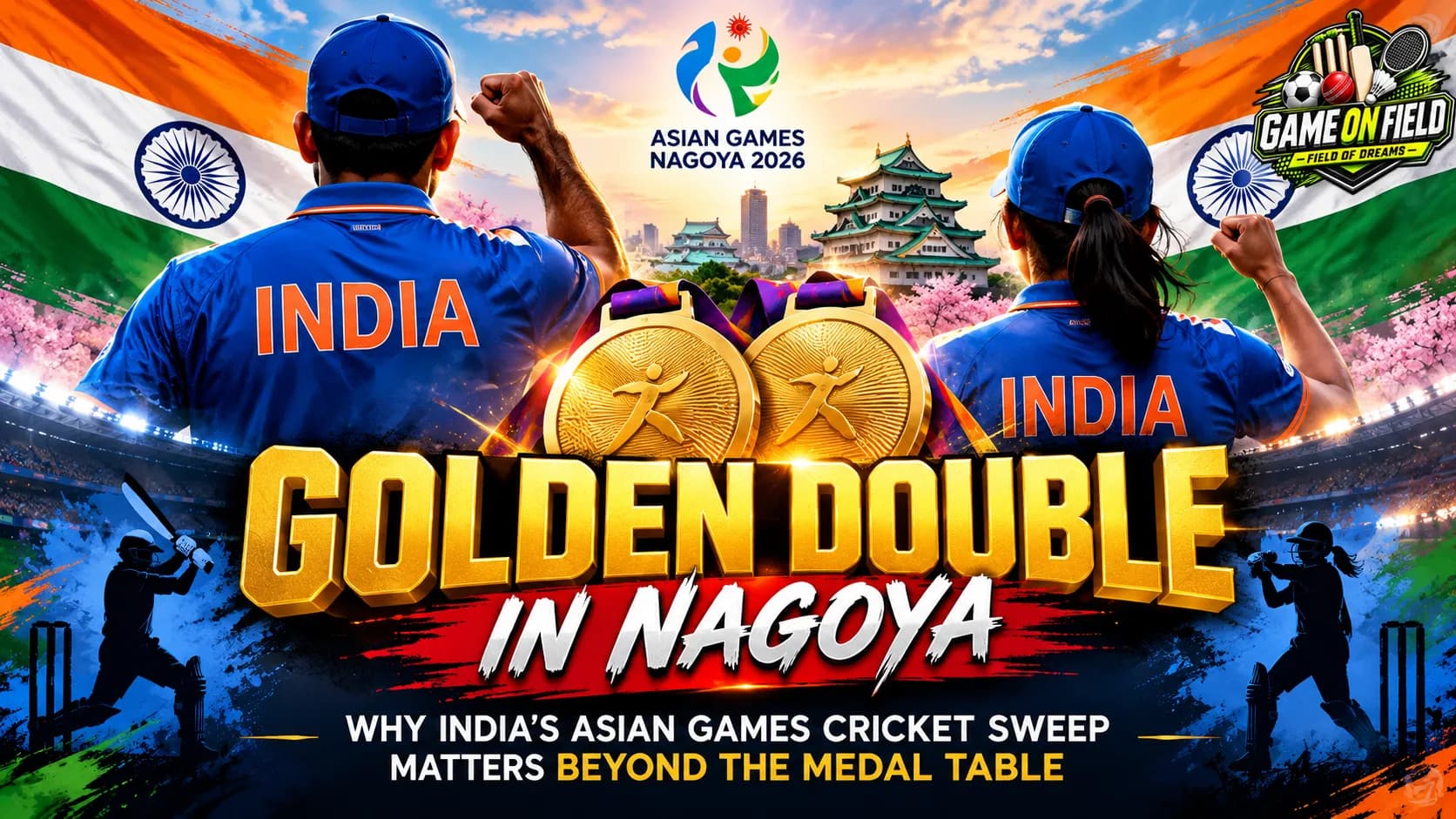
Two finals. Two gold medals. One powerful statement about the changing place of cricket in Asian sport.
India’s women and men have successfully defended their Asian Games T20 cricket titles, completing a golden double in Nagoya. The women began the job on September 22 with a commanding 147-run victory over Sri Lanka. The men completed it on October 3 by beating Pakistan by 19 runs in a final that carried all the weight of one of cricket’s biggest rivalries.
On the surface, these are simply two more gold medals for a cricketing nation that already has a crowded trophy cabinet.
But that would be missing the bigger picture.
These victories matter because cricket is entering a different sporting ecosystem. The Asian Games are not the Olympics, but they provide an important bridge towards cricket’s return to the Olympic stage in Los Angeles in 2028. They also offer something particularly valuable to Asian cricket: visibility, competitive exposure and the possibility of turning cricket into a genuine multi-sport national priority.
India’s double gold, therefore, deserves to be viewed as more than a line in the medal table.
India’s Women Set the Tone
India’s women were the first to deliver gold.
Against Sri Lanka in the final, India produced one of the most dominant batting performances in Asian Games cricket history, scoring 216/3.
Smriti Mandhana led the charge with a brilliant 79 off 45 balls, while Shafali Verma contributed 48. Richa Ghosh provided the finishing acceleration as India pushed beyond the 200-run mark. Sri Lanka never came close to matching that intensity.
India bowled them out for just 69, completing a massive 147-run victory. Deepti Sharma was particularly outstanding, finishing with 3/6.
The significance of the performance was not simply the margin of victory. India did not depend on one individual to win the final.
Mandhana gave them the platform. Shafali provided aggression. Richa accelerated. The spinners then dismantled Sri Lanka's chase.
That balance is what makes India's women's side so dangerous.
The Men Finish the Job Against Pakistan
The men's final brought a completely different atmosphere.
India faced Pakistan in a gold-medal match, immediately giving the contest an additional layer of attention. India batted first and posted 211/6, with Abhishek Sharma scoring 61 and Tilak Varma making 51.
Pakistan, however, refused to disappear quietly.
Hasan Nawaz produced a superb 96, keeping Pakistan's hopes alive deep into the chase. For stretches of the innings, India had to work hard to maintain control.
Eventually, the Indian bowling attack held its nerve.
Pakistan finished on 192/6, giving Shreyas Iyer's side a 19-run victory and another Asian Games gold medal.
The scorecard says India won comfortably enough.
The match itself was considerably more competitive.
And that is exactly what a final should be.
The Asian Games Are Not the Olympics — But They Matter
Cricket's relationship with multi-sport events is still developing.
The sport appeared at the Asian Games in 2010 and 2014 before disappearing from the 2018 edition. It returned in Hangzhou in 2023, when India won both men's and women's gold.
Now, with cricket heading towards the 2028 Los Angeles Olympics, the Asian Games have become more significant.
They offer cricket a chance to understand what it means to operate inside a multi-sport environment.
Cricketers are no longer simply representing a cricket board or competing in a standalone tournament. They become part of a much larger sporting movement.
That distinction matters.
For decades, the traditional markers of success for an Indian cricketer were Test caps, World Cups, bilateral trophies and franchise achievements.
The Asian Games introduce another form of sporting identity — representing India alongside athletes from every other discipline.
Smriti Mandhana's comments about watching Indian athletes win gold and wanting to experience that herself captured this change perfectly.
Cricketers increasingly want to be part of the larger Team India story.
Two Genders, One Standard
Perhaps the most encouraging aspect of India's Asian Games campaign was the consistency between the women's and men's teams.
The women's side won its final by 147 runs.
The men's side won by 19.
The margins were different, but the underlying message was similar: India had enough depth to win without requiring one superstar to rescue the team.
That is an important development.
For the women's side, Mandhana and Shafali provided the batting firepower, Richa Ghosh added late aggression, while Deepti Sharma, Shree Charani and Shreyanka Patil controlled the middle and lower phases with spin.
The men's team followed a similar pattern.
Abhishek Sharma provided the early momentum. Tilak Varma played the stabilising role. Shivam Dube helped maintain the scoring rate, while Axar Patel and Washington Sundar controlled the chase with disciplined bowling.
This is what a strong cricket system looks like.
Not dependence on two or three superstars.
Depth.
And perhaps the bigger achievement is that India's women's team is no longer being treated as an afterthought.
Indian cricket increasingly looks like one ecosystem producing successful men's and women's teams simultaneously.
That matters far beyond Nagoya.
The Pakistan Final: Rivalry Adds Weight, But Context Matters
India-Pakistan finals rarely require additional promotion.
The rivalry itself guarantees attention.
The Nagoya final was no different.
India eventually extended their winning run against Pakistan in T20 meetings, but the result should not completely erase the quality of Pakistan's challenge.
Hasan Nawaz's 96 was an outstanding innings. He kept Pakistan in contention and ensured India could not simply coast to victory.
There was also considerable discussion around Pakistan's squad strength, which is an important part of the context.
India deserved the victory, but analytical coverage should acknowledge the circumstances rather than treating every India-Pakistan result as an absolute measurement of the two cricket systems.
The rivalry may dominate the headlines.
The cricket deserves more nuanced analysis.
Why India’s Success Matters to Smaller Cricket Nations
This may be the most important part of the entire story.
India winning both gold medals can easily be viewed from an Indian perspective: two titles, two celebrations and another successful tournament.
But look beyond India.
Sri Lanka, Bangladesh, Afghanistan, Nepal, Malaysia, Oman, Hong Kong, Japan, China and Thailand are part of the wider Asian cricket landscape.
For several of these countries, cricket offers something that very few other sports can provide — a realistic route to international recognition.
The Asian Games can accelerate that process.
1. Medals Can Change National Priorities
Governments tend to invest in sports that produce visible results.
A cricket medal at a multi-sport event becomes part of a country's national medal count.
For emerging cricket nations, that visibility can help justify greater investment in grounds, academies, coaching and youth programmes.
2. Players Get Experience Against the Best
Associate nations rarely get regular opportunities to compete against cricket's strongest teams.
The Asian Games change that equation.
Japan, for example, showed that the gap is not necessarily impossible to bridge. Their narrow two-run defeat to India in a five-over warm-up match in Sano was a reminder that developing cricket nations can make progress when given opportunities.
Those experiences matter.
3. Young Players Get a Bigger Dream
A young player in Kathmandu, Kuala Lumpur or Muscat watching cricket at the Asian Games sees something different from a bilateral international series.
They see cricket as part of the national sporting identity.
They see athletes wearing national colours.
They see medals being won.
And they can imagine themselves doing the same.
That psychological shift can be more important than one match.
Does India’s Dominance Hurt Asian Cricket?
At first glance, India's dominance might appear discouraging for emerging teams.
But there is another way to look at it.
Strong teams raise the standard of the competition.
When India arrive with high-quality players and serious preparation, other teams get an opportunity to measure themselves against the benchmark.
That can expose weaknesses.
It can also reveal possibilities.
For developing cricket nations, the goal should not necessarily be to defeat India immediately.
The first goal is to reduce the gap.
Then reduce it again.
And eventually, create a generation capable of producing an upset.
That is how sporting ecosystems grow.
What Nagoya Tells Us About India
There are several lessons from India's double gold.
Depth Is Becoming India’s Biggest Advantage
India's greatest strength may no longer be simply the number of world-class players it possesses.
It is the number of players capable of stepping into a major tournament and performing under pressure.
Both teams received contributions from multiple players.
That is difficult for other nations to replicate quickly.
But it is something that can be built through domestic structures.
Women’s Cricket Is Driving the Growth
The women's victory deserves particular attention.
Indian women's cricket has undergone a major transformation in recent years, and the confidence within the team is increasingly visible.
Winning another Asian Games gold reinforces that momentum.
More importantly, it normalises the idea of cricket as a serious professional pathway for young girls.
That impact will not appear on a scorecard.
It may take a decade to fully measure.
The Asian Games Give Cricketers a Different Perspective
There is also a cultural benefit that is easy to overlook.
When cricketers spend time alongside athletes from athletics, shooting, wrestling, badminton, hockey and other disciplines, they become part of a much broader sporting community.
They see how other athletes train.
They understand different pressures.
They experience the meaning of representing India outside the traditional cricket bubble.
That exchange may ultimately be one of the most valuable outcomes of cricket's presence at the Asian Games.
The Road to Los Angeles 2028
Nagoya should not be the destination.
It should be a stepping stone.
The next obvious landmark is the 2028 Los Angeles Olympics.
For India, the challenge will be to maintain the depth that produced these two gold medals while ensuring the women's and men's pathways continue developing together.
For Asian cricket's smaller nations, the challenge is different.
They need more matches.
More coaching.
Better facilities.
Stronger domestic competitions.
And, most importantly, consistent exposure against higher-ranked opponents.
If the Asian Games can become part of that development cycle, their value will extend far beyond four-year medal counts.
Gameonfield’s Stump Mic
The easiest way to describe India's Nagoya campaign is simple: two teams, two finals, two gold medals.
But the real story is much bigger than the medal table.
India's women showed that their dominance is built on depth, confidence and a system that can produce match-winners across departments. India's men faced Pakistan in a high-pressure final, absorbed the challenge and delivered when it mattered most. Different matches, different circumstances, but the same underlying message: Indian cricket has built a level of depth that is increasingly difficult for the rest of Asia to match.
Yet, for us at Gameonfield, the most important part of this story begins outside India's dressing room.
The Asian Games give countries such as Sri Lanka, Nepal, Japan, Malaysia, Hong Kong, Oman and others something extremely valuable — a bigger platform for cricket. A medal can influence government funding. A competitive performance can attract young players. A match against India can provide lessons that no domestic fixture can replicate.
That is why India's dominance should not automatically be viewed as bad news for Asian cricket.
A strong India creates a benchmark. A bigger Asian Games creates opportunities. And greater exposure can help emerging nations gradually close the gap.
The next challenge is to make sure this momentum does not disappear after Nagoya. For India, the road now leads towards the Los Angeles 2028 Olympics, where cricket will enter an even bigger sporting environment. For the rest of Asia, the priority should be development — more international fixtures, better coaching, stronger domestic structures and greater investment in women's cricket.
If that happens, India's double gold in Nagoya will eventually be remembered as more than two victories.
It will be remembered as a moment when Asian cricket showed that it belongs on the multi-sport stage.
Two teams. Two golds. One bigger message: Asian cricket is ready for a larger stage.
And perhaps the most exciting part is this:
The next chapter does not necessarily have to belong to India.
It could belong to the team that watched India lift the gold in Nagoya and decided that, one day, their turn would come.
Key Takeaways
- Two teams. Two golds. One bigger message: Asian cricket is ready for a larger stage.
- Indian cricket has built a level of depth that is increasingly difficult for the rest of Asia to match.
- A medal can influence government funding.
- That is why India's dominance should not automatically be viewed as bad news for Asian cricket.
- Nagoya should not be the destination. It should be a stepping stone.