

The 2026 Commonwealth Games in Glasgow were unlike any edition before them.
Held from July 23 to August 2, the Games featured a significantly reduced program with only 11 sports, making it the smallest Commonwealth Games in decades. For many nations, the streamlined format meant fewer opportunities to compete. For India, it meant something even more challenging—the absence of five disciplines that have historically been among the country's biggest medal contributors: wrestling, shooting, badminton, table tennis, and hockey.
On paper, this should have severely weakened India's campaign.
Instead, Team India delivered one of its most efficient and strategically impressive performances in Commonwealth Games history.
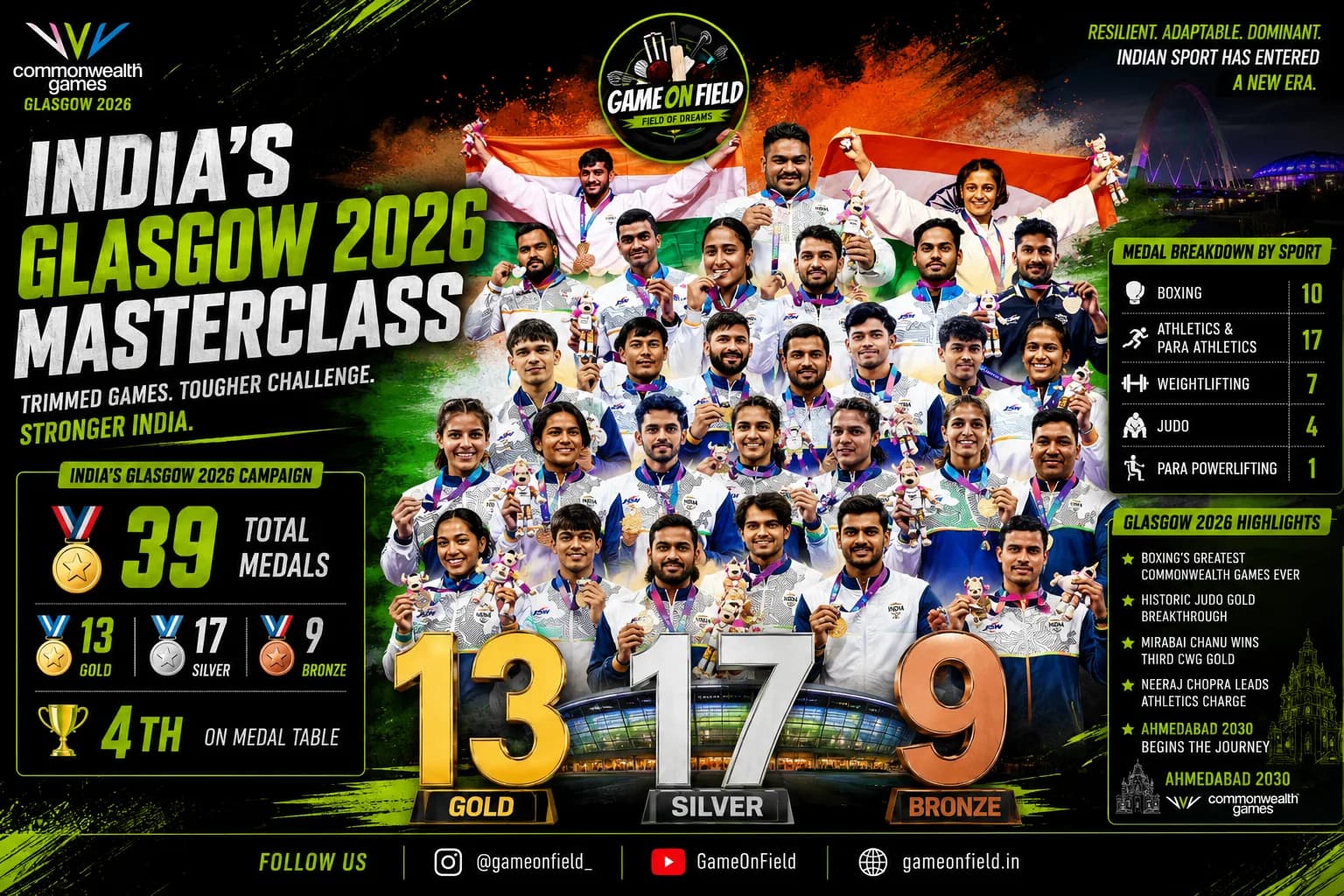
The Indian contingent finished 4th on the medal table, winning 39 medals (13 Gold, 17 Silver, and 9 Bronze). More importantly, these medals came from a remarkably diverse group of athletes, proving that Indian sport is steadily moving beyond dependence on a handful of traditional disciplines.
Every one of the 124 Indian athletes and para-athletes who represented the tricolour in Glasgow contributed to a campaign built on resilience, preparation, and competitive excellence. Their performance deserves recognition not merely for the medals won, but for the statement it sends about the future of Indian sport.
Glasgow 2026: A Different Kind of Commonwealth Games
Unlike previous editions, Glasgow adopted a compact model designed to reduce hosting costs. The Games were trimmed to just 11 core sports, eliminating several disciplines that have traditionally shaped India's medal tally.
The impact was substantial.
Historically, the excluded sports have contributed a major share of India's success:
- Wrestling and shooting have produced more than 30% of India's Commonwealth Games gold medals.
- Badminton and table tennis combined won 13 medals at Birmingham 2022.
- Hockey has consistently been among India's strongest medal prospects.
Even before competition began, analysts estimated that India had effectively lost access to nearly 35–40 potential medal opportunities simply because of the reduced sports programme.
Yet instead of viewing this as a disadvantage, India adapted.
Rather than relying on traditional strengths, the contingent found new avenues for success through boxing, judo, athletics, para-athletics, and weightlifting.
That adaptability became the defining story of Glasgow 2026.
India's Medal Breakdown
| Sport | Gold | Silver | Bronze | Total |
|---|---|---|---|---|
| Boxing | 7 | 3 | 0 | 10 |
| Weightlifting | 1 | 5 | 1 | 7 |
| Athletics & Para Athletics | 3 | 8 | 6 | 17 |
| Judo | 2 | 1 | 1 | 4 |
| Para Powerlifting | 0 | 0 | 1 | 1 |
| Total | 13 | 17 | 9 | 39 |
Athletics and para-athletics contributed the largest number of overall medals, while boxing emerged as India's biggest source of gold.
Boxing: India's Golden Revolution
If one sport defined India's campaign, it was boxing.
The Indian boxing squad produced an extraordinary return, winning 10 medals from just 14 boxers, including an incredible 7 gold medals and 3 silver medals.
The women's team led the charge.
Gold medals came through:
- Preeti Panwar (54kg)
- Sakshi Chaudhary (51kg)
- Jaismine Lamboria (57kg)
- Priya Ghanghas (60kg)
- Arundhati Choudhary (70kg)
The men's team matched that dominance with brilliant performances from:
- Sachin Siwach (60kg)
- Ankush Panghal (80kg)
India's seven boxing gold medals represent the highest boxing gold tally achieved by any nation at a single Commonwealth Games.
It was not merely success—it was complete dominance.
Judo Finally Breaks New Ground
Perhaps the biggest surprise of Glasgow came on the judo mat.
For decades, India had struggled to convert promise into Commonwealth Games titles.
That changed dramatically in 2026.
Asmita Dey created history by winning India's first-ever Commonwealth Games judo gold in the women's 48kg category.
Soon after, Harsh Singh added another gold in the men's 60kg event.
Supporting performances from Yamini Mourya (Silver) and Unnati Sharma (Bronze) completed India's best-ever judo campaign.
More importantly, these results suggest India's investment in judo is beginning to produce world-class athletes.
Weightlifting Continues to Deliver
Weightlifting once again proved why it remains one of India's most dependable sports.
Olympic medallist and Commonwealth champion Mirabai Chanu delivered another gold medal with a composed performance in the women's 48kg category.
India's depth was equally impressive.
Silver medals came through:
- Rishikanta Singh
- Muthupandi Raja
- Gyaneshwari Yadav
- Ajaya Babu Valluri
- Lovepreet Singh
Along with one bronze medal, weightlifting contributed seven medals overall, reaffirming its status as one of India's strongest disciplines.
Athletics and Para-Athletics Reach New Heights
Athletics produced India's largest overall medal haul.
The integrated para-sports programme showcased remarkable depth across both track and field events.
Gold medals were won by:
- Sharmila Dhankar (Shot Put F57)
- Dilip Gavit (100m T47)
- Soman Rana (Shot Put F57)
India also collected several notable silver medals through elite athletes including:
- Neeraj Chopra (Javelin Throw)
- Murali Sreeshankar (Long Jump)
- Sarvesh Kushare (High Jump)
Distance runner Gulveer Singh added further distinction by winning silver in the 10,000m and bronze in the 5,000m.
These performances underline India's growing competitiveness in athletics, an area that historically lagged behind traditional medal sports.
Looking Beyond the Medal Count
At first glance, India's total of 39 medals appears lower than the 61 medals won at Birmingham 2022.
However, raw numbers tell only part of the story.
The context is far more important.
| Edition | Overall Rank | Gold | Total Medals | Sports Contested |
|---|---|---|---|---|
| Delhi 2010 | 2nd | 38 | 101 | 17 |
| Gold Coast 2018 | 3rd | 26 | 66 | 15 |
| Birmingham 2022 | 4th | 22 | 61 | 16 |
| Glasgow 2026 | 4th | 13 | 39 | 10 |
When adjusted for the reduced programme, India's performance becomes significantly more impressive.
The country's medal-per-sport efficiency remained almost identical to Birmingham despite nearly 40% fewer medal opportunities.
That consistency highlights a stronger and broader sporting ecosystem rather than dependence on a few elite disciplines.
The Rise of India's New Sporting Identity
One of the most encouraging aspects of Glasgow was the emergence of new medal-winning sports.
In previous editions, wrestling and shooting were responsible for a substantial portion of India's gold medals.
In Glasgow, boxing and judo stepped into that role.
Meanwhile, para-athletes continued to raise India's international reputation with outstanding performances under equal competition conditions.
The message is clear.
India's sporting future is becoming more diversified.
That diversity is essential for sustained success at global multi-sport events.
Ahmedabad 2030: The Next Big Opportunity
The closing ceremony carried added significance for Indian sport.
As the Commonwealth flag was officially handed over to Ahmedabad, attention immediately shifted towards the 2030 Commonwealth Games.
Hosting the Games presents India with an extraordinary opportunity.
As host nation, India is expected to push for the inclusion of sports such as:
- Wrestling
- Shooting
- Badminton
- Archery
- Kabaddi
These are disciplines in which India has consistently excelled.
Combined with the emergence of stronger boxing, athletics, judo, and para-sports programmes, India could realistically target one of its greatest-ever Commonwealth Games medal hauls on home soil.
However, Glasgow also offered valuable lessons.
Investment in grassroots development, sports science, coaching infrastructure, and athlete exposure must continue if India wishes to compete consistently among the world's leading sporting nations.
Gameonfield's Smash
Judging Glasgow 2026 solely by the number 39 would miss the bigger picture.
This was not a reduced performance.
It was a smarter one.
India entered the Commonwealth Games missing five of its traditional medal-producing sports and still finished fourth in the standings through adaptability, depth, and exceptional performances across emerging disciplines.
That is the hallmark of a mature sporting nation.
To every athlete who represented India in Glasgow, your achievements have inspired millions and laid a stronger foundation for the future.
As the Commonwealth Games journey now moves towards Ahmedabad 2030, Indian sport has every reason to believe that its best chapter is still waiting to be written.
Jai Hind 🇮🇳
Key Takeaways
- India finished 4th with 39 medals (13 Gold, 17 Silver, 9 Bronze) despite the absence of wrestling, shooting, badminton, table tennis and hockey.
- Boxing delivered a record 7 golds — the most by any nation at a single Commonwealth Games.
- Judo produced India's first-ever Commonwealth Games gold medals, through Asmita Dey and Harsh Singh.
- Athletics and para-athletics contributed the largest overall medal haul with 17 medals.
- India now looks ahead to hosting Ahmedabad 2030, with an opportunity to reinstate traditional strongholds.