

By Gameonfield
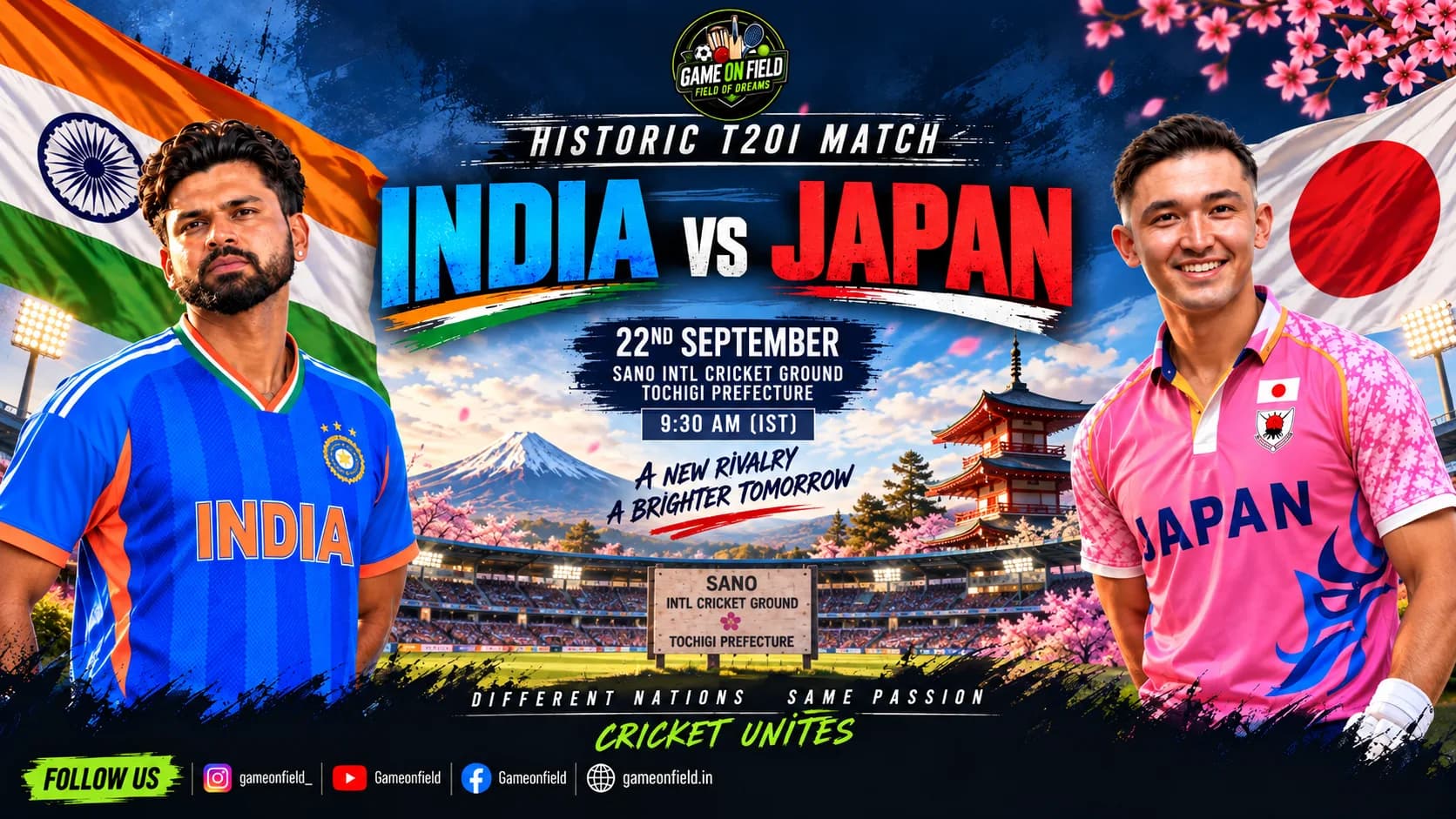
On September 22, 2026, something will happen that nobody watching cricket a decade ago would have predicted: the Indian men's cricket team will step onto a ground in Sano, Japan, to play a T20 International against the Japanese national side. It will be the two nations' first-ever men's T20I meeting, marking the launch of celebrations for the 75th anniversary of India-Japan diplomatic relations. On paper, it looks like a mismatch. In substance, it might be one of the more significant fixtures on this year's cricket calendar — not for the scoreline, but for what it represents.
The Match: What, Where, and Why Now
India and Japan will meet for the first time in international cricket on September 22, with the match set for the Sano International Cricket Ground in Tochigi Prefecture. The contest has been branded the Suzuki Cup and doubles as the opening event of an initiative called "Sport 75." The game gets underway at 1:00 PM local time — 9:30 AM back home in India.
The timing is no accident. The fixture is designed to give the Indian team valuable game time to fine-tune combinations and build momentum ahead of the Asian Games in Aichi-Nagoya, running from September 19 to October 4. India, the reigning ICC Men's T20 World Cup champions, will use the game as an important warm-up before defending the cricket gold they won at the previous Asian Games, while Japan get the far rarer opportunity to test themselves against one of the sport's leading teams. Because of their seeding, India go straight into the Asian Games quarter-finals, while Japan will have to work through the group stage.
There's a diplomatic layer here too. The fixture follows an agreement reached during a summit involving Japanese Prime Minister Sanae Takaichi and Indian Prime Minister Narendra Modi, and forms part of a broader push to promote sporting and cultural exchange between the two countries — one that also nods to India's ambition of hosting the Olympic and Paralympic Games in 2036.
For Japan's cricket administrators, the occasion carries obvious weight. JCA CEO Naoki Miyaji called it a landmark moment for Japanese cricket, thanking the BCCI and inviting local fans — cricket followers and newcomers alike — to come out and support the home side. BCCI secretary Devajit Saikia echoed the sentiment, framing the game as a chance to take Indian cricket into new territory and introduce the sport to a wider audience across Japan and East Asia.
India-Japan Relations: Cricket as the Newest Thread
India and Japan have spent 75 years building a relationship that has moved well beyond formal diplomacy — spanning infrastructure investment, technology partnerships, defense cooperation, and a shared strategic outlook in the Indo-Pacific. Bullet trains, manufacturing tie-ups, and steadily deepening trade ties have long been the visible face of this friendship. Cricket, until now, was nowhere in that picture.
That's exactly what makes the Suzuki Cup interesting. Using a single T20I to open a year of 75th-anniversary celebrations signals that sport — and specifically a game India is fanatical about and Japan barely plays — has been chosen as a soft-power tool. It's a low-cost, high-visibility way to put a human, emotional face on a relationship that usually gets discussed in terms of GDP figures and summit communiqués. When two prime ministers sign off on a cricket match as part of a diplomatic anniversary, it tells you the game has become genuinely useful currency in international relationship-building — not just entertainment.
Why This Matters for Cricket's Smaller Nations
This is the part that should interest fans well beyond India and Japan. Japan is an ICC Associate member, ranked 41st in T20Is as of May 2026, with their first-ever T20I only coming in October 2022. That's a cricketing infant compared to India. And yet, in a matter of weeks, Japan's players will share a field with a team that just won a world title.
For associate and affiliate nations trying to grow the game, opportunities like this are rare and precious. Cricket's global structure has always struggled with a core problem: the gap between the "Big Three or Four" full members and the rest of the cricketing world is enormous, and it rarely narrows because top teams have little financial incentive to schedule matches against weaker sides. Bilateral calendars are dominated by high-revenue clashes between established rivals. A match like India vs Japan barely makes commercial sense in isolation — which is precisely why it needed a diplomatic push to happen at all.
But the value of these fixtures for smaller cricketing nations goes well beyond the 40 overs played on the day:
- Visibility and legitimacy: A game against the world champions puts a country's cricket program on the global map in a way years of Associate-tier fixtures cannot. Media coverage, sponsor interest, and federation funding all tend to follow star power.
- Player development: Facing genuinely elite bowling and batting, even briefly, gives emerging players a benchmark they can't get from domestic cricket or matches against similarly ranked sides.
- Grassroots growth: Miyaji's appeal to "local Japanese people curious about cricket" to attend reflects the real goal — using a marquee match to introduce a largely unfamiliar sport to a new audience. A packed ground and a competitive telecast do more for grassroots interest than any development program alone.
- Federation confidence: Hosting a team like India, even for one match, gives Associate boards leverage to negotiate future fixtures, attract broadcasters, and justify continued investment from the ICC and government bodies.
There's a template worth noting here too. Bigger teams occasionally playing smaller ones for reasons beyond pure competition — Olympic qualification pathways, diplomatic anniversaries, ICC expansion mandates — has historically been how the game's footprint grows. Nepal, USA, and other emerging nations have all benefited at various points from marquee opposition showing up, even briefly. Japan's turn now fits that same pattern, just with an unusually explicit diplomatic wrapper.
The Cricketing Reality
None of this is to pretend the September 22 match will be competitive in a cricketing sense. India's depth, experience, and firepower make them overwhelming favorites, and a lopsided scoreline is the likely outcome. But judging this fixture purely on the final score misses the point entirely. The real success metrics are different: Did Japanese crowds show up? Did local media cover it seriously? Did young players in Japan get to stand at the non-striker's end against a bowler who's dismissed the best batters in the world? Did the match generate enough goodwill and interest to justify a follow-up fixture, or a development partnership between the BCCI and JCA?
If those boxes get ticked, the Suzuki Cup will have done its job — regardless of what the scoreboard says.
Gameonfield's Stump Mic
Cricket has spent the last decade trying to expand beyond its traditional strongholds, with mixed success. The Olympic return of the sport at LA 2028, the growth of T20 leagues worldwide, and the ICC's push into new markets have all been part of that effort. A one-off T20I between India and Japan, wrapped in a 75th-anniversary diplomatic celebration, is a small but telling data point in that larger story: when politics, sport, and genuine grassroots ambition align, even an "impossible" fixture between a world champion and a 41st-ranked Associate side can happen — and can matter.
For Japan, September 22 is a chance to be seen. For India, it's a low-stakes warm-up before a bigger prize at the Asian Games. For cricket as a whole, it's a reminder that the sport's future growth may depend less on giant broadcast deals and more on moments exactly like this one.
Key Takeaways
- India play Japan in men's cricket for the first time ever on September 22, 2026, at Sano International Cricket Ground, Tochigi Prefecture — a T20I branded the Suzuki Cup.
- The match opens "Sport 75," part of the 75th anniversary of India-Japan diplomatic relations, following an agreement between PMs Narendra Modi and Sanae Takaichi.
- It also serves as a warm-up for India ahead of defending their cricket gold at the Asian Games in Aichi-Nagoya (Sept 19 - Oct 4), where India go straight to the quarter-finals.
- Japan, ranked 41st in T20Is and playing their first-ever T20I only in October 2022, get a rare chance to face the reigning T20 World Champions — a template that has historically helped grow the game in emerging cricket nations.