

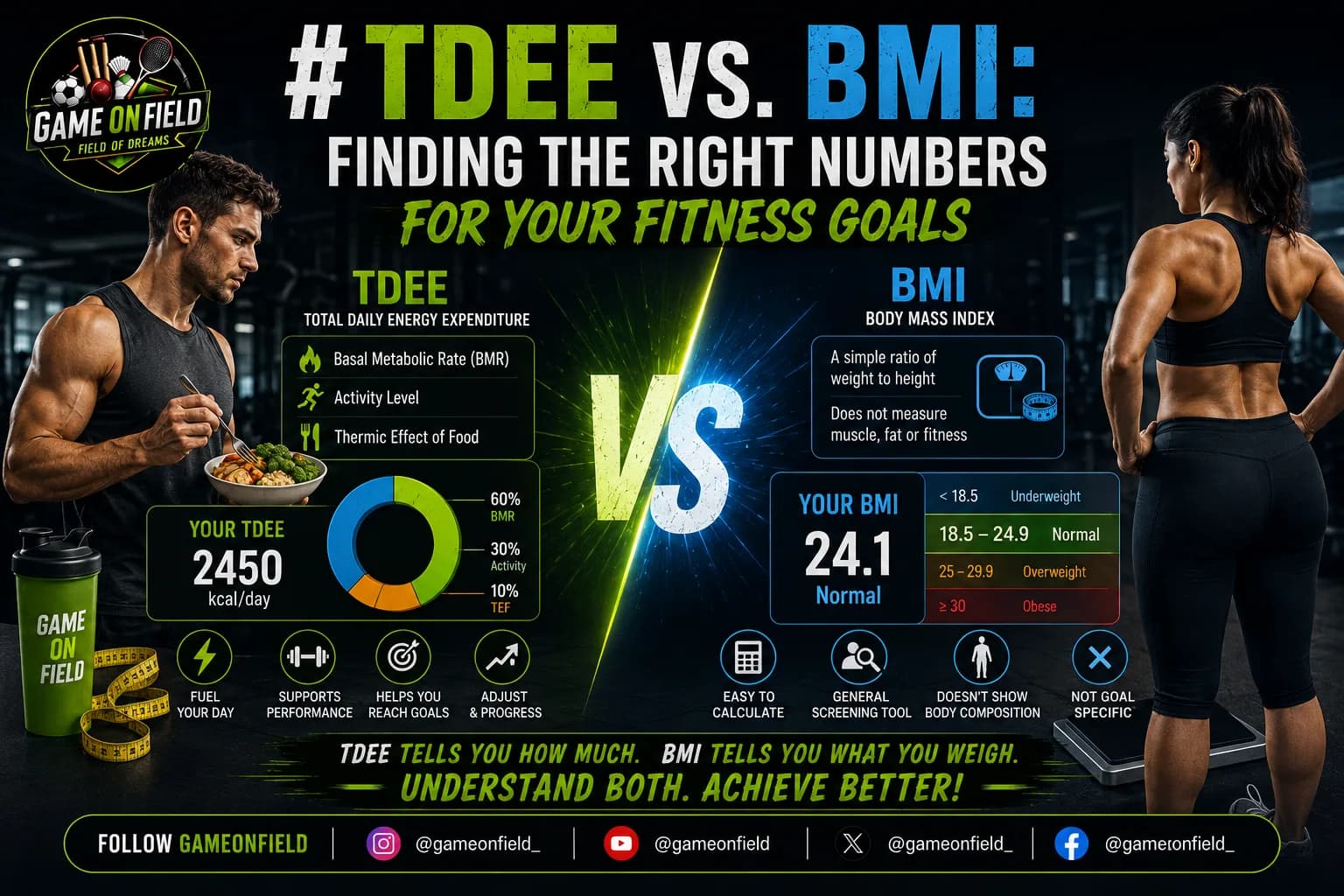
Many people judge fitness using only Body Mass Index (BMI). While BMI is useful for general health screening, it doesn't tell the full story—especially for athletes and active people.
For better nutrition and performance planning, Total Daily Energy Expenditure (TDEE) is a much more useful metric.
This guide explains what BMI and TDEE are, why they matter, and how to use the Gameonfield Fitness Calculators to reach your goals.
What is BMI?
BMI (Body Mass Index) compares your weight with your height.
Formula
BMI = Weight (kg) ÷ Height² (m²)
It classifies people as:
- Underweight
- Normal
- Overweight
- Obese
BMI is simple, but it cannot tell the difference between fat and muscle.
Why BMI Has Limits
Two people can have the same BMI but very different bodies.
For example:
- A bodybuilder may have a high BMI because of muscle.
- Another person may have the same BMI because of excess body fat.
BMI does not measure:
- Body fat percentage
- Muscle mass
- Fitness level
- Daily activity
That's why athletes should not rely on BMI alone.
What is TDEE?
TDEE stands for Total Daily Energy Expenditure.
It is the total number of calories your body burns in one day.
It includes:
- Basic body functions
- Exercise
- Daily activities
- Digestion
Knowing your TDEE helps you plan your nutrition more accurately.
Why TDEE Matters
Every fitness goal depends on calories.
Fat Loss
Eat slightly fewer calories than your TDEE.
Muscle Gain
Eat slightly more calories than your TDEE while following strength training.
Weight Maintenance
Consume calories close to your TDEE.
Without knowing TDEE, it is difficult to create an effective nutrition plan.
BMI vs. TDEE
| BMI | TDEE |
|---|---|
| Measures body size | Measures calorie needs |
| Based on height and weight | Based on body and activity |
| Doesn't consider exercise | Includes activity level |
| Good for general health | Better for athletes |
How to Use Gameonfield Fitness Calculators
Step 1 – Check BMI
Use BMI to understand your general weight category.
Do not treat it as the final measure of fitness.
Step 2 – Calculate TDEE
Enter:
- Age
- Height
- Weight
- Activity level
The calculator estimates your daily calorie requirement.
Step 3 – Plan Your Goal
Use your TDEE to:
- Lose fat
- Build muscle
- Maintain weight
- Fuel endurance training
Update your TDEE regularly as your body weight and activity level change.
Common Mistakes
Judging fitness only by BMI.
Following random calorie plans.
Eating too little during heavy training.
Ignoring changing calorie needs.
Gameonfield Verdict
BMI gives a general idea of body size, but it doesn't measure fitness or performance.
TDEE tells you how much energy your body actually needs, making it far more useful for athletes and active individuals.
For the best results, use BMI as a reference and TDEE as your nutrition guide.
The Gameonfield Fitness Calculators make it easy to calculate both, helping you make smarter decisions for fat loss, muscle gain, and better athletic performance.
Key Takeaways
- BMI measures body size using height and weight; it can't distinguish fat from muscle.
- TDEE measures total daily calorie needs, including activity level.
- Fat loss, muscle gain, and maintenance all depend on eating relative to your TDEE.
- Use BMI as a general reference and TDEE as your actual nutrition guide.