

A hamstring injury can change an athlete's season in a matter of seconds.
A hamstring injury can change an athlete's season in a matter of seconds.
One sprint, one sudden acceleration or one attempt to stop quickly—and the athlete can be forced off the field with a muscle strain. Hamstring injuries are particularly common in sports that involve repeated sprinting, high-speed running and sudden changes of direction.
But preventing these injuries is not simply about stretching more.
Modern sports science has shown that how strong the hamstrings are when they are being lengthened under load is extremely important. This is where eccentric training, fascicle length and exercises such as the Nordic Hamstring Exercise come into the picture.
Let's break down the science in simple terms.
Why Do Hamstrings Get Injured During Sprinting?
To understand hamstring injuries, we first need to understand what happens during a sprint.
The hamstrings work across both the hip and knee joints. During the final part of the leg's forward movement, just before the foot hits the ground, they have to work extremely hard.
Think about what is happening:
The hip is moving forward → the knee is rapidly extending → the hamstrings are trying to control both movements.
This means the hamstrings are being stretched while simultaneously producing force.
The critical moment: terminal swing
The late or terminal swing phase of sprinting is considered a major period of risk for hamstring strain.
Mid-Swing → Leg moves rapidly forward → TERMINAL SWING → Hamstrings lengthen while producing high force → Foot Strike → High force continues
At this point, muscles such as the biceps femoris long head are working eccentrically.
In simple terms, eccentric contraction means the muscle is producing force while it is getting longer.
It is similar to lowering a heavy weight under control. The muscle is not relaxing—it is actively trying to control the movement.
If the force and stretch become greater than the muscle-tendon unit can tolerate, injury can occur.
What Makes the Biceps Femoris So Important?
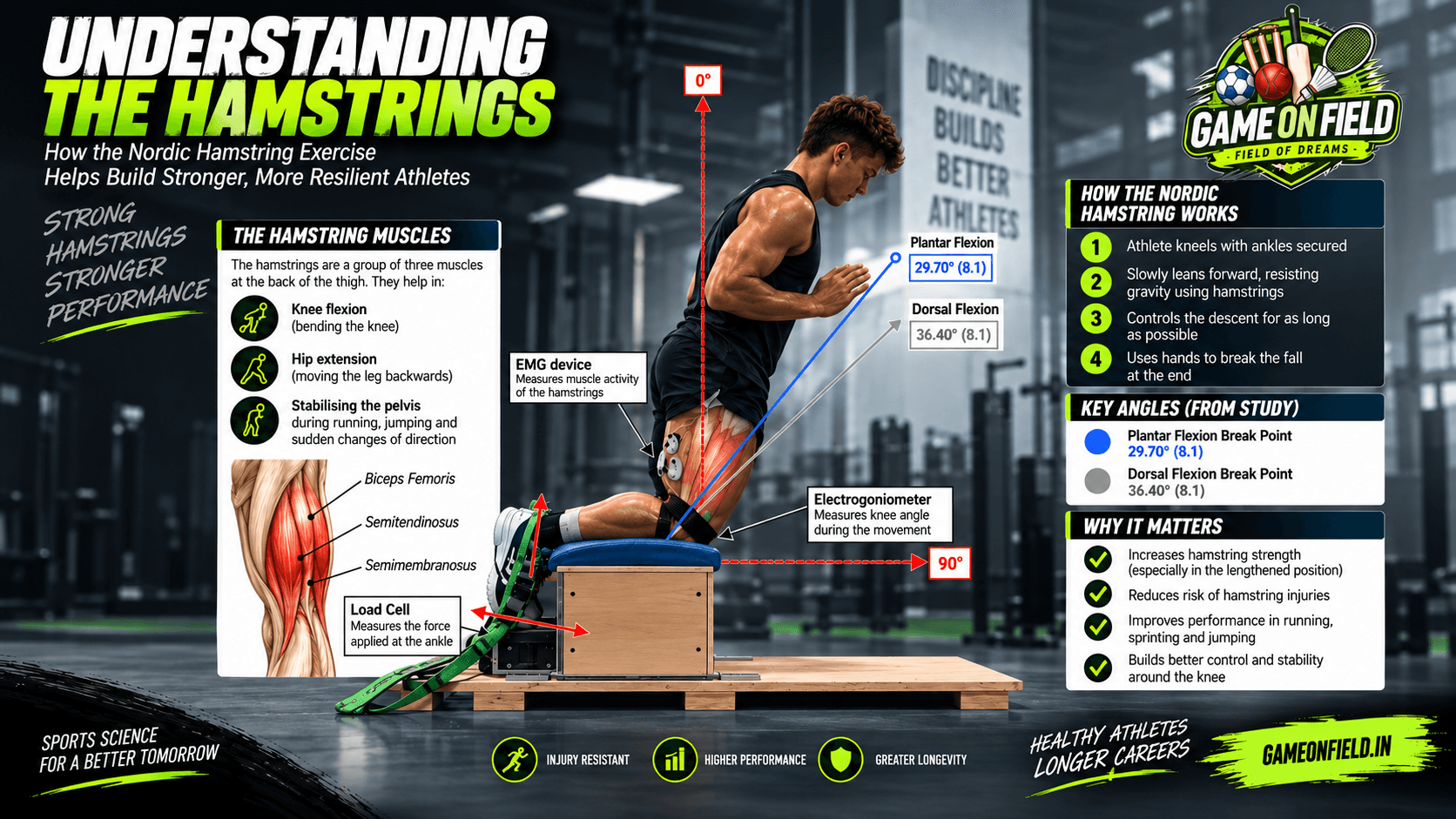
The hamstrings are actually a group of muscles rather than one single muscle. They include:
- Biceps femoris
- Semitendinosus
- Semimembranosus
Among these, the biceps femoris long head (BFlh) is frequently involved in sprint-related hamstring injuries.
One reason is its role during high-speed running. It has to produce and absorb large forces while the leg is moving rapidly.
This is why simply having "strong legs" does not necessarily mean an athlete has adequate protection against hamstring injuries.
The muscles need to be able to handle high force at longer muscle lengths.
Fascicle Length: The Hidden Part of Hamstring Strength
This is where the science becomes particularly interesting.
A muscle is made up of bundles of muscle fibres called fascicles.
You can think of fascicles as the working strands inside the muscle.
Their length matters because it influences how the muscle produces force and handles being stretched.
Shorter vs longer fascicles
SHORTER FASCICLES → Less room for the muscle fibres to operate at longer lengths → Greater strain during high-speed movements
LONGER FASCICLES → Better ability to produce force at longer muscle lengths → Potentially greater resilience during sprinting
Research has associated shorter hamstring fascicles—particularly in the biceps femoris long head—with greater hamstring-injury risk, while eccentric training can increase fascicle length.
However, fascicle length is not a simple injury-risk switch. An athlete's previous injury history, sprint exposure, strength, workload, technique and many other factors also matter.
How Does Eccentric Training Change the Muscle?
This is one of the most important concepts in hamstring injury prevention.
Eccentric training exposes the muscle to high forces while it is lengthening.
Over time, this can stimulate structural adaptations within the muscle, including changes in fascicle architecture.
A simplified way of looking at it is:
ECCENTRIC TRAINING → High force while muscle lengthens → Muscle adapts to the repeated load → Potential increase in fascicle length → Better ability to produce force at longer lengths
One proposed mechanism is the addition of sarcomeres in series.
Sarcomeres are the basic contractile units of muscle. Adding more of them in series can contribute to a longer fascicle and alter how the muscle behaves when it is stretched.
The important point for athletes is straightforward:
The goal is to teach the hamstrings to tolerate and produce force when they are long.
That is exactly the situation they face during high-speed sprinting.
Enter the Nordic Hamstring Exercise
The Nordic Hamstring Exercise, commonly called the Nordic curl, has become one of the most widely discussed exercises in hamstring injury prevention.
In a Nordic curl, the athlete kneels with the ankles secured and slowly lowers the upper body forward.
The hamstrings have to resist the movement.
START → Kneeling + ankles secured → Lean forward slowly → Hamstrings produce high eccentric force → Control the descent → Use hands to catch yourself
The athlete is essentially asking the hamstrings: "Can you keep producing force while I am trying to fall forward?"
That makes the exercise particularly useful for developing eccentric knee-flexor strength.
Why Is the Nordic Curl So Effective?
1. High eccentric demand
The athlete's body weight creates a significant external load. As the athlete leans forward, the hamstrings must generate force to slow the movement. This creates a strong eccentric stimulus.
2. It targets the hamstrings directly
The exercise places considerable demand on the knee flexors, including the biceps femoris and semitendinosus. This makes it a practical way to develop the strength qualities required during high-speed running.
3. It trains the muscle at longer lengths
This is particularly important for hamstring injury prevention. The athlete is not simply trying to make the muscle stronger in a comfortable position. The exercise challenges the hamstrings as the knee moves toward extension and the muscle is placed under greater length-related demand.
But More Is Not Always Better
This is an important point that is sometimes lost when the Nordic curl is discussed.
The goal isn't to perform hundreds of repetitions.
Nordic curls create a substantial eccentric stimulus and can cause significant muscle soreness, particularly when an athlete is new to the exercise.
For athletes competing regularly, training volume needs to be managed alongside:
- Matches
- Sprint training
- Strength sessions
- Travel
- Recovery
- Existing injury status
During the competitive season, coaches may use relatively small doses to maintain adaptations while avoiding unnecessary fatigue.
The exact number of sets and repetitions should depend on the athlete, training phase and overall workload rather than following one universal prescription.
Does a Nordic Curl Guarantee Injury Prevention?
No.
This distinction is important.
The Nordic Hamstring Exercise has strong evidence supporting its role in hamstring injury-prevention programmes, but no single exercise can eliminate injury risk.
Hamstring injuries are influenced by several factors, including:
- Previous hamstring injury
- High-speed running exposure
- Sudden increases in workload
- Muscle strength
- Fatigue
- Sprint mechanics
- Training history
- Recovery
- Age and individual characteristics
So the Nordic curl should be viewed as one part of a broader injury-prevention programme, not a magic solution.
Strength + Sprinting + Load Management
There is another important lesson here.
An athlete cannot prepare for sprinting only by doing strength exercises.
The hamstrings ultimately need to tolerate the forces created by high-speed running.
That means a good programme generally combines appropriate:
Eccentric strength → Sprint exposure → Running mechanics → Load management → Recovery
Strength training builds capacity.
Sprint training teaches the athlete to use that capacity at high speed.
Load management helps ensure that the increase in demand is progressive rather than sudden.
Want to track your own strength and conditioning numbers? Try GameOnField's Fitness Calculators.
The Gameonfield's Stump Mic
Hamstring injury prevention is often presented as a battle against stretching, soreness or weak muscles.
The real story is more complicated.
The hamstrings are remarkably strong muscles, but sprinting places them under extreme demands—especially when they are long and producing high force at the same time.
That's why eccentric training matters.
And that's why the Nordic curl has become such an important tool in modern sports performance.
The bigger lesson is this:
Don't just train the hamstrings to be strong. Train them to be strong where the sport demands it most.
For a sprinter, footballer, cricketer or any athlete regularly exposed to high-speed running, that ability can be crucial.
What Do You Think?
Should Nordic hamstring exercises be a regular part of every sprint-based athlete's training programme, or should their use depend more heavily on the individual athlete and workload?
Share your views in the comments. We'd love to hear what coaches, athletes and sports fans think.
Key Takeaways
- Hamstring injuries most often occur during the terminal swing phase of sprinting, when the muscle is lengthening while producing high force (eccentric contraction)
- Shorter fascicles in the biceps femoris long head are linked to greater injury risk; eccentric training can increase fascicle length over time
- The Nordic Hamstring Exercise builds eccentric strength at longer muscle lengths — exactly the demand sprinting places on the hamstrings
- More reps isn't better — Nordic curl volume should be managed alongside matches, sprint training and overall workload
- No single exercise guarantees injury prevention; the Nordic curl works best as part of a broader programme combining eccentric strength, sprint exposure and load management